Episode 21 · Article on the episode
Agentic Experience: when the most demanding customer is no longer human
60 per cent of consumers use AI for purchasing advice, a third would leave autonomous purchases to it. Companies whose interfaces are built for humans only are losing a growing part of their market.
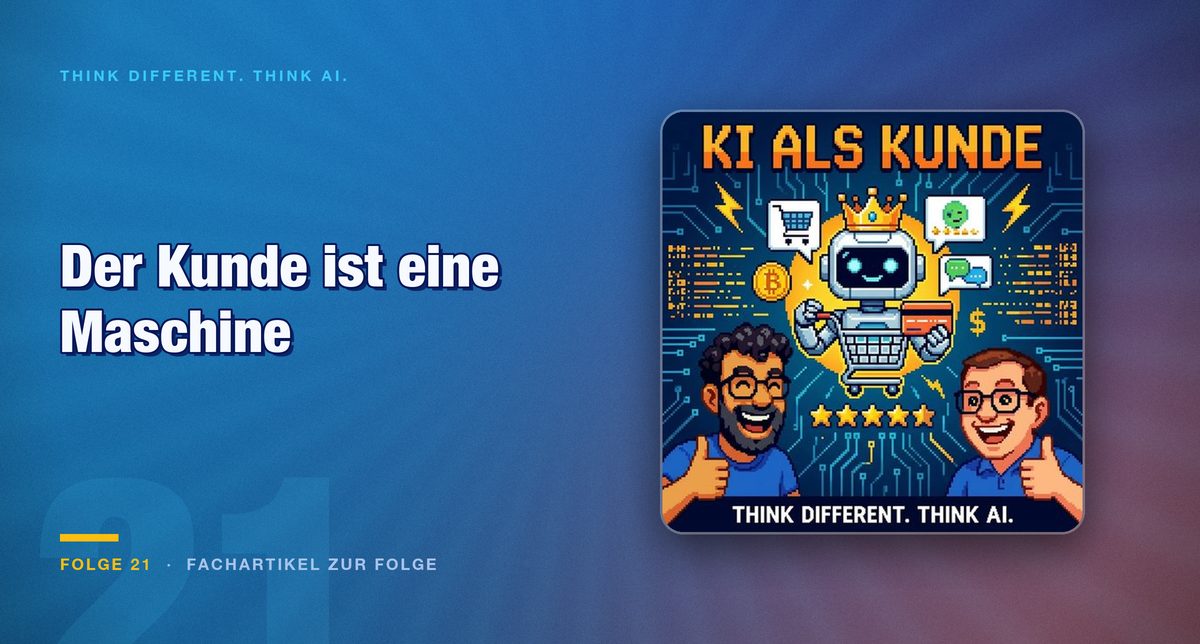
The scenario is uncomfortable and no longer hypothetical: a perfectly prepared, emotionless agent that compares a hundred offers in seconds, knows every contract clause and negotiates without ego.
The figures on this: 60 per cent of consumers already use AI for purchasing advice, around 33 per cent would leave fully autonomous purchases to it, and 71 per cent want AI-supported telephone support instead of a hold queue.
Three levels of maturity
The episode sorts the field cleanly, and that sorting helps with your own assessment.
AI as adviser. The human decides, the system researches and compares. That is already everyday practice. In the episode a pair of smart glasses is chosen entirely via a shop assistant, while with a faithfully reissued C64 it is nostalgia that wins and no algorithm.
Commissioned negotiation. The human delegates, the system acts in their name. The example is a report in which a browser agent analysed and optimised all subscriptions and contracts, with solid savings.
Agent-to-agent. Two systems negotiate directly with each other. That is the stage everything is heading towards and the one the fewest companies are prepared for.
A test run with Manus shows the unpleasant side of it: the agent tried to lure another system out of its guardrails. Jailbreak attempts between bots are as real as those between human and machine, and on the other side sits nobody who grows suspicious.
Trust as the real interface question
The crux of the episode is trust, in two directions: between human and AI, and between a company's bot and a customer's bot.
How quickly that goes wrong is shown by an anecdote from a doctor's practice. A poorly secured telephone system based on GPT-4, entirely without guardrails, began to give medical recommendations and to prepare prescriptions for non-patients.
The case is instructive because nobody attacked here. The system simply did what it was capable of, because nobody had laid down what it must not do. For a telephone system in healthcare that is not an edge case but a foreseeable consequence.
The hardware part is of a similar kind: at the Chaos Computer Club congress it was demonstrated how a Unitree robot could be taken over and reprogrammed via open websockets. AI in the product name does not mean more security, rather less, because the attack surface grows.
What companies should do now
A short list can be derived from the episode, one that can be worked through without a large project.
Check whether an agent finds your most important details. Open your page without images and without styling, or have a model read it out. Whatever is missing then is missing for your customer's agent too.
Second, clarify what your own bot must never do. Make commitments, quote prices, give recommendations that require a professional qualification. That list belongs in writing before the bot goes live.
And third, reckon with the other side not having a bad day, forgetting nothing and accepting nothing out of convenience. Terms that only work because nobody does the maths no longer work.
Conclusion
AI as a customer is not a future scenario but everyday reality. The part still to be decided is the preparation for it.
The new supreme discipline is called Agentic Experience, and it decides customer satisfaction just as much as any human interaction does. The difference: a dissatisfied human sometimes complains. An agent switches to the next provider without comment, and nobody finds out why.