Episode 22 · Article on the episode
AI gets a body: what CES 2026 reveals about robotics
Hyundai intends to take the entire annual production of around 30,000 Atlas units. The reason for the sudden push in robotics lies not in mechanical engineering, however, but in multimodal models.
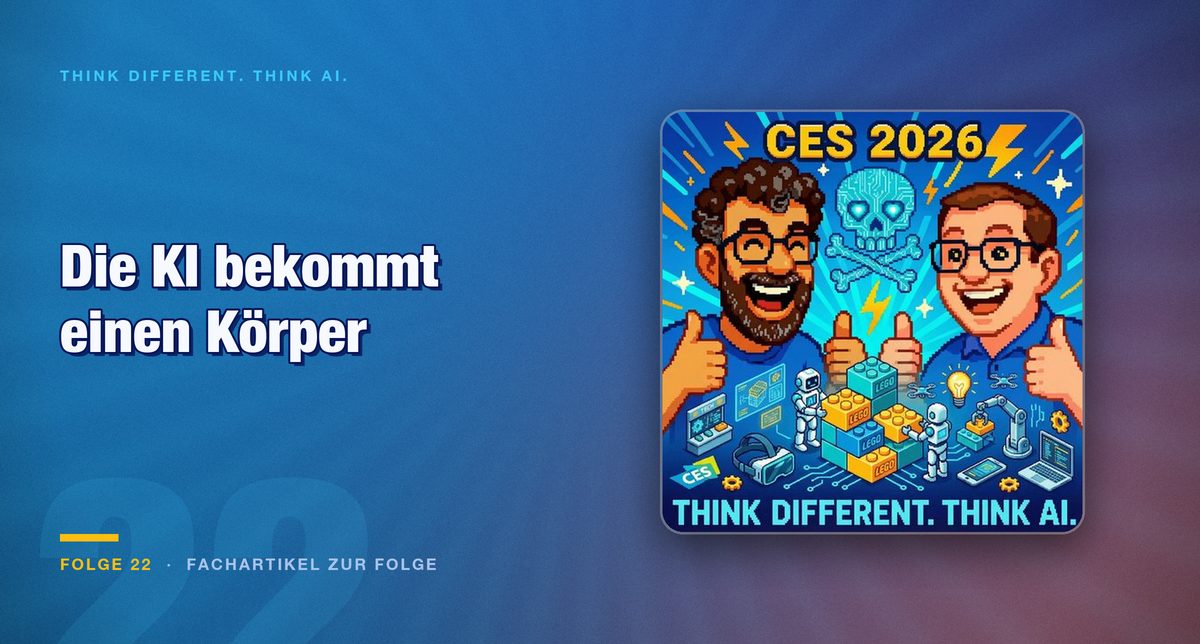
At CES 2026 practically every product carried the AI label, with genuine benefit behind it or as a pure sales promise. The part that counts beyond the trade show is a different one: AI is getting a body.
Why now and not five years ago
Humanoid robots have been around for decades, and for a long time the mechanics were not the obstacle. The obstacle was perception: a robot had to be programmed specifically for every environment because it did not understand what it saw.
Multimodal models change that. A system that grasps the world as three-dimensional space instead of processing text can solve a task in an environment it was not specially set up for. That is the difference between an industrial robot standing in one place and one walking through a hall.
Hyundai's order for around 30,000 Atlas units for its own production is therefore the most telling signal of the show. It is the difference between a demonstration and a procurement decision.
Note the place of deployment. A production hall is a comparatively controlled environment: known objects, recurring processes, defined routes. That is a realistic first market and a long way from the household.
Health as the second focus
The second block of topics concerns health gadgets, such as the Withings Body Scan as a set of scales with vital-data measurement, together with the option of uploading health data directly into chat systems in future and having it analysed.
Here the distinction the episode draws is worth making: what brings genuine relief to an overburdened health system, and what merely looks like progress.
Relief arises where a measurement replaces an examination or makes a problem visible earlier. The opposite arises when additional readings trigger additional visits to the doctor because nobody can classify them. A device that reports anomalies without knowing the context creates demand instead of reducing it.
When AI sells feeling instead of function
Two products stand for a different category. The LEGO Smart Brick for a Star Wars set with responsive, networked bricks, and Razer Project Esther, a holographic companion for the bedside table.
Both sell not a function but a relationship. That is a legitimate product category and calls for a different assessment. With a tool you ask whether it works. With a companion you have to ask what it does to the person using it, and that applies especially when children are the target group.
The critical side glance in the episode at xAI and its handling of user images belongs in the same context: where emotion is sold, particularly sensitive data holdings arise.
Ring's smart cameras with emotion recognition are to be classified similarly. Emotion recognition is technically contested and legally delicate, and it is sold as a convenience feature.
Conclusion
CES 2026 delivers one clear message and several side noises. The message: robotics has changed its bottleneck. It lay in perception and now lies in availability, cost and operation.
For companies with production that means reassessing the timing. Anyone who examined humanoid robotics three years ago and rejected it examined a technology that no longer exists in that form.
For everyone else the sober observation remains that an AI label on a product no longer says anything. The usable question is what the device can do without a network connection, and what data it sends when it has one.