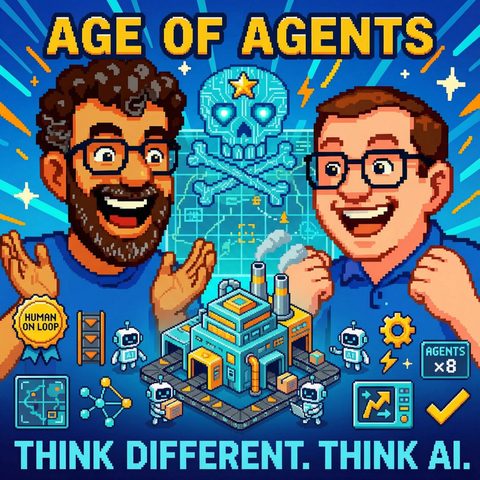
Age of Agents
Auf Deutsch lesenTopics KI-Agenten
What it is about
How gaming UIs are revolutionizing the future of AI orchestration and why this changes our thinking.
In this episode, we take you on a journey through the new era of AI agents. We discuss how classic chat interfaces are reaching their limits and why inspiring approaches from the gaming world could be the key to controlling and understanding complex agent systems. With a dash of humor and plenty of practical examples, we show how visual interfaces and orchestrated AI agents redefine working and decision-making. We talk about current developments, ethical questions, and why the skills of strategy gamers are suddenly in demand in business. Tune in to find out how the future of human-machine interaction really looks and how trust becomes the biggest challenge.
https://x.com/tom_doerr/status/2027791060873711658?s=46
https://x.com/alexfinn/status/2024169334344679783?s=46
https://github.com/pablodelucca/pixel-agents
https://x.com/idosal1/status/2021661865588535599?s=46
Transcript
00:00:00Welcome to Think Different, Think AI, the podcast by Mark and Jens.
00:00:07Two technology-loving minds who not only talk about artificial intelligence but live it.
00:00:14Here you will find clear classifications, real practical insights, and a fresh look at what is possible.
00:00:20Understandable, critical, and always with a wink.
00:00:24KDI for thinking, chuckling, and especially for joining the conversation.
00:00:33Hello, welcome back to a new episode of Think Different, Think AI.
00:00:38Today with the well-known and always present Mark Zimmermann
00:00:43and my person Jens Scharnetzki.
00:00:46I am ridiculously happy that we are making a really cool episode today,
00:00:50which I have wished for a long time, titled Age of Agents.
00:00:55You know what I think is great?
00:00:57I believe we have mentioned our first and last names for the first time.
00:01:01Crazy, right? That I have both and both are correct...
00:01:03Hansin! Yeah, probably people are hanging up now and saying,
00:01:05oh, that's them!
00:01:06No, I don't hear myself in that.
00:01:07I just don't find it appealing.
00:01:09The two of them are crazy, no.
00:01:10Yeah, no idea why.
00:01:11It's just the way it came to me.
00:01:13I thought we should make an episode.
00:01:15Uh, yeah.
00:01:16Age of Agents.
00:01:18It’s of course a little reference to Age of Empires
00:01:21and other games.
00:01:23It’s also a little hint towards what we will be talking about today.
00:01:27In this episode, we will mainly talk about the design of surface-user, surface-UIs,
00:01:37user-faces, whatever you want to call them, that function in a similar way
00:01:43to games, in order to control larger amounts of agents.
00:01:49Before we do that, let's touch on some current topics, what we've been up to in the last few days, since we don't need to check the fluff,
00:01:58fluff check is unnecessary. We have hardly messed up in recent weeks and months.
00:02:01Yeah, we are just too good.
00:02:03Where we are, is perfect.
00:02:08Yeah, there’s also an almost perfect prediction that has happened in the last few days.
00:02:13You wanted me to count something, Mark.
00:02:16So it's not humorous in that sense, but nonetheless, I would say it's impressive,
00:02:23that Croc, we know it, yes, Elon’s favorite AI, predicted the attack on Iran very accurately
00:02:31in terms of timing, I couldn't help but
00:02:38write a post that said, Croc predicted the timing well, but
00:02:45this happens when the Pentagon uses Croc and forgets to switch our data not
00:02:50to be used for training the model, probably everything
00:02:55is not right.
00:02:56But I still found it somewhat ironic when the War Department uses Croc and
00:03:04for the average person Croc makes a pretty accurate prediction about the timing of
00:03:09yes, that’s already interesting.
00:03:11battles or activities, or however you’d want to call it now.
00:03:15Yes.
00:03:16It predicts beforehand.
00:03:17That's true.
00:03:18It’s, as I said...
00:03:21even if these events are horrible as they are,
00:03:24but it also shows this topic we’ve brought up before,
00:03:28security or not,
00:03:30this thought of having really forgotten to switch
00:03:33it on or not, whatever happened there,
00:03:35remains to be seen.
00:03:37But the Department of War has produced other AI news in recent weeks.
00:03:46There was still quite a bit that had the AI community excited.
00:03:53On one hand, there was the case that was made public last week, or was in many
00:03:59media, that Enttrophic, with its CEO Dario, said they want to collaborate with the
00:04:09Department of Defense, or how did you actually say it? I just said it
00:04:14correctly. Department of War. Exactly, because they were not secure about it.
00:04:21it can be, that the AIs, if they also hand over the models openly to the Pentagon, that the
00:04:27are not used to conduct mass surveillance, nor to
00:04:32be used to actually independently finalize weapons in combat operations,
00:04:42thereby also killing people and something else. That could not be promised.
00:04:47Accordingly, he did not sign the contract, did not say,
00:04:52I completely reveal myself and give my model completely free for you. As a result, I think he got kicked out of everything. That is, I believe, some 200 million dollar contract.
00:05:01I believe Trump and Co. immediately posted that one must absolutely not use it, that no employee should use a trophy anymore, because it's now a devil's tool and I think this has also been put on the
00:05:11list of
00:05:13risks or something. What is happening there is quite massive.
00:05:22One must mention it. I mean, that is my word now. Yes, I am allowed to enter the States. Thank you.
00:05:30And then one must know on the other side that the attack
00:05:34was directed at Ela, which is being viewed as an operation, whether one approves of it or not, but it was relatively
00:05:40successful in that sense, so to speak, well executed in that regard,
00:05:47that things went well from the perspective of the Americans and the idea they had back there.
00:05:52This was also helped by the Trophy Cooperative. The AI actually helped out quite a bit
00:05:57apparently, from what has become known, which makes it even more astonishing.
00:06:00But there is not just one AI successor in this world, another is directly in the
00:06:07jumped into the breach, I would say. Our dear Sam from Open AI. He then
00:06:14announced shortly afterward that he would sign the contract with the Pentagon, with the Department of Defense
00:06:21and that it wouldn't be a problem at all. They would adhere to the fact that
00:06:25essentially, no mass surveillance would be implemented, although that is somewhat
00:06:31amusingly worded. So Sam's tweet is kind of strange,
00:06:35the community reacted a bit oddly to it. I don't know if you've noticed
00:06:37I read through a few things, a few comments. People aren't quite
00:06:40convinced whether the way Sam wrote it in that
00:06:45tweet actually means that he's saying nothing other than, well, the actual law
00:06:51states anyway that this cannot be done, that there cannot be mass surveillance
00:06:56permitted by the police, and that no autonomous weapon systems are allowed in that sense
00:07:00give, the self-employed should decide. The way he expressed it is actually
00:07:05interpretable in such a way that we say, well, as the sender says, then of course
00:07:11then some general can still decide as a human in the loop, that but a
00:07:15million drones can now actually decide for themselves whether to attack someone
00:07:19or do something else.
00:07:20So that's a bit what the drone Rupus means.
00:07:23Yes, it's really a bit wild and he also presented it in his tweet so
00:07:27that this is a totally cool solution, this contract he made
00:07:30that can now also be offered to all other AI companies, which then
00:07:33somehow totally becomes an issue because one thing that Entophic with Dario rejected,
00:07:39is supposedly because Sam then simply comes up with the exact same contract, that has now just
00:07:44well, so it becomes a bit of a topic where we have to say, but this has to be
00:07:46observe how it develops further. What we see in the teeth, I don't know,
00:07:52if this is the case for everyone, but what we see in the teeth is that very, very many users
00:07:57have been happily switching from Open AI, from GPD, to Cloud, to Entrathic since this news.
00:08:07And I believe there is even a functionality now for this, that what was basically
00:08:13a bit difficult before. I mean, if he ever moved from his Spotify account
00:08:18to an Apple Music account or vice versa, transferring playlists is quite
00:08:23sometimes a bit tricky. You sometimes surprisingly need an AI-for or a
00:08:31software solution or something like that.
00:08:34With
00:08:35AI relocations, I have also always thought about it, I now have a lot of knowledge, basically my ChatGPT has revealed, yes.
00:08:42Now to move with it, I was already afraid I would have to copy all the threads somehow and copy the rober
00:08:48into another AI, but I believe there is another solution, there's somehow an export or something.
00:08:52There are actually two solutions by now. You can both in ChatGPT itself say, I want a copy of my data and then you get a hint,
00:09:01so to speak, when it's ready, you'll get an email and then you have an email and a link and then you can click, you get a zip.
00:09:08I can recommend everyone to do this, regardless of whether you want to switch or not, because then you first see what they actually have collected about you,
00:09:18which is not so little, and if you don't take this function, because everything is actually included,
00:09:26what you have chatted in your life, files and chats and whatnot,
00:09:32if you want that a little bit more compressed, Claude offers you a relocation function,
00:09:39not that you just press a button and then he talks to Chatchivity, but he gives you a prompt.
00:09:45A prompt that instructs the AI system to disclose data about you in a structured form.
00:09:52And then you basically have a prompt window in ChatchiBT.
00:09:56You copy your prompt out, don't go into ChatchiBT in Cloud, you have a prompt.
00:10:02You can copy that, go into ChatchiBT, and enter the prompt.
00:10:05The prompt instructs ChatchiBT to fill this out based on knowledge.
00:10:09You take the result, copy it back into ChatchiBT in the Cloud.
00:10:13back to Claude. Man, too many words with looking and then he can basically his memory
00:10:21about you. But one has to say, if you export this in ChatGPT at OpenAI via
00:10:28the data export, it's much, much larger, much, much more powerful. For that you have
00:10:33the problem, how do you play this back in? Because it definitely doesn't fit into the
00:10:38small text window that Claude would actually offer you for that. But those are
00:10:42both ways that work. And I have to say here, the Chat-GPT moment started for me with AI,
00:10:50but at the moment I have no active subscription with Chat-GPT, because I actually find,
00:10:56the models and the offered functionality right now are not state-of-the-art, which however
00:11:03really doesn't change, was state-of-the-art. But everyone can decide that for themselves,
00:11:07whether politically or idealistically motivated, or for technological reasons,
00:11:11usability reasons, at which motel it is. There are definitely ways to
00:11:14transfer that. I find it a bit unfortunate, since you were just talking about that, that it
00:11:17basically, I know that the topic of context windows is just difficult
00:11:20for an AI, to copy in too much content. But honestly, it wouldn't be
00:11:25that hard to say, even if I receive something there,
00:11:28that I first split the content of this file. So I have
00:11:33often found myself in situations where I copy something in and still get
00:11:36one of those error messages today saying, but that is
00:11:41too long at that moment. I actually find that a bit unfortunate, but there is still no
00:11:43solution to say, okay, I'll just cut that part off and put it in
00:11:47put in the second prompt machine. I shouldn't have to do that as a human, honestly.
00:11:50and so that almost hits me a little again.
00:11:52We're maybe slowly getting to the topic
00:11:54Orchestration and that kind of thing, but what I actually find astonishing
00:11:57is how quickly also the way you say is
00:12:01is spoiled. So something like Claude creates nice Excels, Power Points. You get Markdown
00:12:09files, then it continues in ChatGbt, you start there, that just had a preliminary meeting for me,
00:12:13then you start in this kosher html thing and try to copy that out and
00:12:18then it gets interrupted and then yes Gemini reacts differently somehow.
00:12:23I also gave this prompt to Gemini. Like, look up everything you have from me.
00:12:27Gemini then said, what do you mean, I don't know anything about you.
00:12:30Yes, where I then thought, what is this? I've been using it for half a year, what is going on here?
00:12:34Yes, so you've really gotten used to it, and I also find the philosophies behind it quite interesting,
00:12:38yes, with Gemini, that's James, while this is block the last room. And with Open Air
00:12:43it's called Skilds and with JetGPT it's called no Ahnowatt, yes, up yours, the thieves,
00:12:49that's all somehow very different. And in between comes Croc, who answers
00:12:54some very nice chemistry questions and questions about the American invasion or questions
00:12:59about X from Reddit, but otherwise he's a bit, I would say, well, I don't really know.
00:13:04So Supercrug and Heavy-Crug haven't convinced me so far.
00:13:09Yes, and that's why it's even more important that we, let's say, I would have
00:13:12a bigger reading again and then we can smoothly transition to the topic.
00:13:15So the models are increasingly becoming about comedy, so about the topic, what
00:13:19is actually not so important anymore and interchangeable at that moment, but
00:13:23the combination of the model weather is more interesting. Well, how can I orchestrate that
00:13:27with various agents, we keep saying, it's no longer just the model,
00:13:33it's the skills that are perhaps important, what I do locally, what I might
00:13:37do in the cloud, so this combination of topics is becoming increasingly important and the
00:13:41usability of that is becoming more critical. And we are slowly getting to the topic of today's
00:13:46show, because we have actually called it the Age of Agents, saying that we have
00:13:53for a long time thought that the main interaction with AIs, whether it's Weibkohle
00:13:59or something else or just asking how my next trip is, would be the chat window and
00:14:03the pure chat, but somehow that has surpassed itself. Ever since, basically, an AI is no longer just
00:14:10a prompt and an answer, so my prompt and the answer, but that it actually
00:14:13persistent is that it performs actions. That's a certain API action, whether I
00:14:20now have with the workflow system that you also sometimes like to use. There are
00:14:24tool calls with existing packings being triggered, skills need to
00:14:27be updated, memory files need to be written somewhere. API actions that
00:14:32also actually cost no money are performed in the background. So there is
00:14:35budget consumption, these topics are there. Well, I certainly have an AI that or
00:14:40an agent who might position himself as the head of the other agents about this
00:14:45talks about what they have to do and such things. All of that is in
00:14:48principle now there and leads to the fact that you actually can't handle it over a
00:14:54can solve simple chat windows but needs something else, something different
00:14:57Layer needs to process that so we can keep humans a bit in the loop, so to speak. This means chat works well for
00:15:01keeping us engaged a little.
00:15:06I need something and get an answer. For a
00:15:10orchestration, a chat is rather moderately suitable, to be honest.
00:15:16Before you dive into these new interfaces with all of us, maybe just
00:15:22briefly, one more overview to what is currently happening and what is
00:15:28there regarding orchestration, maybe precisely because I would say briefly, Perplexity
00:15:31has brought you something out, Perplexity Computer, where you’re somewhat back in this text world
00:15:37albeit with images, but the system doesn’t just try to imitate a bit of Open Clown
00:15:41like that.
00:15:42The motto is, I solve tasks and install things, and I do and act, but they actually mix
00:15:47between Kimi and Gemini and Open AI and Cloud quite casually
00:15:54and start various activities, depending on which model is active.
00:15:58can help the best.
00:15:59Croc has also done something like that, where you have agents warming up and agents that they start and orchestrate separately because there is an orchestrator agent that gives its commands.
00:16:15And since we were talking about Claude, I mean, Claude has also, when was that, the day before yesterday, I can’t remember again, they started doing something like, okay, you can now plan tasks,
00:16:26Plan, which means prompts are filled out at certain times, so that they can
00:16:30send you summaries, create something for you on social media
00:16:33post, I don’t know, whatever. You can now also operate it remotely,
00:16:39whether you got a Telegram connection, for example, with Kimi,
00:16:43so you can write to your friends over Telegram
00:16:47or with Claude, for example this Remote Claude, that you can chat from your phone
00:16:53to your computer at home. So everyone is currently making a lot of attempts,
00:16:58to delight you with orchestration possibilities. But now I will close this circle and
00:17:06I'm returning back to the broadcasting house. This orientation in these long chats
00:17:14in Telegrams becomes confusing. If you have five different topics going on,
00:17:18it's like in a family chat. Then suddenly grandpa writes, where are you and refers to the
00:17:24message you got three weeks ago. That’s complete madness for these AI times.
00:17:30And the other thing is, whether it’s perplexed computers or whatever your
00:17:35interface is, as soon as you have this project list on the left, I don't know how you feel, but I
00:17:40find it super confusing. Where were you last? What is currently being worked on?
00:17:46Is this an old version? Is this already a new working state? That's really outdated. From
00:17:51that perspective, I’m glad about this topic, as you raised it, that other
00:17:56interfaces give us different possibilities. Yes, definitely. I also believe
00:18:02that no matter how wild the times are right now and how wild the possibilities are,
00:18:09that we have through AI, the UIs that we currently offer to orchestrate these topics
00:18:15are still very text-heavy, terminal-heavy,
00:18:19development-heavy, because we also have to say, many things that we talk about in this
00:18:24scope are again not accessible to everyone. Anyone
00:18:28can somehow install pipes or something else to then
00:18:31run certain things, can present a GitHub account to upload topics there,
00:18:36upload other things. It's all still very, very
00:18:39development-heavy. I believe there's
00:18:41just such a gap that needs to be closed, especially when I dive into the topic of
00:18:45orchestration, which is already in the gaming world, and there are now a few approaches that
00:18:52have been taken up, that have been closed for a long time, in a very playful way.
00:18:57I mean, especially the German developer scene has always been very well known for
00:19:02Construction simulation games. So, I would now consider the big series as the
00:19:08Anno comes from Germany, the Anno series, which has tons of variants, from Anno you haven't seen,
00:19:13so Anno you haven't seen, where it’s always about being a manager of a certain
00:19:21system for people who are not familiar with playing, it often involves
00:19:25somehow building my little village in the Middle Ages, something else, I have to fell trees,
00:19:32of course, I also need to add a forester who reforests the trees,
00:19:36when such a system functions, there are always simple rules, like
00:19:39sending the miner or something like that.
00:19:41If I have two tree fellings, then I need a forester, then that is enough, then I can
00:19:46add the sailmaking and then it works and then my people can eventually
00:19:49build houses from that.
00:19:50And so there is a complex fuss going on behind these topics,
00:19:56often these surfaces look like a bumpy picture, that will
00:19:59then in the more modern games, modern is a good word, they look
00:20:03a bit like old games from The Refactory or something, it's really about
00:20:07the orchestration of vast supply chains, factories that I then build to produce optimal products,
00:20:13to produce.
00:20:14The supply chains also need to be optimized, short supply chains that players
00:20:18simulate in the game.
00:20:21So, now back to the lumberjack, he has to walk a few meters
00:20:25to the sawmill, which is smart, it's silly if I have the sawmill on one side
00:20:28of the pixel map and my lumberfalls on the other side,
00:20:32have.
00:20:33should be relatively short. So these are highly complex management games that allow us
00:20:39to really run a highly complex system. That means we
00:20:45are managing a kind of virtual person in these games who is doing something. And this analogy
00:20:54was recognized by one or another AI expert who is out there, who
00:20:59has worked a lot with agent orchestrations, where they pack different agents together,
00:21:05to solve tasks, whether that's, in the simplest case, three coding agents,
00:21:09a research agent, and a testing agent who basically just looks at the topic
00:21:14of what the coding agents are doing, then I might have four or five agents running around, who
00:21:18I can view in the background through terminal windows, I can control them through chat windows,
00:21:21I can check what they are currently programming in the project folders.
00:21:25I can control that.
00:21:26I can also see the API costs on another website, theoretically, that they produce
00:21:31or the tokens they are burning in this model.
00:21:33However, I could represent that just as I am doing in the games, which we have been doing
00:21:38for decades now, and say, wow, I just have five virtual
00:21:44agents running around on such a surface where I can perhaps see if they are
00:21:49currently active or if they are hanging out in the break room of my virtual office that I
00:21:54built, yes, or if they are burning money or if they are currently programming.
00:21:59I'm currently imagining how the little agents stand by the oven and shovel the
00:22:03virtual money in. But what you're saying is really great because
00:22:07while you were describing it, right? Let's stick with the example, you
00:22:12had it, I believe, a simple example, the three coding agents are building three apps.
00:22:15I had a lot of discussions today, yes, I sat down with three apps in parallel
00:22:20and in a world where you're working with text windows. Even though I come from IT,
00:22:28I don't necessarily find text windows to be the most appealing format. Then you have
00:22:33three windows open and I noticed that each agent also started the app
00:22:38and validated the app. Then the app opens, and you start working inside it already
00:22:42just typing around, while it wasn't even finished yet. So it's fundamentally through
00:22:47overlapping of the windows is confusing. If I now imagine that you don't have all of this in
00:22:53a text desert and additional windows, but really, as it is in these games,
00:22:59that you say, okay, you see, up there are the three miners or the three
00:23:03programmers who are working away in their winter gear. And if they have something where you
00:23:09might need to do QA or something, then these typical symbols, as they say
00:23:14you can play. I have a quest for you. You can submit your quest. So you can submit your
00:23:20task and look at the results. No idea what such mechanics make you think of,
00:23:24what such mechanics reveal transparency, because I think of those little characters,
00:23:32that run across the screen, I always think of Lemmings, that's a very old game,
00:23:36the very old games. Although Lemmings, well, they probably all fell to their deaths,
00:23:40but it must be much simpler than all of this here in
00:23:49Zerlich-Grad-What and here something shines blue and yellow and red and green, but at
00:23:52the end of the day, it's still just text. Exactly, let's travel out of such a
00:23:55situation, in which we often find ourselves as knowledge workers,
00:23:59staring at a monitor and doing something,
00:24:01when I say, if I'm going to sew a complicated factory alone, that
00:24:06I say, I have a factory plant that does chemical processing
00:24:09something else. So the control room of this factory is then
00:24:16also not a terminal window at that moment. Individual steps are of course programmed down,
00:24:21all the software solutions, the individual conveyor belt, that's all of course program code,
00:24:27programming, the orchestration of it is actually maybe represented again as
00:24:31a map, as a control chart that I have somewhere, where red lights
00:24:37light up when some production chain fails, so that I know I have to look there, whether
00:24:41afterwards, what went wrong, whether the software is wrong or something has
00:24:44fallen into the conveyor belt, whatever, it doesn't matter, but this...
00:24:48It does matter, but you have gained attention.
00:24:52Yes, and that is definitely the attention. But this, I think we humans have to abstract.
00:24:58We do that as we develop language, we develop other things, we abstract
00:25:03in principle of course, and that is the same with complete situations, we need to abstract.
00:25:08So I wouldn't say, I'm glad that there is in principle a visual
00:25:11representation of a radar in a, in an airport tower and not just
00:25:16lines of program code standing underneath each other that I somehow have to calculate or read
00:25:20through to see which 50 is currently the case, but that people can visually recognize,
00:25:23oh, a plane is coming from the left or another, it might be a bad
00:25:26idea that they are both on the same runway now. So, that means we humans are
00:25:31So it is not usual, it is our preferred means in complex systems,
00:25:37to abstract things, to represent them differently, to represent them as visually as possible, to not have in context
00:25:42there.
00:25:43We are indeed speaking about visual interfaces in complex matters endlessly.
00:25:49everywhere.
00:25:50And such complex relationships are really extremely represented in games.
00:25:55So far, there haven't been any AI components in the background, but if you
00:25:59now have a real-time strategy game or any other game like Starcraft or
00:26:03the big games that exist, there are really often thousands of
00:26:08units that are produced somewhere in factories, these are all supply chains
00:26:12troop movements, combat actions represented on a map with other visualizations where
00:26:17represented, this is a very, very complex system that is influenced by humans
00:26:23the presiding, so the Human Invaluable, or maybe already in this case Onvaluable, we can
00:26:29perhaps delve a little into the two terms that are also floating around a bit in the
00:26:31AI discussions regarding this complex matter in various
00:26:36can orchestrate zoom or abstraction stages, because it is visually represented. And that is
00:26:43actually a bit of what perhaps the near future is. When we talk about
00:26:49how we will engage with agents, especially with the
00:26:55orchestration of agents, that
00:26:57such game UIs might gradually become more prominent
00:27:01and also the business applications that we have.
00:27:03Because I can quite well imagine how
00:27:06you wrote it just now, whether I now say, now
00:27:08I have that, I can observe a coding window like that the whole time,
00:27:12of course, and wait until eventually I get an
00:27:14error report, but I can of course also
00:27:16similarly take a look again somewhere at the
00:27:19virtual office and see that one of my agents is waving a caution sign
00:27:24all the time to get my attention, because he might be basically waiting for
00:27:29some input from me. This is a much quicker way to recognize when I then
00:27:35dismiss it again. If I say there are maybe 1000 agents programming and ten
00:27:41of them have problems, then I might see at that one spot, the virtual location on
00:27:45my map, called Cologne, Düsseldorf, Karlsruhe, whatever, Berlin, then
00:27:50the programmers in Berlin, they have a problem right now, then I can maybe
00:27:54look into that and then I recognize that it's just that one single agent, and then
00:27:57I can maybe take another look at this code and see why this
00:28:01one agent has stayed stuck, whether he has a budget problem or a technical problem
00:28:05or something else at the moment, I think we need something like this, and that’s why
00:28:09I think it’s great that we are already seeing such things, they are indeed
00:28:12meant to explain this to you. There are all kinds of things. There is something like Agent Craft, where
00:28:16I can really play similarly to Starcraft with orcs and so on, they run
00:28:21around there. These are the agents, I can further build and construct them and such things. There are
00:28:24indeed very, very many applications, rather small bustling applications, where AI agents
00:28:31are then depicted in such an office situation. Then really one comes in who is
00:28:35the programmer, the other one is the researcher, the other is the boss. Then there is the
00:28:38easel, then there’s the tester who runs around and then they sometimes meet
00:28:42at the coffee corner and also chat during coffee because they just
00:28:46have nothing else to do.
00:28:47Then I can simply say, I’ll delete him now and throw him out, because then
00:28:52he no longer uses Idol Time or somehow takes money from you.
00:28:55So, what are the kinds of things that you find instead?
00:28:57In Baden-Württemberg, they call teachers in the summer phases, in Baden-Württemberg
00:29:00I believe teachers are always let go during the summer phases and then
00:29:05reappointed after the summer phases, but that's a different topic.
00:29:08I think it was like this, so if it's different, please comment, but I'm
00:29:12pretty sure that this is in Baden-Württemberg, I don't really know how
00:29:15many other federal states it seems to be the case in one way or another.
00:29:19What I find quite funny about it while you were telling that
00:29:23is problems that I've really encountered over the last weeks again and again,
00:29:27namely, you might know that a lot means a lot when one
00:29:32once you've had a good experience with a good model, you stay
00:29:35my good model, yes in my case with Claude, that's Opus. But actually, you need
00:29:39Opus isn't always the answer. There are, let's say, things where Opus might be a bit too
00:29:44heavy-duty for the task at hand, and when you're working with it, you don't really
00:29:51have an immediate sense of how many resources I've just used, or is it
00:29:56that is necessary. And for both I have an example where I think that such a
00:30:00interface will probably help us in the future. One topic is,
00:30:04what I just mentioned about resources, yes, so if you perhaps have time and the progress bar is allowed
00:30:08gradually move forward, then you can also take another model, because maybe the
00:30:12other solutions might also need a bit more time. It’s not like you can do everything by yourself.
00:30:16you decide for yourself, but sometimes you might rely on cooperation from others
00:30:20Processes have been assigned, and if that, let's say, needs to be finished by 9 AM, then it has to be done
00:30:25maybe not with the Ladies and Creators and I can do everything and in general
00:30:29reasoning and maximum and you see what I mean, but maybe the small one will do here,
00:30:33quickly borrow a helper. When it comes to formatting texts, it's
00:30:36perhaps a perfect example, but you can still imagine that.
00:30:39And the other thing is, we had, since you already mentioned tools, we had
00:30:43worked with a few tools, in this case again in software development, how
00:30:47to handle different components, so task lists, where it says what the
00:30:52software developer needs to do or other components with which the developer
00:30:55normally needs to collaborate, we had all that over MCP, we have
00:30:59explained that in a podcast before, what that is, it is the
00:31:02possibility for agents to interact with tools, data provided by the
00:31:08neighboring system.
00:31:10And we had taken a very weak AI model, and the AI model said, yes,
00:31:15so this MCP thing, that doesn't work, so ah, no, no, no, that's
00:31:19the MCP server, it is broken.
00:31:21Then we took a slightly stronger model, which said, no, no, super,
00:31:24the MCP server is running, then it took a little while and then you saw in the chat history
00:31:27oh yes, I forgot what I wanted. I think that was the goal and just
00:31:34continue. And when you took the really good model, it already ran through it
00:31:38from the beginning. So it recognized that MCP had to be running, and didn't do any nonsense during
00:31:43the MCP communication. And that's how they behaved differently. If I relate that
00:31:47back to games, then it's similar to the simple character,
00:31:52that I used, who can then, let's say, carry the tree. And if
00:31:56it takes a little longer, that's not a problem. Carrying the tree is something she can do. A builder takes
00:31:59on a master's role. And if you're back in your military exercises, you take
00:32:04someone who maybe has a sword and a club. And not the one who is currently
00:32:08holding a tree because he has an advantage on the battlefield, like the odds.
00:32:11Exactly. And in this way, you can also control faster. So, you say, okay,
00:32:14if, for example, you were to define zones that would represent a certain security zone in such a
00:32:20real system. If
00:32:23an agent then perhaps has the wrong permissions, then he shouldn't even
00:32:28enter that other zone. So you would also see that, okay, I might have
00:32:31done something wrong with the security settings of this agent, who simply doesn't
00:32:36have certain permissions. Did I do that wrong? Because he's now running around here,
00:32:40where he shouldn't be. So something like that can help. The complexity,
00:32:45that we might not otherwise see in the system, that is hidden in the prompts, in the
00:32:50lines of code in the skills that we give to the agents, we can obviously
00:32:54visualize there. So streamline. That is simply a huge advantage that we have from such
00:33:00interfaces. Because, as I said, we humans are also visual. We are not only focused on text
00:33:05we need visual input, that's why we also look for signals, now from
00:33:11a classic signal design. There, signs are also important, because they are not just long
00:33:16texts, but basically work through symbolism.
00:33:21Exactly, symbolism helps. So we also need this abstraction, because then
00:33:29you can simply react faster in crisis situations. So now in such a
00:33:34long, so if he somehow becomes prompt to get our result,
00:33:37that's often already the case, it's always such a wild thing, then the
00:33:40AI just throws out a five-page response that just scrolls past you,
00:33:44where you often find yourself going, wow, now I have to scroll back up and such
00:33:48what. If there's a hidden danger message in there, it could very well be that I
00:33:53overlook it. So alone, that's not what I wish? Yes, exactly, I wish for example in
00:33:59such a case a visual hint of a danger. And you can solve that wonderfully with such
00:34:06gaming interfaces. Mark, I wanted to briefly mention, before we continue,
00:34:10because I just called it up. I want to briefly address the two terms that I
00:34:14threw in, human envelope and envelope, to go a bit deeper. Can you briefly
00:34:20explain them, why they are interesting right now? I find it totally funny because I wanted
00:34:24to say another sentence just before we get to these terms, from that perspective I now
00:34:29use the word allocation and afterwards I would like to explain that too. Another point is also,
00:34:34I find, is the topic of delegation. Now not everyone in professional life is someone,
00:34:42who distributes work. Some people have a boss who tells them, this
00:34:48is what I need from you. Depending on what you work on, how you work, that might also be,
00:34:52I would say, standardized or not, but in the long run, the shorter version is,
00:34:56the delegation of work, the trust that what is being done,
00:35:00is good and that it is correct, and the trust in the person behind it is,
00:35:03one thing. But delegating always sounds so easy, but sometimes it's not always so
00:35:09simple. And especially, if you are new in a position where you might come to delegation,
00:35:14it always feels strange. Until now, it was always that I was used to doing it myself.
00:35:18Now someone else does it. So not according to the definition of what it stands for, that a team
00:35:22great, someone else does it. No, rather in the sense that you say, okay, I’m giving this
00:35:27as an order, and when it comes back, yes, maybe there can be further adjustments,
00:35:31but overall I have to live with what is there, and I trust that it’s
00:35:34good.
00:35:35And that is already a change in thinking, and I believe that such
00:35:42interfaces could help with that.
00:35:43Now you just asked me to dive into the topic of Human in the Loop and what else
00:35:50there is, I’d like to briefly outline, so Human in the
00:35:57That characterizes systems where humans are actively involved in the decision-making processes.
00:36:03The AI prepares, the human checks and decides, gives approvals, is essentially right in the middle,
00:36:09instead of just being present. And with Human on the Loop, that describes systems where the AI is largely
00:36:15acts autonomously. The human supervises, can intervene, but actually the AI,
00:36:22let's say the AI works autonomously and the human bears the responsibility and the
00:36:29human can, as I said, oversee, but the AI mostly does things on its own. Now I would like
00:36:37to say, for the sake of fairness, that I would still want to know a thing or two additionally.
00:36:42Loyal listeners also know that we should actually not talk about human, but about expert,
00:36:48shout out. Still, I would like to also add one or two more terms
00:36:55since there’s also something called Human Intelli... In the Lead, yes, that characterizes
00:36:59systems where the human retains full control and leadership, but the AI makes analyses and
00:37:06offers suggestions, while the human is basically the main actor. There are always slight,
00:37:13subtle differences. We had once, when René was our guest, talked about such things
00:37:18yes, again. And if we complete the four conceptual worlds,
00:37:23there is still Human Out of the Loop. This is basically completely autonomous. The human only has at most
00:37:29some peripheral issues to deal with, but the AI carries out protein processes completely independently
00:37:37. We might still have that as our best practice.
00:37:41And to place this a bit more in our gaming world, this means essentially the
00:37:46topic of Hume Invalu, would be after the wood, the wood-felling AI has felled the wood and
00:37:54it is lying somewhere, it might still be the case that it has this largely autonomous
00:37:58operation, but the next step, whether it should also store the wood somewhere or
00:38:02take it to the lumber mill or something, would mean that I would then
00:38:07need to intervene and say, yes, please do that. In Schumen-Onvelu, we are
00:38:13then already at these orchestration surfaces. That I say, okay, I then look more at
00:38:17ensuring that the flow is running properly, that the resource chain is
00:38:22closed, now perhaps initially only for wood required
00:38:27for houses or then maybe the second production chain comes along,
00:38:30which delivers stones and then there's also food when we finish that and
00:38:34then of course at some point this Humen in Beloop will expand, if it is like this, I believe,
00:38:38in this third or fourth stage, as you just described.
00:38:41So, when is an individual Humen in Beloop in the combination, in the orchestration not
00:38:47perhaps Humen in lead only in principle, because then very, very many autonomous systems
00:38:53indeed still show me what is happening, but at many, many points
00:38:59intervene very, very independently and that's why it becomes extremely important that we then
00:39:03find visual solutions, interfaces that go far beyond the normal prompting, beyond the
00:39:09usual coding display that we are familiar with, which are important for me to
00:39:15orchestrate that. And for example, I had that now a time or two.
00:39:18is already totally exciting in reading, which also brings up this topic that maybe the gaming skills,
00:39:26the people who have played a lot, who might bring the skills needed in
00:39:31searching. I am an expert.
00:39:35World of Warcraft, over a year in gameplay time, over a year, guys,
00:39:41strap yourself in, strap yourself in, strap yourself in. I knew it was good.
00:39:45Maybe it's good. Of course, there’s a bit of a thing behind it,
00:39:48when you, as I said, do 1000 hidden object games or production chains over several
00:39:55I was a warlock.
00:39:56Which command stations and yes, there’s also always everything, so, what all exists.
00:40:01Then coordinating and orchestrating it, that’s also a human envelope, yes, and
00:40:08this orchestration ability, this optimization ability, then indeed going down at the right moment
00:40:14and maybe again being the human envelope and not the human envelope
00:40:18being and grabbing someone in certain situations, because something reacts, because something
00:40:22isn't working so well, is a skill that if you want to play successfully, you have to bring along
00:40:28or learn. I don't even think that what some claim is so absurd, that
00:40:34this ability might not be one of the worst skills in future
00:40:39AI agents that we are currently stepping into. It will also be really exciting to see,
00:40:44not that I want to dismiss this now, but I just had the chance
00:40:49to discuss how the current interfaces for the masses look, that you
00:40:57can now from anywhere time-controlled, start automations, start actions,
00:41:04have things installed, the way you described, how correctly I am in
00:41:09a GitHub and how correctly with Python one. You theoretically don’t even need to do all that anymore
00:41:14to know, because when you say to that thing, I need this, then it installs
00:41:18the stuff on your machine and does what it does, and when you're on the go, you have to
00:41:23give an okay while you're out and about. So I do believe that once these foundations
00:41:29are laid, the big players will also start to pay attention. If that
00:41:35really takes hold, not that Grandma Erna, no offense to Grandma Erna, yes, just figuratively speaking
00:41:42here as a persona for this topic, I write a birth poem with an AI that
00:41:47serves a purpose, but that really all the concepts we've discussed in previous episodes, MCP tool integration,
00:41:52skills, i.e., work instructions according to the systems, then performing tasks. Suddenly, you are
00:41:59working with multiple agents. If we look at the consulting thing I had back then on
00:42:04N8N, which I've now built as a skill collection with subagents in Claude, if that
00:42:11increases, then you won't be able to get around the fact that the interface will change, but this
00:42:17foundation that you have now, that, let's say, every morning at nine the harngrät or in our case
00:42:22a report is generated, that things can somehow be controlled from everywhere,
00:42:26that things can somehow orchestrate, install things technologically, do stuff, that the
00:42:32next logical step will bring me into something graphical, bring me into something spatial. So along the lines of
00:42:39up in the right corner, there's, let's say, the library city and down in the left is the
00:42:43developer city and up in the left is the resource pool or in your case now the coffee kitchen
00:42:49and the cloud and the office for working and no idea, because as a human you can navigate in
00:42:55this spatiality, in the visual spatiality, that
00:42:59you can also interact with the acoustics, yes, you hear an Ibi, yes, it means that or like
00:43:05were there not some games that when you said, bark the tree, they always
00:43:08said AI Sir or something like that, yes, there was also something, so you are
00:43:11capable, so to speak, of your stimuli. Acoustically, visually, spatially, that you are able to interact
00:43:16quick to find you, quick to act, and then you have to think about it, yes you as a person
00:43:21have a sack full of agents with dubious skills, you have a sack full of budget,
00:43:26so tokens that you work with, but next to you sits someone who also works
00:43:32in their company, on the same topic, also has their agents, you work together with all your
00:43:37troop members and little men and agents on topics. That's pretty crazy. And I just thought,
00:43:44while I was rambling on, maybe we’ll get something back like these Jamba savings subscriptions.
00:43:49Jamba savings subscription, not Jamba savings subscription, here ringtone, everyone
00:43:53can get their own skin. So the idea is, you have your orc skin and I
00:43:57have my bird of War-craft skin. No idea. So I'm really curious when we will see
00:44:03this in broad masses and not, and I do not mean it derogatorily, I mean, guitar projects become
00:44:08quickly successful, greetings to Peter, built Open Claw once and then became rich for the second
00:44:14time in his life. This will definitely be a point that differentiates
00:44:22the big players from each other again, who this mystery of
00:44:28usability and controllability and simplicity. Yes, this is something Apple has also claimed
00:44:35about themselves, like 1000 times saying no before they say yes once. I believe they have
00:44:40said yes more often than no recently, but that's another topic. Maybe one gets tangled
00:44:44up there still, but just bringing that thinking into this complexity will
00:44:49change a lot in terms of acceptance, usability, adaptability,
00:44:54resource avoidance, and we had the topic of resources. Also cost-saving,
00:45:00so you don't start by saying, I've burned 500 euros on AI tokens. Just the
00:45:07whole AI firms, if there’s an interest in them, because they burn out the servers in the cellar, the water
00:45:11and the electricity, if the application people don't always choose the largest model,
00:45:16but maybe also the small one. That fits in the context. Exactly. I think,
00:45:21but that’s why it’s like, one could slowly say,
00:45:25it should also slowly lead to wrapping up the show.
00:45:31The idea of putting the topic aside is wrong because we will definitely pick it up again.
00:45:36No, you do that so you never bring it up again.
00:45:40No, we will bring it up, of course.
00:45:41Because I think, let me say this sentence now,
00:45:44but I think the UX and I-concepts will probably be the next,
00:45:48probably will not follow these classic interface rules that we currently
00:45:52have for apps or websites, but actually need to orient themselves more towards strategy games honestly
00:45:58because perhaps there really lies more potential and more to learn,
00:46:05as if you look at how websites have been designed in the last 20 years or the apps that
00:46:08have been created over the last 10, 15 years, because they are actually not designed
00:46:12to orchestrate topics, but in principle, they have always been single-feature applications,
00:46:20that we built to solve things very, very simply in the moment, then just
00:46:23functionality, a weather app or something else, the weather icon or so. But they were not
00:46:27also designed, so to speak, to orchestrate things. I think everyone had to deal with that,
00:46:32who are currently working with AI orchestrations and how it can be represented,
00:46:35they should probably take a look at what it looks like in this
00:46:40Gaming is already involved, and as always, we will share some links in the show
00:46:43notes, so the things we just mentioned, like Agent Force, how that works,
00:46:48you can explore that a bit. But I find it a totally
00:46:51exciting field. You know I come from the third area, I find it super exciting,
00:46:56barely noticeable, I find it super exciting for this human component, but I
00:47:01actually also find it quite challenging again, when you really get into it,
00:47:06that you say and the agents interact here in these worlds
00:47:10with each other and they also have directives, and that's why I say, we will
00:47:14definitely not mute the topic, because we have already mentioned it before, that
00:47:18there were such experiments from MIRT, where they let AIs play in a Minecraft world
00:47:24together, where the lab started to build cultures,
00:47:28communicated with each other, invented currency, and so on, and
00:47:31then traded with each other, invented a religion while they were
00:47:33playing. And that's yet another aspect we must never forget about AI.
00:47:38Everything we've just described sounds very linear and predictable.
00:47:43You just mentioned Open Cloud. There are a few things that are somehow
00:47:46surprising, not just that letting an AI agent run a bit more freely.
00:47:51It does things that you wouldn't have thought before, we've discussed that occasionally in the last
00:47:54episodes. And when I imagine that in such a
00:47:58game world, the AIs with the Human Invaluable on the loop then at
00:48:05one point act, but there are also other AIs out there, maybe also foreign game worlds
00:48:10to Frank, foreign, orchestrated agent systems, docking onto my agent systems, creating a
00:48:17new world for us to explore and engaging with it.
00:48:19I believe there's also material for episodes in there, that makes it worthwhile.
00:48:25Which brings me to the topic, we still haven't talked about, what were they called
00:48:35again?
00:48:36Bio-Needle?
00:48:37No, we called this combination of neural, so real nerve cells, which
00:48:43are programmed into neurochips.
00:48:45Ah these height chips there, that are on height mass...
00:48:47Yes, yes.
00:48:48So not that we're already revealing the material for the next episode.
00:48:51No, I don’t want to do that in the next episode, and we’re not making any predictions.
00:48:55No, we won’t.
00:48:56But we will make some episode about it, because I just think it fits simply to the
00:48:59topic.
00:49:00There is actually a start-up that has racks where, in principle, these nerve cells
00:49:06you can basically rent it in such gluristic standings, you can
00:49:10request it as a sort of cloud service, so you can have computing power on these
00:49:15nerve cells to prove how powerful they are, the internet has
00:49:20again cried out and demanded, let them play Doom. Yes, and it's true, these
00:49:26artificially cultivated nerve cells can indeed play a round of Doom, which is somehow
00:49:32mind-blowing that we now have neural networks made up of nerve cells that
00:49:37are capable of playing Doom independently. We live in the following time. Before we finish,
00:49:44a little anecdote from my youth. Doom, that's the time when I was using a computer
00:49:49And back then, my computer didn't have Ethernet, so no network, instead you
00:49:55had to connect two computers with a serial cable, and we played Doom there.
00:50:00we played Doom.
00:50:01And if you know what Doom is, you look it up on Google, it was cool back then, today you would
00:50:06not for rolling dice.
00:50:07I would definitely roll dice for our podcast.
00:50:10Hopefully, we didn't chase a dinosaur through our SimCity city.
00:50:14That's also a point when all the agents are running around here.
00:50:17doesn't matter. If you enjoyed the episode, leave a like, a five-star rating, and write
00:50:26a note to your neighbor on a napkin with a little love message. I'm done. I would like to
00:50:32say goodbye, unless Jens wants to add a sentence. Very gladly. I leave
00:50:36him the floor. I'm already out. Ciao.
00:50:39Thank you, Mark. And thanks also for the last sentence. I can't resist saying it,
00:50:44because some people know me and especially like it when it's mentioned again, that the
00:50:47topic of visual representation, user interface is very dear to me, this interaction.
00:50:53between human and machine, so my main theme is, and I keep saying it again, that
00:50:58in this world we are currently in, the topic of trust is actually really
00:51:04this final UI challenge and now with this episode today I wanted to touch on it again,
00:51:09that we say trust actually does not arise from control,
00:51:12trust does not arise from control, but that in the future we need this system dynamics
00:51:17understand better.
00:51:18That it becomes comprehensible to us.
00:51:20And here, in my opinion, gaming interfaces can, we can
00:51:25learn a lot from them, and accordingly, this statement is even truer than it was before
00:51:30in this episode.
00:51:32Trust remains the final UI challenge, especially in this AI image landscape we are in.
00:51:37let's listen through and work on our nice, lovely podcast.
00:51:43Mark and I are working on it by discussing the whole scene, thinking about it.
00:51:47We're trying to incorporate it into our private world, into our work world.
00:51:52It remains exciting and is a lot of fun.
00:51:54I'm looking forward to the next episode.
00:51:55Wishing you a great week and see you soon.
00:52:00Welcome to Think Different, Think AI, the podcast by Mark and Jens.
00:52:06Two technology-loving minds who not only talk about artificial intelligence but live it.
00:52:12Here you will find clear categorizations, genuine practical insights, and a fresh perspective on what's possible.
00:52:19Understandable, critical, and always with a wink.
00:52:22AI for thought, for a chuckle, and above all for joining the conversation.