Episode 29 · Article on the episode
Ten agents, ten terminal windows: why the chat interface reaches its limit
Building simulations have made thousands of units and supply chains manageable for decades. Agents, by contrast, are steered through terminal windows placed side by side. That is not a detail, it is the bottleneck.
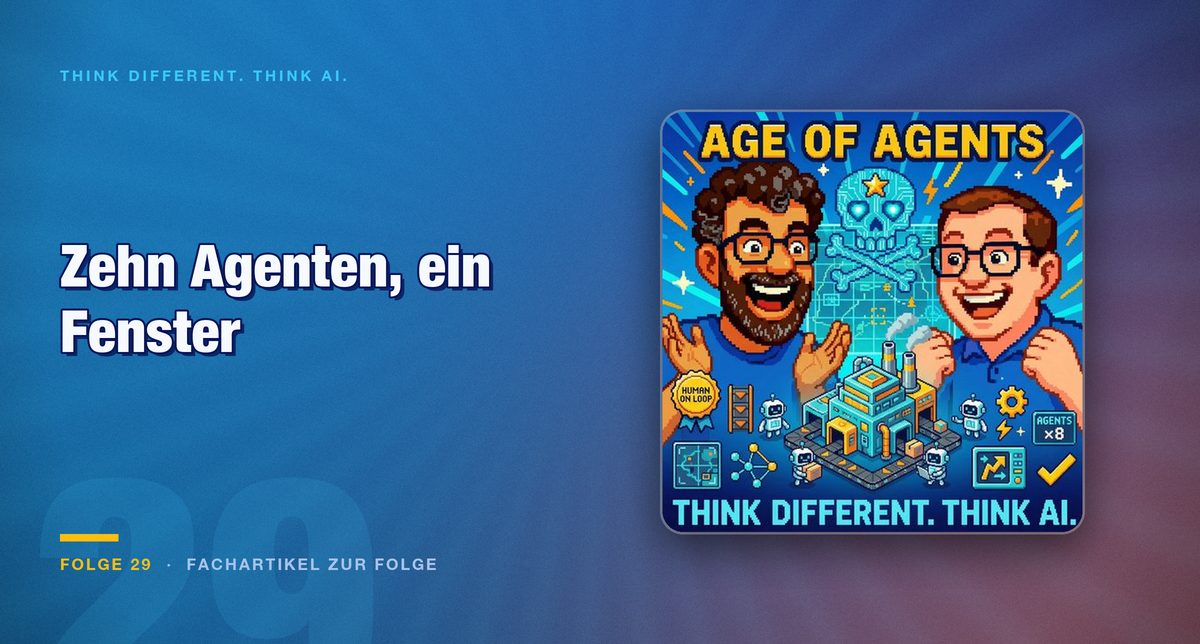
One prompt, one answer: for a conversation with a model that is the right form. For steering several agents working in parallel it is not, as soon as skills, MCP connections, memory files and budget consumption all have to stay in view at the same time.
The episode's title is a bow to Age of Empires, and the analogy carries further than the joke.
Why games can do this better
Factory and economic simulations make thousands of units, supply chains and production lines manageable. They do so with means that barely appear in developer tools: an overview map, status colours, warning symbols at the location of the problem, grouping of similar units, and the possibility of switching between overview and detail without giving up one for the other.
A terminal window can do none of that. It shows one thing, chronologically, and whoever has ten of them open has ten chronicles and no overview.
First approaches in this direction do exist. Tools such as Agent Craft or the mentioned pixel-agents project present agents as figures in a game world, including safety zones which, through the assignment of permissions, determine where an agent is allowed to walk at all.
The last point is the most interesting one. Presenting permissions spatially makes them verifiable. Nobody reads a permission matrix. A zone a figure cannot walk into is understood by everyone.
Four levels of control
A second focus concerns a sharpening of terms that constantly gets muddled in discussions.
As the number of agents rises, this distinction becomes more important, because the first level simply no longer carries.
Gaming experience as a working skill
With a wink, but not without substance, the thesis is put forward that experience with real-time strategy and World of Warcraft is becoming a sought-after skill. Delegating to many units acting at the same time and supervising them is exactly what strategy players have been training for years.
Viewed soberly, this is about the distribution of attention: recognising where something is going wrong right now without observing everything at once. That is a learnable skill and it is barely contained in classic IT training.
What happened alongside
The news section of the episode contains a remarkable juxtaposition. Anthropic under Dario Amodei turns down a Pentagon contract because mass surveillance and autonomous weapon systems cannot be ruled out. OpenAI signs the same contract shortly afterwards.
Alongside that, a very practical question: how does one move one's AI history between vendors. Via the data export at ChatGPT and a migration prompt at Claude it works in part. That this question comes up at all shows how far everyday work and choice of model have become interwoven by now, and how little scope for switching actually exists.
Conclusion
The episode ends with a sentence that works as a leitmotif: trust remains the real final challenge to the user interface.
The point behind it is precise. Whether we trust a system with many autonomous parts is not decided by control but by comprehensibility. A system that shows its processes traceably will be accepted even when not every step is approved. A system that works opaquely does not become trustworthy even with an approval button, because nobody knows what they are approving.
For your own environment a simple test follows from this. Can you see at a glance how many agents are running, what they are doing and which of them needs attention? If the answer is “I have the windows side by side”, the interface is the bottleneck and not the model.