Episode 62 · Feature article on the episode
Knowledge space instead of chat window: why context decides the quality of an agent
An agent is only as good as the context it is given. Whoever sorts their data before handing it to an AI gains quality and reduces risk.
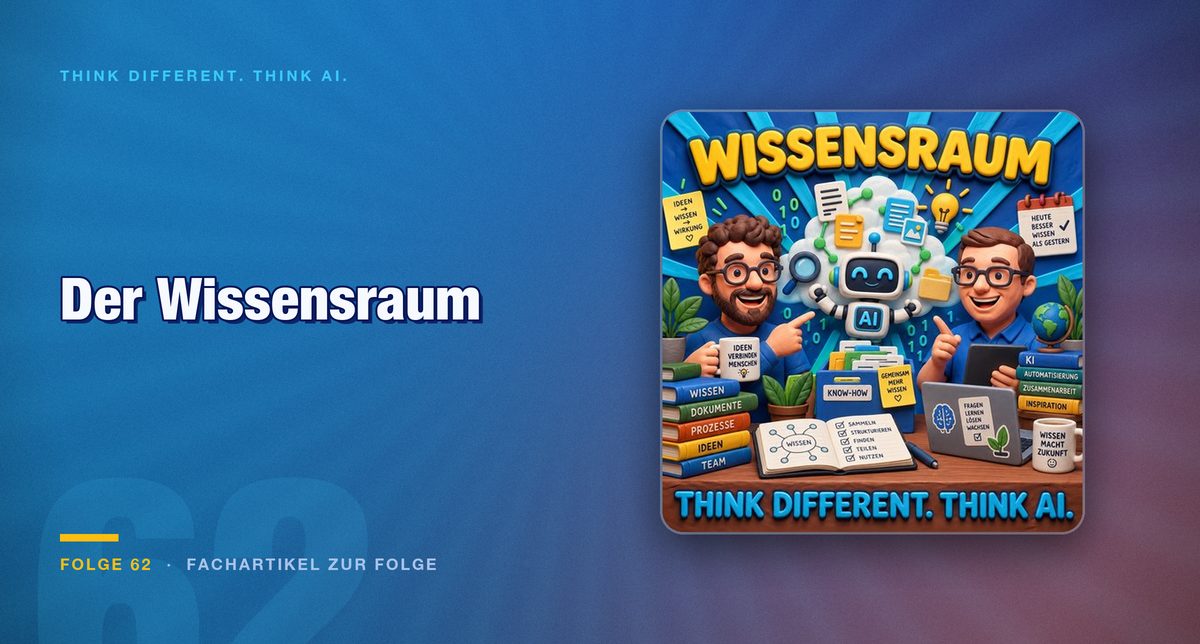
Alexander Heusingfeld is a guest again, this time without Jens. The question the episode revolves around: how do you build a knowledge space in which an AI system can really work? An agent achieves something with the right model and a suitable harness, but above all with the context you give it. With good context, a casually spoken sentence is enough. Without it, even a long prompt helps little.
Data first
Before tools, the episode turns to data. Mark asks whether people realise what happens to their whole life, health data included, when they entrust everything to an assistant such as Meta's Muse. Linked data reveals more than one thinks. Movement patterns from location data show where someone works and where they sleep.
Mark sees the greatest risk in companies, in a new shadow IT. Sentences and documents travel into AI systems whose processing agreements nobody has regulated. His example from private life: anyone who uploads their dog's insurance contract for reading out may, in an unfavourable case, see the passage from someone else's contract, with name and contract number.
From inbox to wiki
The alternative to the memory functions of large apps starts, for Mark, with chaos: a folder called Inbox, containing e-mails, chat messages, presentations and transcripts. A skill converts this into Markdown and builds from it a wiki with a knowledge graph. There is also a file that defines how the system should answer: with a source or without, with internet or without. That is how SkillSafe came about. The knowledge ends up in a directory that works offline and wherever an agent can read skills.
Alexander highlights what many RAG systems cannot do: qualify relationships between nodes. Whether someone is a partner, a child or a colleague, we know in everyday life as a matter of course. A knowledge graph must be able to represent this kind of connection, otherwise it remains a list of facts.
What this brings in daily life
The episode does not stay with theory. Mark packed two matters with a combined 28 GB of user data into one SkillSafe each and let the system look for the differences. He also turned the talks of an Apple developer conference into a skill and sent an agent with it through his own projects in Azure DevOps. The result was a list of what is outdated and where new features are on offer.
Added to this are levels such as organisation, area, team and person, and versioning as one knows it from everyday life, without calling it that. An example from the episode: grandma is not coming on Thursday but on Wednesday, and everyone should have the current state.
Two further building blocks show the direction. ContextMe does not determine knowledge but relevance: once a day it evaluates e-mails, Teams messages and projects and shows what currently occupies Mark, professionally and privately. A second application collects screenshots, breaks them down into text, appointments, links and QR codes with a local model, and only reports what matters.
Working together in the knowledge space
The last block concerns collaboration. A workshop in which knowledge stays alive rather than frozen must answer questions that a single skill does not have: does only the new information apply, or the old too? Who checks that everything is still consistent? What happens when two agents write at the same time?
Alexander uses such a workshop with colleagues via a shared folder. From imported meeting transcripts it found contradictory decisions, demanded coordination, created a template for decision records and brought tasks over from Jira. Much of this had not been built in that way.
Conclusion
The difference between a useful agent and a disappointing one rarely lies in the model. It lies in the context, in maintenance, and in the question of whom you entrust which data to. A knowledge space starts small: a folder, a filing rule, a file with the answer rules. Anyone who takes this seriously protects their data and at the same time makes the agent better.
For getting started, the episode recommends no large projects. Mark tells of an acquaintance who sat for three months over a second brain, while another had a usable result after one weekend. The difference, he says, is experience and the courage to simply begin. Alexander, by his own account an overthinker, advocates a protected framework in which, in the worst case, little happens, and small experiments.