Virtuelle Freunde
Auf Deutsch lesenTopics Modelle und AnbieterKI-Agenten
What it is about
Warum KI ein Gesicht bekommt, und warum Mark dafür ein Essen zahlt
Diesmal sitzen Mark und Jens nicht über Riverside zusammen, sondern in Karlsruhe am selben Tisch, draußen, mit Burger und Radler. Der Anlass ist eine verlorene Wette. In der vorigen Folge hatte Mark über Metas kleines Gerät für den Schlüsselbund gelacht und versprochen, Jens zum Essen einzuladen, falls darüber bis Weihnachten noch jemand redet. Es hat keine zwei Wochen gedauert.
Jens erklärt, was Metas Assistent Muse heute schon kann, auch wenn er bisher nur in den USA und in Kanada verfügbar ist. Muse bekommt eine eigene E-Mail-Adresse und ist auch über WhatsApp erreichbar. Man schickt ihm also Dinge so, wie man sie Freunden schickt, über die normale Teilen-Funktion. Er läuft in der Cloud weiter, wenn der Rechner aus ist, und bringt zum Start rund 1.500 Integrationen mit, Expedia etwa, sodass er auch eine Reise buchen kann. Jens hält es für einen geschickten Zug, die KI aus der Welt der Modellnummern zu holen. Während man bei anderen Anbietern ständig über Versionen redet, bleibt Muse einfach Muse, und die Modelle dahinter dürfen wechseln.
Mark rudert an einer Stelle zurück. Den spielerischen Teil findet er weiter albern, die Personifizierung aber nicht. Ein System, das auf Sprache ausgelegt ist statt auf ein Textfeld, verhält sich anders. Das kennt er aus dem eigenen Harness in der Firma: Wer per Sprache arbeitet, bekommt keine Tabellen vorgelesen. Dazu kommt der Fingerabdrucksensor am Gerät, der Käufe bestätigen kann und die Aufnahme erst startet, wenn man ihn berührt. Jens findet das geschickter gelöst als bei Geräten, die versehentlich mithören.
Dann wird es verspielt. Füttern heißt beim Tamagotchi von heute vermutlich Abo, und ein Begleiter, der um Aufmerksamkeit kämpft, wird jammern, wenn man ihn liegen lässt. Was passiert, wenn zwei dieser Figuren mit eigener Persönlichkeit nebeneinander liegen? Mark sieht schon die Szene wie aus Toy Story: der Piraten-Muse, der den Feen-Muse über ein Lineal auf die Planke schickt. Jens beobachtet in seinen Feeds, wie viele Leute gerade eigene kleine Geräte mit Avataren bauen. Für ihn ist die Wette damit dreifach gewonnen.
Der zweite Teil gilt OpenAIs Dots, kleinen Figuren, die auf dem Rechner leben und für einzelne Aufgaben entstehen, für eine Fehlermeldung, eine Mail, eine Excel-Datei. Mark erzählt von einer Vorführung am selben Morgen, bei der ein kleiner Avatar während einer Präsentation auf die Folie zeigte, über die gerade gesprochen wurde. Viele kleine Agenten auf dem Bildschirm hält er weiter für einen Fehler, ein orchestrierender Agent sei besser. Die zeigende, unterstützende Funktion aber sei echte Hilfe und keine Spielerei.
Jens ordnet das historisch ein. Der Personal Computer war schon der persönliche Zugang zu den großen Rechnern, und die Science-Fiction hatte ihre Assistenten längst: Bit aus Tron, der nur Ja und Nein sagen konnte, Professor Simon bei Captain Future, die Sprachsteuerung bei Star Trek, Data. Und Karl Klammer. Die Idee dahinter sei gut gewesen, nur die Umsetzung nicht. Marks Frage dazu: Wenn auf das komplizierte Word früher Karl Klammer die Antwort war, sind es heute Muse und Dots?
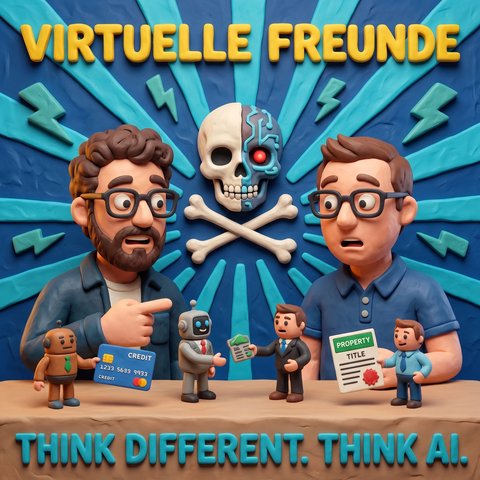
Gutes Design lässt die Technik verschwinden, sagt Jens. Ob Text, Sprache oder eine Darstellung gerade passt, soll die KI entscheiden, und der Avatar hat die Chance, zum Hüter dieser Schicht zu werden, egal ob am Telefon, am Rechner oder vor einem großen Display. Mark hält dagegen, dass all das Tokens verbrennt, und fragt, ob Tokens am Ende eine Grundversorgung werden wie Strom, Gas und Wasser. Jens glaubt, dass Avatare erst einmal mehr Verbrauch bringen, weil sie mehr Menschen einen bequemeren Zugang zur KI geben, und dass Kosten und Verbrauch danach über lokale und schnellere Modelle sinken. Am Ende steht sein Bild vom virtuellen Freund, der recherchiert, bestellt, Entscheidungen vorbereitet und die Post vom Anwalt liest. Mark ergänzt die dunklere Fassung gleich mit.
Zum Schluss stellt Mark fest, dass sie sich am selben Tisch weniger ins Wort gefallen sind als sonst. Er schiebt es auf Jens' Statur.
Transcript
00:00:00Welcome to Think Different. Think AI., the podcast by Mark and Jens.
00:00:07Two technology-loving minds who do not just talk about artificial intelligence, they live it.
00:00:14Here you get clear classifications, real practical insights and a fresh look at what is possible.
00:00:20Understandable, critical and always with a wink.
00:00:24AI to think about, to smile about and above all to join in on.
00:00:29A warm welcome to Think Different. Think AI. Today Jens and I see each other in person again.
00:00:41I do not know how much beer you have. I know that I have the second shandy. Jens, nice that you are here.
00:00:45Nice that I am allowed in here, Mark. I hope
00:00:49you could hear that. Yes, of course, we have just clinked glasses. In, may we say that? Yes,
00:00:53we are in picturesque Karlsruhe. Oh, I thought you wanted to say
00:00:56that we are sitting in the garden, and whether we may do that as advertising. There
00:01:00are certainly other tasty burger places too,
00:01:02which we do not dispute in any way.
00:01:05Today we want to talk about
00:01:07how AI will probably change our lives in future.
00:01:11And apart from the fact that we met here today,
00:01:14so that I can invite the esteemed Jens to dinner, as we promised.
00:01:18Oh, I did not know that yet.
00:01:20I see.
00:01:21Because he got me out of the box a bit with Muse.
00:01:27Shall we talk today about Muse and about Dots
00:01:30? Nice, right? Although that one wants to wait three months, and only then do I win the dinner,
00:01:37it is no longer two weeks now, and I get to pay for the dinner already. Because whoever did not hear the
00:01:45earlier episode, I wrung out of the dear Mark, with some reluctance on his part,
00:01:51that at the end of the episode I briefly mention the news, which the dear Mark Zuckerberg announced
00:01:57I do not know exactly where he also presented a rather cool new
00:02:05VR headset, one has to say, honestly that is a hot topic.
00:02:08So, if the thing really comes to the shops with the specifications, hats off.
00:02:13But when we talked back then, it was that he has the news, that is the virtual character,
00:02:21the Facebook Meta thing, which has been announced a little while ago and
00:02:25which already exists: an agent that runs for you in the cloud, and in the cloud
00:02:30too, without you needing your computer on, without you needing your ChatGPT or
00:02:34anything else open, can carry on doing things for you in the cloud,
00:02:38personalised, in that you get a small mannequin, a small animated mannequin
00:02:43on top of that.
00:02:44There are thousands of versions of it too, because they can all naturally be
00:02:46rendered, with different voices and so on, and what else they announced
00:02:50has effectively been put onto a small gadget, and that is what I told you about.
00:02:54And that is a bit of Tamagotchi style. And Mark's hair stood on end straight away,
00:02:58so to speak. Hmm, he said, along the lines of, if we still talk about it at Christmas,
00:03:04I will invite you to dinner. And then this episode came along, and you
00:03:09offered in the episode that they had announced it for Christmas. So that is
00:03:12more or less a self-fulfilling prophecy, because I had not seen the original report.
00:03:16I was already lying under the table laughing at the presentation of the photo. But we can
00:03:21talk about that in a moment, and in the same breath talk about the other little helpers,
00:03:25which come in the form of small ones; I recently used the word sprites,
00:03:30and older ones among us know that, what does that still mean today, sprites?
00:03:34Sprites, yes, or yes, so one could say sprites, but I would say avatars,
00:03:37I think, the vertrümelett so to speak, right?
00:03:39Mm, avatars. By that we do not mean big blue people, but never mind. Keep to that,
00:03:46because we have already been made happy by OpenAI.
00:03:50Let us start now with this little helper that I made fun of,
00:03:53because during the preparation,
00:03:56between when we met here,
00:04:00we met here with beer and food,
00:04:03and in the recording now you have already given us a taste of it.
00:04:06What could a Muse possibly take over for me in future?
00:04:10What comes to mind for you?
00:04:12So we can talk a bit about what has been announced.
00:04:15It is not available in Germany either. At the moment it is only accessible in America and
00:04:19Canada. Accordingly one can for now only report from the description and from what
00:04:25one sees. What it can do is, it will have its own e-mail address, for example, which is quite
00:04:30practical. I often had the topic that I want to send something to my AI.
00:04:34If I overlook something, I take a screenshot of something and have to put it
00:04:37into ChatGPT or into Claude or wherever. Now the thing has its own
00:04:41e-mail address, so you can already address it in a standard way.
00:04:44That means, WhatsApp has it too, so across all these channels you
00:04:48can simply address it.
00:04:49That means, when I share something, in the normal way I share something
00:04:54with my friends, in every app, you know that yourselves, in the browser, you have
00:04:57the share function and can do that quite normally, in the app or by mail, now in future
00:05:02send it to your Muse friend.
00:05:03Whoever wanted to, I find that cool, that is great for now.
00:05:06Then at some point you visit someone, and there are about 40 of these things in the cupboard,
00:05:10and then he says, I have a family celebration here.
00:05:12For example, that could be.
00:05:14That is another topic.
00:05:16We might come back to that later.
00:05:18What these things can perhaps still do with one another.
00:05:20But it is quite practical in the first place.
00:05:22Basically a kind of virtual machine runs as well.
00:05:24That means it is essentially always reachable.
00:05:26Reachable, it has an internet connection of its own in principle.
00:05:28From the start, I think, somehow ...
00:05:30But it has no e-SIM or anything like that,
00:05:32instead it takes what it needs from the phone or from ...
00:05:34I do not know that either.
00:05:36Just like how the WhatsApp number works.
00:05:38can be the fuzzy zone. Or the, what is it called, how did I put it, when we get
00:05:46mixed up? The fluff corner? We rarely get tangled up, yes. I do not even know
00:05:50why that always happens. I think we still get tangled up on purpose,
00:05:52because this fluff corner you have sort of endangered could only be used. But joking aside. It has
00:05:58from the start, I think, somehow 1,500 integrations from various providers.
00:06:03Among them, somehow Warmind, Best Buy, Gap, Hass, I did not see that, Expedia. So
00:06:07the thing can also directly access things, I want to book my trip, it can do that for
00:06:13you. That means it is in principle really a kind of thing, which, as I was told earlier,
00:06:17AI is changing the world again. He has also
00:06:22often already talked to me about AI becoming a kind of personal assistant.
00:06:25I think that was a clever move by Zuckerberg and the Meta people,
00:06:29to say, yes, let us personify it a bit more now and take it out of this
00:06:34model world. Because with the other providers you keep talking all the time about just
00:06:39whether this is model 5.5? Sol, Hass, not? Or is it already 5.6? Or is it already Astra?
00:06:45Or Hass, not? Or Sol? Or Fable? Or Muse? Now it is Muse. Muse will probably
00:06:51stay Muse forever. My point of contact, the models behind it will probably
00:06:55be different. But I no longer have to worry about these models,
00:06:58because one has to, it should then be left to it, you know, that is a bit, it is closer
00:07:03to consumers now, what has been done here.
00:07:05In the last episode we talked about it, and I would very much like to talk about it again,
00:07:09so if you hear background noise, we are sitting out here nicely, perhaps
00:07:14so cold today.
00:07:15Yes, that is a nice half-time.
00:07:17We talked about the complexity of the choice when I want to
00:07:21do something.
00:07:22Ultra-ultra code and Max and Opus and version numbers and planet names and goodness knows
00:07:31what else, and there is of course a little box that I can put in my trouser pocket, hang
00:07:37on my neck or on a key ring, which takes this complexity off
00:07:41my hands, because it offers me a sweet little older-among-us companion, which will remember us, Tamagotchi-like,
00:07:47and gives me the chance to authenticate with the fingerprint sensor, so that I
00:07:52can say, when I want to buy something, okay, that is it, or when I
00:07:55want to confirm something with anything, that one can also ensure that
00:07:59I am me. We had that topic, right? So I said for the iPhone, you know, we have a
00:08:03fingerprint sensor and could use it for that, to legitimise our
00:08:06actions, but something like that could also be imagined for the user, and in
00:08:11one point I actually have to row back regarding what the playful quirk is,
00:08:14because I think this personification, not the
00:08:20evil, that would be another film, the personification of AI, the alienation of, I have no
00:08:28keyboard field, I have no strange screen where I type text, which bombards me with even more
00:08:33text, but a system designed to interact with
00:08:37speech is quite different.
00:08:39I do know that, we also built such a harness in the
00:08:42company.
00:08:43And when we say we build an interface and the thing answers me in a text window,
00:08:49it behaves differently than when I tell it, hey, I want to interact with you by voice,
00:08:52as when it reads out tables. Yes, if I read out a table, it does not say day,
00:08:56weather, Monday, cloud, Tuesday, rain. Yes, instead it then has to present it
00:09:04to you differently. And from that side, this idea of taking a pure voice interface is
00:09:09good. I would like to take another radler. I will take one too. And yes,
00:09:18we admit, it is not alcohol-free. So, what would you like to say about that?
00:09:22What would I like to say about that? Well, A, that is, through the radler order,
00:09:28quite off my red thread. He digressed before he drank it, that is totally great.
00:09:32Well, of course it is in principle the, when you now imagine these devices,
00:09:41and I have a small one, that is exactly the small point I still had, for you,
00:09:45like this little Tamagotchi-style thing. We have also talked about other ... more often...
00:09:49How can you feed it?
00:09:50I do not know. With Tamagotchi it has to... I do not know. It could be a good idea
00:09:55to feed it, but with Tamagotchi one had to back then...
00:09:57Could they perhaps release an add-on? Feeding means a subscription.
00:10:00That will come. Feeding means subscription. Of course it will somehow show behaviours
00:10:05that we humans then, because it will then also fight for attention again,
00:10:08as at all other points, now of course trying, in principle, to get our attention as well
00:10:12Of course it will then somehow also whine when it has not been used for a long time.
00:10:16He put on the Apple Watch. Now I am quite sad. Important, I just wanted to say something briefly,
00:10:22about the device. We always had a few other devices in there, and we have of course
00:10:25also talked about data protection today. If I now run some kind of plug along
00:10:28to record voice, and accidentally have a device hanging round my neck that is in voice mode and records conversations
00:10:33that perhaps cannot be recorded. With this device it is done a little more cleverly.
00:10:35It has a small fingerprint sensor on it. That means it is only activated when I touch it
00:10:40at the front, the finger-pad. But apparently I can also point it around the
00:10:44place. That means there are probably cameras in it, or whatever. There are, I doubt it,
00:10:49sensors in it. But something is in there, so that one can simply see
00:10:53the surroundings. That is cleverly done already. But it could also become exciting
00:10:56as you just had. What actually happens when small Muses,
00:11:01nameless, that is, when two of them lie next to each other, for example, do they start to talk to each other, we also had that in a very early
00:11:06episode of ours, that we talked about what then actually happens
00:11:11when Kami talks to one of them. We have already had that, you
00:11:15remember one of our first appearances, where the topic...
00:11:19I like that. You know, our podcast is not even two years old, and you say, do you still remember? Yes, but I know you.
00:11:24Yes, there we talked about how AIs then also developed their own language,
00:11:28in order to communicate with each other faster. Yes, those were all laboratory-condition stories, but of course it could be exciting.
00:11:31If then in principle avatars like that develop a certain personality not just by accident,
00:11:36but on purpose, because they should of course behave according to the personality, because they
00:11:41to communicate with each other faster.
00:11:44Yes, those were all laboratory-condition stories, but of course it could be exciting.
00:11:49If then in principle such avatars develop a certain personality not just by accident,
00:11:56but on purpose, because they should of course behave in line with the personality, because
00:11:59as humans we then perhaps get the pirate voice, yes, the pirate voice,
00:12:07get the pirate look, which then leads to my pirate news, your
00:12:16poor fairy news then perhaps somehow gets hijacked or something.
00:12:20Hijacked, that is nice.
00:12:21I am just imagining it, like in Toy Story, where at some point you come into the room
00:12:26and the pirate Muse is sitting on the table and your fairy Muse is somehow standing on a ruler
00:12:31that was pushed across the table as a plank. Imagination, imagination. Yes, well, I think
00:12:37a great deal is possible there. I can see that you come round the corner, and then you hold it up to my face,
00:12:47press the button and then you say, look, that is Mark, and then he says,
00:12:51I am curious about that.
00:12:52So I would like to prophesy now that perhaps we do not have to wait so long
00:12:57until these devices come to Germany, because I do not know whether it is the same for her,
00:13:00but my various social-media profiles, whether that is professional, somehow LinkedIn
00:13:05and co., or X or something else, have already exploded in this direction,
00:13:10that there are very, very many people who are now starting to
00:13:13build such small devices themselves.
00:13:14There is also a repository project, it is called Open Human, where there is
00:13:19exactly this theme, how I make a small, personalised, but not human, that is what it is called,
00:13:24Slush. If not, we will check out a funding check. But I mean, I looked into it this week.
00:13:28You can check right away while you keep talking. I actually already had
00:13:31my cloud look at what is in the repo, how
00:13:35how it fits with my second-brain setup at home. But that is just the same kind of thing,
00:13:39where a small avatar can then talk to you. I had dozens of reports this week in my feeds that
00:13:43went past me, from people who have already built small handhelds, or even smaller devices,
00:13:48with small avatars living on them, that can talk to you, which is something else. Accordingly,
00:13:53I think something has now been set in motion. And the reaction in these feeds alone shows
00:13:58that I would have won this bet three times. You are only being invited today. I want to tell you
00:14:05that in front of witnesses. Whether you order another radler is another topic, but you are only being invited today. We can gladly come back to Muse in a moment,
00:14:09but I think the Dots go together quite well. Before the Dots come,
00:14:14maybe one more small funny anecdote as a transition. I had contact with someone this
00:14:19morning, and I was allowed to look at a small avatar on the screen.
00:14:25And the avatar lives on the screen and only has a kind of tech-study, and its task is to
00:14:32react to what the user says. And the demonstration went like this:
00:14:37the person gave a presentation, and then the slides ran across the screen, and there was the whole,
00:14:43this little avatar. And about what he was talking about, the avatar went over there
00:14:50and pointed with its little symbolic fingers at what was being talked about. And
00:14:56because the avatar knew, in essence, what was happening in the PowerPoint, and knew
00:15:01what was being said, it really could, let us say, it was really like
00:15:08support, and one could get a bit of a feeling that these
00:15:13things, honestly, oh how cute and sweet, and you can teach emotions,
00:15:21big eyes, smiling, movements, who does not know that, the last one clears up the earth,
00:15:26Volley, so these are certainly things that can be attributed to these things,
00:15:30that they bring emotions, can convey, can convey,
00:15:35sorry, or simulate, it does not matter. And it was nice to watch,
00:15:39that they bring emotions, can convey, can convey,
00:15:42sorry, or simulate, it does not matter. And it was nice to watch
00:15:46how the thing supports its presentation. And if you think on, we now come to
00:15:51these Dots that OpenAI introduced, so avatars that live in your computer, that spawn for certain topics,
00:15:55that can come into being, to, I do not know,
00:16:00process error messages, process e-mails, process Excel files,
00:16:07I do not know, to react to whatever events. But these are then symbolised
00:16:12by small pictograms, small symbols, small 3D figures that live in the screen. And that is
00:16:18another ballgame again, compared with not so long ago, when avatars
00:16:25still had to have a face, a torso and full facial expressions, where I also
00:16:30said today in the preparation, either it is so realistic that you no longer know whether it is art or real, or it is
00:16:35so digital that you think again, okay, neither fish nor fowl.
00:16:39And there I find these small avatars that live on the screen and show that
00:16:46exciting. And hopefully you have already looked up what you wanted to check.
00:16:51But before that I wanted to make the point, as if more... presented that,
00:16:56I thought they were making a mistake.
00:17:01I still believe that.
00:17:03But perhaps my assumption of error is just as silly as the one about News.
00:17:04Because I believe that spawning many small agents is simply stupid.
00:17:07Many small agents I find somehow stupid.
00:17:11I think, somehow, an agent that orchestrates and sports many other agents
00:17:13I find much better, because it can interact with me.
00:17:17I do not need so many insights living in my screen.
00:17:19Yes, I have a simple monitor, there I still need 40,000 very different
00:17:22Yes, I have a simple monitor, there I still need 40,000 very different
00:17:28small pictograms that drift across the screen somehow.
00:17:30And what I actually wanted to get at is, I found it totally great to see
00:17:37what it is like when these pictograms run across the screens, and that they
00:17:40also have this supporting function.
00:17:42That is a pointing function, this function.
00:17:45It is not just a gimmick, because they are pictograms, but it is real help.
00:17:49Yes, and that is, let us say, if we now look back into the past
00:17:57and at what, in principle, if we look, the computer, that is, the personal computer,
00:18:04which was my personal computer, in order to access the large mainframe of the
00:18:09internet or whatever, the idea was back then, the mainframes in companies.
00:18:13That means we have always tried to build a very personal access
00:18:23to the large, wide information values out there, in order to process data, to make something from the data,
00:18:29to collect information, to build something new with the information, to build products.
00:18:33To build products.
00:18:34Today they say, coding, always to form something different or to play, even as a sager.
00:18:38That means this urge has always been there, to personalise things further in this way.
00:18:43If you look at the science-fiction series, how long there has in principle been, in quotation marks,
00:18:48one or other that always had AI assistants. I remember the lovely little
00:18:53Bit in Tron, who flew around there, who could only say yes and no, or something like that.
00:18:59Yes. Yes. Yes. Exactly. Could only say yes? No. And then we also had, who else did we have?
00:19:07Oh yes, with Captain Future. The flying brain.
00:19:11Hello, you cannot compare him with that now. Simon, Professor Simon.
00:19:17Yes, right.
00:19:18Craig and ...
00:19:19Yes, the other characters too, but in principle that flying brain was of course nothing else,
00:19:24even though he was a human, who then somehow had the brain put in and such.
00:19:27But of course he was in principle the AI assistant of that series,
00:19:32who however was not tied into a normal screen, he was not inside a screen.
00:19:36I did not have to go to him, he could fly,
00:19:40accompany, there was always the Star Trek voice control in the room, and I can talk
00:19:48to him again and again. Even Data was Star Trek, the android, who can walk around the area.
00:19:52Android?
00:19:53Yes, an AI in that moment.
00:19:54Small details, positronic brain and so on.
00:19:56Now we do not want to do that again...
00:19:58Oh now, you have done it, you have done it.
00:20:01Attention, small motion. The Sol model, that is what it used to be called, the speed before the performance warp drive.
00:20:05So in plain German one could now say Open-Eye Sol 8.
00:20:14Back to the seriousness of the legend. There has always been a certain urge in our imagination as well as in technology
00:20:19to make the world around us graspable for us as humans in a certain way.
00:20:35No, more graspable, not more attackable. Attackable people are also interested, but that is another topic.
00:20:41True, that is completely right. So to make it more graspable, so that I can in principle see there,
00:20:45that it is more comprehensible to me what is actually happening, by it, for example,
00:20:49looking a bit sad when I have handled the data wrongly, or things like that.
00:20:55Or when I have not looked at something for a long time. Or as you say, when I now have something,
00:20:59like a small character that lives on my screen, and I want
00:21:03not the paperclip back from Microsoft, but one that in principle then
00:21:07points in some directions to draw my attention.
00:21:10points in some direction to draw my attention.
00:21:14I think that is really the strange feeling, you make Karl Clippy into an early hero
00:21:19who was far ahead of his time.
00:21:22In principle he was. Did Microsoft have any right to this depiction?
00:21:28Otherwise one could do a revival, because now Clippy is clever.
00:21:32Yes, the idea behind it was good, the execution just was not good,
00:21:38but the idea went in exactly the same direction, saying, how can I make this dreary Word,
00:21:46I have to do something.
00:21:47Oh no, of course we may have the word processing program.
00:21:50How can I shape help there, how can I in principle take the things that are hidden
00:21:56behind menus, which the normal data person can of course
00:22:00do well, but which the rest of the population never deals with, those
00:22:05who already have problems tidying things properly into a drawer at home.
00:22:08I have that problem too. I wanted to say that. And that means, if back then
00:22:15Word was so complicated, and Microsoft's answer was no Clippy and Apple's
00:22:19answer was Pages, is now the answer Muse and Dots? For the
00:22:24increasingly complicated world, yes, definitely. But I found, when you said that
00:22:29Muse can order things, the other can do that too, yes. So on that side it is all,
00:22:34let us say, not so far apart from one another. There is now basically nothing special any more,
00:22:39because our chat window can do that too. Right. They have, in quotation marks,
00:22:43done nothing other than lift what I just said, text interaction, to a purely spoken level.
00:22:50That is certainly quite nice, because you can now take it everywhere. I have
00:22:54also again, we are now jumping a bit between Muse and there, but that
00:22:57is probably not so bad. I found the Dots quite nice, for example,
00:23:00you can also call them. And how much of this is marketing or not, is still to be seen.
00:23:06But OpenAI said they do not know why the Dot sometimes takes off immediately and sometimes lets it ring a few times.
00:23:11Along the lines of, it is coming out of the bathroom or something. That makes
00:23:16the matter somehow the boundary between how a machine reacts and how a
00:23:22human reacts. If you use, for example, OpenAI's speech model, because the OpenAI apps
00:23:27are used and the voice app then always says, yes, let me look that up.
00:23:33And then you tell it, yes, while you look it up, tell me more.
00:23:38And then it goes on talking, yes, but let me think.
00:23:41Last time the thing told me, I have to concentrate again, which I thought,
00:23:45I have to concentrate again, of course. Concentrating is just like when you write,
00:23:49oh, that requires manual work, I am starting. So I am very curious about that as well.
00:23:55Yes, but it is a bit like this, I think when something is well designed, when things work well
00:24:04in this world, then it is often the case that the technology behind it
00:24:09has in fact receded further into the background.
00:24:12I no longer have to know how, I do not know, how the dishwasher works
00:24:19or how the water machine works.
00:24:21Great, this morning the dishwasher reported a water-supply fault.
00:24:23Yes, well.
00:24:24solve. A small side note: it gave itself away to my wife. I simply pressed start again,
00:24:29and then oddly it worked. It was no lasting solution, only a temporary help.
00:24:33But normally a good product should in principle be designed so that we no longer really
00:24:37have to see the things in the background. And of course it is the same with technology. We had
00:24:41also already, I think I have mentioned it before, I also no longer knew
00:24:44what a folder structure of pictures on such a phone looks like.
00:24:48For what? And why do you then today still have to know how any
00:24:53software works, how I connect in any case with something, whether I am now in
00:25:00at the right moment better than typing it as text, or speaking it, or moving a slider. All of these
00:25:06things are from my perspective actually completely secondary, and the AI should
00:25:11decide each time for the different application area I am in, what suits me
00:25:16best. Whether text suits, or voice suits, or perhaps a
00:25:21display that explains something better to me in that moment, it can then decide
00:25:25accordingly. And these virtual avatars that we now have take that
00:25:29to the next level. Because in my eyes, they have the chance
00:25:33to become the guardian of this layer. So it no longer matters whether I have
00:25:39my phone with me, whether I sit at the computer, whether I stand in front of a large
00:25:44display, touch display, with several people. My avatar will, I can see, wait there, the
00:25:55avatar. Who was that again? It was in the comedian. I do not know. In any case it will at this
00:26:01point slip into being my interface to this world, and that is of course quite exciting,
00:26:07if I now think in the direction of further things like advertising, but that is fine. Please react gladly.
00:26:12A reaction video, we have spoken about it, one thing occurred to me. As long as we pay
00:26:18for tokens with the providers' models, which are indeed subsidised, and companies like
00:26:23Oh, what was it, six times the speed for eight times the price, or eight times the speed
00:26:28for six times the price, we agree on very fast. Burning tokens to come to
00:26:35solutions is all of what we describe here. Namely, we adapt
00:26:40what we say. We derive actions from that that are more or less complicated.
00:26:45By that calculation we simply say that the amount of tokens we burn in
00:26:52the shortest time produces the solution. The token is in effect the interface. If you
00:26:57used to do refactoring to make things more efficient, meaning refactoring in
00:27:02software, so that the software becomes smaller and faster, better with the errors
00:27:05the user makes with it. The errors always happen in front of the screen.
00:27:09It is clear, that was a little joke, I hope you heard it. We are solving the problem right now
00:27:15that we say, look, model A could not do that, let us go to model B and raise
00:27:19the thinking rate, because more tokens means more help, lots of help, to have a lot is better than
00:27:26needing it. But that is also something we perhaps should look at in the long term. What does it mean when everyone starts to fiddle around with avatars
00:27:30that look at the screen. We both also recorded the Jev episode, where it is not about
00:27:35speech into analysis, analysis into speech, and suddenly everything takes longer and needs tokens and needs money,
00:27:40while Jev just goes click, click, click, click, while the LLM models
00:27:46search their brains out for what they all see on the screen. Now you also get cameras and speech on top, and ideally they also switch,
00:27:51ideally in future between my devices, and the avatar is always wherever I am.
00:27:56I recently told the story in the episode about how my avatar, my ancient one, with the help of the lute
00:28:01for example follows me around the flat, that will be a hot number still, when
00:28:08I think that tokens are the currency we then depend on, that it
00:28:13works.
00:28:17So we are back at the topic, are tokens in effect something like a basic utility?
00:28:18Yes.
00:28:21So electricity, gas, water.
00:28:22Yes, although here I always have to say again,
00:28:23we are right now at the beginning.
00:28:29So, even though we are already in the second year of our podcast, it is still
00:28:31the case that I say the end of the development, also as far as token costs and token use go,
00:28:36where we only recently talked with Jev about the fact that perhaps
00:28:43many things that people still answered with the Eleven until today, something
00:28:46something silly like, is it green or red, can simply be done by other models that are simply
00:28:49better at quick classification, so that we can then do it, because we save a
00:28:54massive amount of tokens. And that will of course go on.
00:28:58save a massive amount of tokens. And that will of course go on.
00:29:01And we have often talked about the topic of local models versus cloud models
00:29:06and so on. I think I would not put these avatars into this token-cost corner at all, but simply say, this is a new virtual
00:29:12layer that forms a new access layer for, I think, even more people in future
00:29:17with the topic of AI. That will most likely even need more tokens at first,
00:29:25unfortunately, and more is produced. And even more tokens. At the weekend I shot almost
00:29:303,000 euros of tokens through the mill, because OpenAI did not only announce the Dots,
00:29:36but also said there is a new subscription model, namely this 500 model,
00:29:41where you get more or less the same performance as with today's 200 model, only
00:29:44you get the option to additionally increase the speed of billing.
00:29:49So not only the billing of the tokens, but also the implementation.
00:29:52And in the same breath they gave all users 200,000 euro of tokens.
00:29:55So dollars.
00:30:00I convert it, though, to mine and mine.
00:30:01That motivated me to start a few app projects and...
00:30:02Now you are not the normal man.
00:30:06I am talking about the broad consumer.
00:30:08You do not simply keep me normal.
00:30:10Do you want to burn me, or what?
00:30:11Yes, maybe a little.
00:30:12I think they will of course make sure that even more tokens get used at first,
00:30:13because they will offer even more, more pleasant access to AI. The avatars that we
00:30:20see right now, because the chat window is there first, you have to understand that. You have to
00:30:27be clear about whether I have held the chat with one AI, whether that is a chat window
00:30:32EOF
00:30:37connected with the other one. These are all things that are always again mental
00:30:41models that you first have to build up in order to understand them. Is it in code now?
00:30:44Did I set up a project for that? Do I actually have a skill? Have I got the connection
00:30:48It is going more and more into the past, in the feedback loops. At home I have more and more to do with my Hermes agent, and there I build the skills myself.
00:30:57That is again something like a bridge technology.
00:31:00Is that so. And as a human I actually do not want to deal with it any more at all.
00:31:04And I think I would first, as I said, the Sabatare, so I think first of all, tokens will hopefully become fewer, the token costs, something like that.
00:31:13And the total economic costs of looking at that now too, so also the environment and everything.
00:31:17All of that. That will become less. It will become much more efficient through local models,
00:31:25other layers, smart models, smart classifications. And not in principle that it
00:31:30is shifted onto the human, but that an AI layer in between can do that.
00:31:33This AI layer in between, which will make that decision, can in many use cases,
00:31:38whether it will come into professional use cases, we will leave that aside for now,
00:31:41but in many cases it will most likely increasingly become a kind of virtual
00:31:46friend who does the research for you, carries out the order for you, makes decisions for you, prepares, reads your letters in order to
00:31:52answer the lawyer, whatever.
00:31:58I like that.
00:31:59You know what you are describing, one could say that is totally great, one
00:32:00could also say, you got divorced because of the lawyer, the lawyer reads
00:32:04his divorce documents, and half a year later he tells you,
00:32:10is it not, you are just fat. Well, so from that side a fine new world, we are looking
00:32:14forward to it. We are totally enthusiastic. You know what I found totally great? We sat here, apart from the fact that it
00:32:19does not cost money, I find it totally great that we sat opposite each other, without an avatar, but with
00:32:25our microphone. You probably heard the odd background noise, but you
00:32:30our microphone. You probably heard the odd background noise, but you
00:32:35probably also noticed that we interrupted each other less, because I simply
00:32:39am afraid. Jens is totally the bear. You know, I always sit in front of the one
00:32:43who is very well trained. Yes, well trained. And just when he looks at you, pure
00:32:46eagle energy speaks to you. So, at that point. Oh, Jens, I think we do not need
00:32:53an hour today. Let us do it. I would say that was a good opener. It will
00:32:58certainly be a few things in the next few days with Dots and Muse and whatever. As I can admit now, after I have also
00:33:02settled my bet. Let us see whether I can someday get in touch with a revenge question topic.
00:33:07If you enjoyed the episode, leave a thumbs up and a like. Look at
00:33:11our landing page. You look at our show notes, you look at our WhatsApp channel.
00:33:16And yes, we would be glad if you stayed loyal listeners, and inspired further people
00:33:21to join. We were recently in the iTunes podcast chart, at place 19,
00:33:28but only very briefly. But at least we were there, from that side.
00:33:32Stay tuned. And until next time.
00:33:41Until next time. A cheerful news to you all. Ciao.
00:33:44Why could?
00:33:45Welcome to Think Different. Think AI., the podcast by Mark and Jens. Two
00:33:55technology-loving minds who do not just talk about artificial intelligence,
00:34:00but they live it. Here you get clear classifications, real practical insights and
00:34:05a fresh look at what is possible. Understandable, critical and
00:34:10always with a wink. AI to think about, to smile about and above all
00:34:15to join in on.