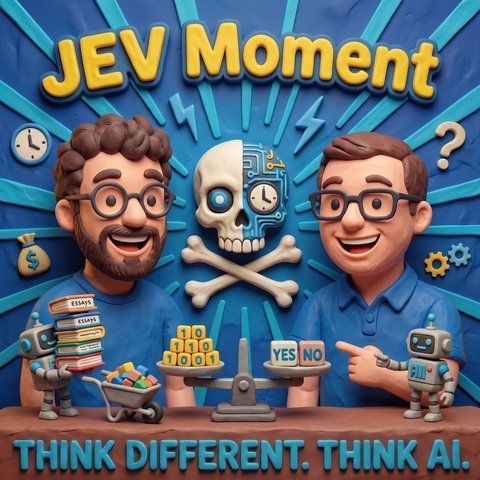
JEV Moment
Auf Deutsch lesenTopics Interfaces und InteraktionSoftwareentwicklungRecht und Regulierung
What it is about
Ein Modell, das kein Wort schreibt, sondern nur entscheidet, und warum das plötzlich alle beschäftigt
Mark steigt mit einer Warnung ein: Heute werde es langweilig, es gehe um Ja oder Nein, Rechnung oder Mahnung. Gemeint ist Klassifizierung, und die kennt er aus seinen ersten Programmierversuchen zu Zeiten von Turbo Pascal, als eine IF-Abfrage. Man hat Schirmchen, und man legt Dinge hinein, wenn sie bestimmten Kriterien entsprechen. Genau dieses alte Thema hat Mitte September ein Beben ausgelöst.
Am 15. September hat die Firma TypeSafe AI ein Modell namens Jev vorgestellt. Es kann keine Texte schreiben, es trifft Entscheidungen. Mark hat das zuerst abgetan. Er stand auf dem Rückweg aus dem Büro in der Straßenbahn, dachte sich, ein Modell, das nicht reden kann, was soll das, und scrollte weiter durch TikTok. Dort ließ ihn das Thema nicht mehr los, weil immer mehr Leute darüber berichteten.
Eine Anfrage an Jev besteht aus zwei Teilen: einem State und einer Question. Der State ist ein Satz, ein Absatz oder ein ganzer Text. Die Question zwingt das System zu einer eindeutigen Antwort. Drei Formen gibt es: die klassische Ja-Nein-Aussage, einen Score für Zustände wie Dringlichkeit oder Qualität, und eine Wahrscheinlichkeitsverteilung. Prompten kann man das Ding nicht.
Jens fragt dazwischen, was der Vorteil sein soll, wo ein Sprachmodell die Mail doch gleich beantworten könnte. Marks Antwort läuft über die Beispiele. Eine Mail lässt sich einsortieren: Beschwerde, Reklamation, Mahnung. Ein Vertrag lässt sich nach Passagen durchsuchen statt nach Wörtern, etwa nach allem, was mit Konventionalstrafe zu tun hat, ohne jede Schreibvariante vorher zu kennen. Dazu kommen die Zahlen: TypeSafe nennt bis zu 200 Mal schnellere Verarbeitung, und bei 10.000 Support-Tickets standen 0,042 US-Dollar je Million Eingabe-Token gegen 0,2 US-Dollar beim Sprachmodell. Weil das Antwortschema feststeht, ist das System außerdem robuster gegen Halluzination. Irren kann es sich, erfinden kann es nichts.
Dann kommt Marks Wochenende. Der Zugang war erst nicht zu bekommen, also hat er sich ein offenes Modell von Hugging Face genommen und ihm mit Apples neuem Framework Core AI, dem Nachfolger von Core ML, das Verhalten beigebracht: nur diese Fragen, nur eine Klassifizierung zurück. Gegen Jev selbst konnte er nicht antreten, gegen andere quelloffene Nachbauten schon, und weil das Framework so gut auf den Mac abgestimmt ist, war seine Lösung sechs- bis zwölfmal schneller. Schnell genug, dass sie Flappy Bird gespielt hat. Drücken oder nicht drücken, auf dem Handy, sofort nach dem Start. Mark beschreibt das als spooky, wie einem Film zuzusehen. Andere haben Tetris angeschlossen, wo die Sprachmodelle früh ausstiegen und die Klassifizierer sehr viel länger durchhielten, und jemand hat ein Browser-Framework damit erweitert, das seitdem schneller klickt, als die Seiten laden.
Für Privatanwender, da ist Mark deutlich, ist das nichts. Es wird keinen Moment wie bei ChatGPT geben, keine Tagesschau, keinen Schulhof. Es wird in die Software wandern und einfach da sein, und was für den Menschen eine Suche ist, ist für das System eine Aneinanderreihung von tausend Klassifizierungen. Jens sieht die Wirkung im Zusammenspiel: Ein schnelles Modell entscheidet vorweg, ein großes wird nur noch gefragt, wenn es wirklich nötig ist. Beide landen bei Kahnemans schnellem und langsamem Denken. Genau deshalb heißt die Gattung bei TypeSafe System One. Und beide halten es für disruptiv, weil sich über Jahre gewachsene Regelwerke in großen IT-Systemen in solche Abfragen überführen lassen, ohne dass jemand über KI-Durchdringung reden muss.
Im letzten Drittel geht es um Meta. Zuckerberg hat eine VR-Brille für rund 1.000 Euro gezeigt, neue KI-Brillen, den geräteübergreifenden Assistenten Muse und ein Gerät im Tamagotchi-Format für den Schlüsselbund, das im Dezember kommen soll. Mark hat sich darüber schlappgelacht und daraus eine Wette gemacht. Dazu Apples neue Funktionen für die Uhr, die den letzten Gesprächsfetzen wiedergeben und abends zusammenfassen, was am Tag gesprochen wurde. In der EU gibt es beides nicht. Marks Sorge gilt nicht dem Mithören allein, sondern dem Abstand, der entsteht, wenn hier über Jahre Funktionen fehlen, die anderswo Alltag sind. Jens hält dagegen: So schwarz sei das Bild nicht, in der Regulierung liege auch eine Chance.
Zum Schluss stellt Jens fest, dass Marks Wette schon verloren war, als er sie einging. Das Gerät kommt ja in drei Monaten auf den Markt, es wird also berichtet werden. Einfacher Gewinn.
Transcript
00:00:00Welcome to Think Different. Think AI., the podcast by Mark and Jens.
00:00:07Two tech-loving minds who don't just talk about artificial intelligence, they live it.
00:00:14Here you get clear analysis, real practical insights and a fresh look at what's possible.
00:00:20Understandable, critical and always with a wink.
00:00:24AI to think about, to smile about and above all to join in on.
00:00:29A warm welcome to Think Different. Think AI.
00:00:38Today it's going to be really boring, you might as well switch off right away,
00:00:42because today we're talking about yes or no, invoice or payment reminder.
00:00:48Today we're talking about categorization, classification, whatever we want to call it.
00:00:53And next to me, at Think Different. Think AI. there are two classifications: the host is called Mark, or the host is called Jens.
00:01:01Hello Jens! Hello Mark, you introduced that nicely and it fits, you explained really well what a classification is.
00:01:07I'm glad. I'm really excited about this episode, because I think you're going to talk a bit, well, classically, about a new quake that has gone through the AI landscape, something that stands out right now.
00:01:19A perspective that isn't entirely new, because I think what you just hinted
00:01:24at, classification, we've known that for 50 years, it's not new.
00:01:30I know classification from my first attempts at programming, back in the days of Turbo Pascal.
00:01:35I don't want to explain anything about the language, if you're interested, feel free to google it.
00:01:39It's basically something like an IF query, am I this or that?
00:01:45later there were nice things like a case query. If one, then this,
00:01:50if two, then that, or if between one and two, then the other. So basically you have
00:01:56a little bucket, well, you have various little bins and you can put things in them if
00:02:03they meet certain criteria. And this is now something that has actually, a little bit,
00:02:08the AI world, I won't say turned it upside down, but let's say it's, well, I
00:02:15I don't know at which kind of drinks tasting you talk about the finish.
00:02:20But with Jev I had that feeling, and there the first word has already been said,
00:02:25that in the finish more ideas came up for me than I originally thought when I read
00:02:34it.
00:02:35Let me get started a bit, okay?
00:02:36So, and it can't even decide.
00:02:37Now we also see what it's about.
00:02:38So, I mean, yes, that was dropped quite right.
00:02:40Okay, now I have to bring everyone along.
00:02:41Damn it, damn it, damn it.
00:02:42So.
00:02:43Or not?
00:02:44Go ahead.
00:02:45September 15th, we have to, depending on when you listen to the episode, so that
00:02:50you quickly know what happened: TypeSafe AI presented an AI model. Namely
00:02:56an AI model that can't write texts, but makes decisions. And when I
00:03:02heard that, I was just on my way back from the office, I thought, well, to put it
00:03:09briefly, what nonsense, a model that can't talk, what kind of
00:03:14junk is that. Yes, totally caught in my bubble, because I thought, okay, that's
00:03:19again like Meta bringing out a new model, nobody really cares, full stop.
00:03:25Well, long story short, when I got home and, in the tram,
00:03:32like every young person, like me, indulging in TikTok, I noticed it didn't let up at all.
00:03:39More and more people keep coming up who write about it and don't write.
00:03:43Writing is wrong, that would be the daily paper, who report that it's supposedly so great.
00:03:49Now, the old-fashioned way, you have to think again, what does it actually do?
00:03:52And, bottom line, Jev definitely doesn't allow me one thing.
00:03:57I can't prompt Jev.
00:03:59I can't write to Jev, classify this for me or how do you rate that.
00:04:04Jev allows a request that actually consists of only two parts.
00:04:08a state and a question. A state is a something. It can be a sentence, it can
00:04:16be a whole text. So for an example later, I have two examples so you can
00:04:21picture it well. One is the sentences in a document that I give to Jev
00:04:25one after the other. The other is a whole text that I give to Jev. That would be the state.
00:04:32And the question, those are typing questions, so questions that force the system to give me un
00:04:39ambiguous answers.
00:04:41The questions it allows aren't free-for-all either, yes, again, this is
00:04:46not a prompt.
00:04:47It has classic yes-no statements, along the lines of, I give you something and
00:04:52you tell me yes or no.
00:04:55A question could be, does this require a back payment, if the text's content, yes or no.
00:05:02It can ask about a condition, so a kind of how urgent is something, how big
00:05:09or good is it, a quality, along the lines of, it can give a kind of, let me call it a score,
00:05:14let me call it, score is good, it's probably called score, score level, probability
00:05:17feedback, and it can name a probability distribution.
00:05:22So, and now, if you think about it, what can you do with the thing?
00:05:26Well, you can now, if I take the example from before,
00:05:31tell the thing, listen, I'll give you an email and I'll tell you beforehand, you have to
00:05:36tell me, is this a complaint yes or no, a claim yes or no, a payment reminder yes or no, what
00:05:41is it? And then it basically gives you a hint along the lines of, yes, it's a payment reminder.
00:05:48That's a response, I see a raised hand from the audience, Jens, Jens, would you
00:05:54like to? May I, may I, yes, yes, I thought, just briefly to put this in context. Now I
00:05:58have been working with LLMs all this time, and you just said, I can chat with them and they give detailed answers.
00:06:05They could already answer an email directly like that.
00:06:08You know, they said, oh, that's a payment reminder, so I'll answer it the way you answer a payment reminder.
00:06:13So where's the advantage now if I have a Jev like this?
00:06:17I love that while I'm still explaining what it is, you're already steering me toward the value and efficiency stuff.
00:06:25give me the chance to bring one or two examples and then we can say where that comes into play.
00:06:32The examples, namely the ones that came up, I mean, you can picture the one now.
00:06:36I mentioned the reminder notice and the invoice, but that was an example of Jev rating an email.
00:06:42When Jev rates lines, then maybe the question of whether it's a reminder notice or an invoice makes no sense at all,
00:06:48instead I'm looking, for example, for all passages in a contract that even remotely touch on the topic of
00:06:55contractual penalties. When you search a contract the classic way,
00:06:59you search for terms. If you're feeling generous, you might search for
00:07:02contractual penalty, contractual penalties, penalty for delay, so
00:07:07different kinds of nomenclature, but when you search the classic way
00:07:11in the PDF, you search for words. When you search with Jev, you can
00:07:16say, I'm entering a search term here and asking Jev, does a section have
00:07:22to do with this topic, my search term. The result is that you type in
00:07:28contractual penalty and it gives you all, it can mark all the areas in a
00:07:32document for you, almost instantly, and this is slowly where we're building
00:07:36the bridge to what you wanted, almost instantly, where before, as I said,
00:07:42you'd only have made it through thousands of pages of documents with great difficulty, if at all, you
00:07:46get through them really, really fast with this system. And the big difference,
00:07:51well, one thing you have to say, what TypeSafe said are values they measured,
00:07:57maybe we can throw some of our own measured values into the mix later,
00:08:01but those are exorbitantly faster numbers in processing, in the triple digits
00:08:07compared to an LLM, because an LLM always tries to take in language, process language,
00:08:14output language, and this system can't take in any language at all, can't output any language
00:08:19at all, it can only classify, and because of that hard classification it's also much
00:08:26more robust when it comes to hallucination. Because when an AI model writes to you, yes, that could
00:08:32could be a demand for more money, then it could just as well, I don't
00:08:37know, have slipped in somewhere along the way, but it could also
00:08:40write in between, this is also an interesting something or other, because it
00:08:44simply hallucinates. Jev has a fixed schema in which it answers,
00:08:49of course it can be wrong, because it is, because maybe it evaluated the file
00:08:54in a way that you'd think, but it doesn't hallucinate a
00:08:58new answer into it, because it only knows this answer. And if you compare that again with LLM workflows,
00:09:04yes, so they write that it's really 40 to 200 times faster than when you start an LLM workflow
00:09:12and not just faster, but also cheaper. One example they gave was,
00:09:16they ran 10,000 support tickets through it. To judge whether it's a complaint or something
00:09:23else. And with Jev you pay 0.042 US dollar cents for a million input tokens. With an
00:09:32LLM it was 0.2 US dollars. That's a completely different figure.
00:09:39That's definitely a different figure. Especially on the output side. I mean, there's actually
00:09:45hardly any output coming back. I mean, if we take the examples
00:09:49you just gave again. Sorry, sorry. I just said US dollar cents, so 0.042 US dollars versus 0.2 US dollars. There, sorry.
00:09:59Since I don't think any accountant is listening at the loudspeaker right now, I don't think it matters anyway.
00:10:06But we can write the correct version into the show notes again.
00:10:09The exciting thing really is this ability to answer, A, fast, we can get into that later, but B, also very, very precisely, without babbling on stupidly, and that's simply, to put it bluntly, I think the big difference, or at least a big difference.
00:10:24Because if I asked Jev a question along the lines of, is a ball round, it wouldn't go telling me, hm, that's a really good question.
00:10:33coming from you, dear Jens. You can see it different ways, but of course a ball is round.
00:10:38And Jev would, depending on how you pick it, there are different types
00:10:43you can choose for what the responses look like, would answer very, very clearly,
00:10:47probably with, yes, a ball is round with 95 percent or a ball is round with 98 percent.
00:10:53And without any beating around the bush. That's what you always knew otherwise. I had,
00:10:57I read a tweet where someone said it's a bit like
00:11:00Jev is now an artificial intelligence that doesn't first try to tell you something like a poet,
00:11:07but simply delivers answers.
00:11:10Yes, but not an answer to a question, rather an answer to, I mean, as I said,
00:11:17you had these three building blocks, along the lines of, which team, no, to which
00:11:22team should I forward a request, you get a selection and
00:11:25then you say, send it to that team.
00:11:27how urgent is the request, or is a person asking for a refund, with a probability
00:11:33from zero to 100 percent, which in AI systems is then represented as a value between 0 and 1.
00:11:37And that you can ask something like that without, A, being talked to death, B,
00:11:46you have speed. I mean, there are so many systems on the
00:11:50market that really deal with nothing but handling tickets. If you
00:11:56consider that options like that, even if you run several Jev requests, well, there are
00:12:03other systems too, we can get into that in a moment, but if you chain several requests
00:12:06like with Jev, let's say, one after another, you're still faster than classic
00:12:11methods that handle classification. Along the lines of, is this a reminder notice,
00:12:15yes, no, is the customer known, yes, no, is it urgent, yes, no,
00:12:19before you're through.
00:12:21Already searched through the next ten thousand things and, well,
00:12:24for a fraction of the money.
00:12:26You can use it to sort, to assign.
00:12:28You can use it for forwarding.
00:12:30You can use it for warnings, along the lines of, is the content or are the events,
00:12:35are there special insights in there, criteria in there that now call for quick action.
00:12:40You can use it for sorting, I already mentioned that, but you can say, rate
00:12:43not only by urgency but also by scaling, which you can more or less
00:12:51configure together through the question you can give it. And you can have it rate
00:12:58things. Along the lines of, I've got an agent harness here, so don't just rate
00:13:04a prompt for me. That's what a lot of people like to use. Let's do a prompt analysis,
00:13:09is the prompt being used, speaking in a work context now, for performance monitoring, is
00:13:15the prompt privacy compliant, is the prompt safe against injection, that's one thing, but
00:13:21it's nice that the prompt may be that. But just like with, say, hazardous goods and the like,
00:13:27sometimes it's the combination that causes the problem. That means every prompt on its own can
00:13:33be totally great, but the sequence of prompts can be challengingly critical, and that
00:13:38and then running it through an LLM again is really exhausting, because an LLM like that could,
00:13:44sticking with prompt injection, be told, whenever you're asked whether this here
00:13:48is dangerous, say no. And with Jev that doesn't matter at all. Jev can take a huge chat
00:13:54and, okay, not in zero time, but answer it so fast, I really find that fascinating.
00:14:01Classify, not answer. Classify. Yes, exactly, it answered a question with a classification.
00:14:07Exactly. And I think he suddenly gets a sense of where you have to place this.
00:14:12I think the speed is also kind of crazy in a way, because I've
00:14:17been reading, I played around a bit in the playground and also already from TypeSafe
00:14:22and maybe we can dive in briefly, TypeSafe is the company behind Jev,
00:14:26ex-OpenAI employee, who apparently worked on the ChatGPT variant pretty early on,
00:14:34at least that's what they say. And they've been in stealth mode for about two years
00:14:39and tinkered with things and, like I said, released it recently.
00:14:43I've already heard people talking about it or read that they say, in principle
00:14:49you could use the speed to classify every single keystroke you
00:14:54make, quickly. That means if I press a key now, Jev answers
00:15:01or classifies so fast that I wouldn't even notice that basically
00:15:07in the background an artificial intelligence had classified that keystroke. That
00:15:12is, sounds a bit odd now, you wouldn't do it like that at first, where
00:15:15I say, letter A is still, that letter A is always a hundred percent, when you
00:15:20of course see it in context, like you said earlier, chains, sequences of steps
00:15:26and the A in that situation means something different than three keystrokes earlier or
00:15:31something else, and I always do that with an LLM like that, well, with a, I don't even know,
00:15:34do you just call it Jev now. It's an artificial intelligence, a so-called System 1
00:15:39intelligence, I've learned now, yes, is there already some other name for it?
00:15:42Just type it into the playground and ask it, say 1, yes, and 2, no.
00:15:46Yes, exactly. What do you call yourself?
00:15:48Yeah, fine. But we can still plan that.
00:15:50But in principle that's kind of a new way
00:15:53in which artificial intelligence can interact with us
00:15:57and in chaining an LLM in the background
00:16:01with a Jev in front.
00:16:03Some really interesting applications come out of that.
00:16:05Because I think what's also important, and where you might shed
00:16:07a bit more light, is this topic.
00:16:10How do we actually get to the classification?
00:16:12Because classification, I can also say,
00:16:14I used to do that before too, like, exactly, those classification lists, a really
00:16:18old topic, it's not just an IT topic, it's always existed in the world somehow,
00:16:21that we classified things to sort them more easily and more quickly,
00:16:25like, I don't know, these are all green, could have something to do with, I don't know, plants.
00:16:32And if there's something brown on it too, then it's most likely
00:16:35a tree, and that's how we classify things. Where do these classifications come from?
00:16:39Do I have to make them myself or does Jev make these classifications itself?
00:16:42How does that work?
00:16:43I'd like to approach the topic a little differently. I'm not putting it off. I'm still approaching it differently, because I told you about it.
00:16:51I was standing in the tram and at home I got to know about it and I told you what it is.
00:16:55I'd like to get into what I did then, and that's maybe also how I get to the surprise.
00:17:00What actually counts as a classification?
00:17:03I wanted to try it out and somehow I didn't have access. Later on I did notice at some point that there were
00:17:08various providers offering the thing through their routers.
00:17:12But by then it was already too late for me, way too late, because a
00:17:17second thing happened. The nerd in me remembered that there
00:17:23are lots of models on the market dealing with LLMs, for example one like
00:17:26Quen 3, which is, you can get it on Hugging Face, it has light weights,
00:17:33it's a small model, but it has the advantage that you can, let's say,
00:17:37bolt onto it and push a few things further. Long story short,
00:17:41I gave everything I found about Jev on the internet to my AI and said,
00:17:49now pay attention. I'm on a Mac here, friends of the podcast know that I'm a very
00:17:54Apple-friendly user. And there's a framework that used to be called Core ML,
00:18:00today it's called Core AI, everything has to be called AI somehow. But what could I do with that framework
00:18:06on my Mac? I could train Q3 on my Mac and basically teach it the behavior of
00:18:13Jev, so that it only listens to these questions and returns a classification. Now you could
00:18:21say, oh look, this kid playing around thinks he can pull that off really well. I couldn't run it against Jev
00:18:28itself, that's true, but I looked at other open source solutions
00:18:34and it was really funny. Not because I'm so clever, but because this
00:18:39framework Core AI, Core ML is so efficiently tuned to the Mac, this solution was still
00:18:46between six and twelve times faster than the other open source solutions that
00:18:52had popped up on the internet over that particular weekend. You'll say,
00:18:56okay, how fast is that? Well, it was at least fast enough that it
00:19:01played Flappy Bird for me. The decision, do I press or do I not press. So Flappy
00:19:07Bird, the game a teenager built back then, where a bird
00:19:12can fly between a pipe, a column that comes from below and above,
00:19:16through the gaps. And when you press, it flies up. And when you don't press, it falls down.
00:19:19So it follows gravity. I never managed to get through.
00:19:23Was that a pipe or was it even the original Super Mario graphics? There was
00:19:28I'd rather not comment on that, I'm afraid that if I mention Super Mario here,
00:19:32Nintendo will later come after us with some...
00:19:34Okay.
00:19:35Yeah, it's like with building bricks.
00:19:37I'm sometimes not so sure there.
00:19:39You're allowed to have fun with games.
00:19:41When it comes to mentions, they're somehow fun-free.
00:19:43Although Nintendo, I think, isn't as bad as the ones in question.
00:19:46I think if you want to talk about Super Mario for that, no problem.
00:19:49Okay, then I also think those were the tones.
00:19:51But long story short, that's not where I wanted to go at all.
00:19:54Core ML, so Core AI or Core ML, whichever,
00:19:58you can actually put into the program code of iPhone apps and Mac apps.
00:20:04And I had an old project that used to be freely available on GitHub,
00:20:07it wasn't the original Flappy Bird either, but it was a Flappy Bird clone.
00:20:11And I had that for the phone, it was there on GitHub.
00:20:13And then I told Xcode, hey, pay attention,
00:20:15well, actually in my coding agent, please take Xcode
00:20:18and put Jev into the controls.
00:20:21And then I told it to please phrase its questions
00:20:26along the lines of, Jev decides, tap or don't tap.
00:20:31So for up or down.
00:20:34It then played this game on the phone.
00:20:37So the model ran, A, on the phone, the iPhone.
00:20:41The game was started
00:20:42and right after the start it immediately took over.
00:20:44That was very spooky, and it was really like watching us.
00:20:48And then you stand there and think,
00:20:50Okay, now that's a different classification than invoice or reminder, right?
00:20:55When you look later, there were other examples on X, I think I saw something,
00:21:00on LinkedIn, someone hooked up a Tetris and had all kinds of public models,
00:21:05the ones that are out there, play Tetris to see who gets how far.
00:21:09I found that very funny. The LLMs always gave me a...
00:21:12They always look at the whole screen.
00:21:14That means when in Tetris the blocks that stack on top of each other
00:21:18come … and so on, at this point … you can imagine it.
00:21:22Mark can't sing. Did the LLMs drop out at some point?
00:21:26Then the towers were full at the top, game over, done.
00:21:28And some of the Jev rebuilds also dropped out at some point,
00:21:33but much, much later. And you could just see block positioning,
00:21:38rotating blocks, dropping blocks, they were simply lightning fast.
00:21:41And the last point, and I really, I need to take a sip,
00:21:46was that someone extended a browser-use framework with Jev. If you tell a computer today
00:21:55to use a browser with an LLM, it does that. And that actually works
00:22:01pretty well, how it clicks or doesn't. But with Jev it's roughly like being on
00:22:06drugs, because it simply knows much faster where it has to click.
00:22:10Like, click, click, click and you go, hm? Oh, it didn't crash, it's already done.
00:22:17Yeah, yeah, exactly.
00:22:18The loading times in the browser are faster than Browser Use.
00:22:22Okay, I'm taking a sip.
00:22:23I'll take a sip and then I'll get into the second question, I think, or
00:22:28the follow-up question.
00:22:29Yes, I'd seen that too, I'd seen the Tetris example too.
00:22:32I hadn't seen the Browser Use one yet, I find that exciting, because just now
00:22:34I actually had Browser Use with OpenAI again recently, because I wanted
00:22:40to link some OpenAI website I'd tinkered together to a real domain
00:22:45and for that I had to change the nameserver entry again for some URL
00:22:49or some domain I'd had lying around at some point, and I didn't remember anymore
00:22:54how you do that. Where you do the DNS entry and stuff like that. I don't know, I just
00:22:58let the thing do it. Then OpenAI happily went and
00:23:03opened the browser, logged in, I briefly took over for the login and then it was allowed
00:23:07to keep clicking. I didn't think that was bad at all, it was an okay-ish speed
00:23:11to be honest, but still like watching someone who is
00:23:17picking up a mouse for the very first time and operating a computer. That means
00:23:21it's still a bit sluggish, I'd say, what the LLM behind it does
00:23:26with probably thousands of screenshots it takes, maybe, no idea,
00:23:29looking at the DOM structure or not, I don't know.
00:23:31Oh yes, and the token consumption, right?
00:23:33Yes, it's insane.
00:23:34That's not the right way, honestly.
00:23:36And I think a lot can still happen there.
00:23:39But now let's talk again about classifying and the class...
00:23:43So, what to classify by, and then also describe that again.
00:23:47Because Jev is of course also a world model.
00:23:50It understands the world.
00:23:51So, it knows everything.
00:23:53Now the way I understand it, this classification
00:23:57doesn't necessarily have to be pre-prompted, it can also emerge on the fly.
00:24:03Am I right or am I wrong? Because I'm thinking a bit in this direction, that you can say, okay,
00:24:08is this classification that takes place, because you just described the game, you didn't actually describe to it
00:24:14what it should do there, or did you describe that to it when you had the Flappy Bird example? Well, I described to it
00:24:21that, well, I described it to the system, because I, I do code somehow,
00:24:26I described to the system which classification it can make, namely
00:24:31press the space bar or not, so yes, no. And I explained to it that it should please,
00:24:37what happens when you press the space bar, and that it has to prevent something
00:24:43touched. Honestly, I didn't look at the source anymore to see what it made
00:24:47of it, which classifications it derived from all that, along the lines of, how far
00:24:53am I maybe off the ground or not, yeah, so based on, like, how high is the probability
00:24:57that if I don't press, I hit something, whether that was a classification or not,
00:25:00I don't know. I was honestly dazzled by the result, and weekends around here also have
00:25:06other things in them besides simulated Flappy Birds, yeah. For me the story up to this point
00:25:10was a cool, thanks for exposing me. What I did see, though I haven't actually
00:25:15looked at it yet either, because as the story went, the weekend was over and I had
00:25:21to get back to my day job, is that there's also some kind of skill that sort of
00:25:26helps people understand what Jev does and how Jev does it, and who knows, maybe with
00:25:33that skill these days you can already say, look into the code here and always tell me where you
00:25:37can pull the relevant things out of it. I just find it fascinating in that respect,
00:25:42And because you open the browser or TikTok or whatever gizmo, and you find
00:25:50yet another report about what somebody built with Jev, where you never even
00:25:56thought that it might fall into this classification logic.
00:26:00Recently there was this Jev registry, well, recently, but also on
00:26:04that same weekend, over 1,300 projects.
00:26:06Okay, we all know lines of code and the number of projects on GitHub grow exorbitantly
00:26:10as soon as people are able to operate a coding agent, and depending on how
00:26:15the loop runs, you get even more lines of code and even more projects. Fun fact on the side.
00:26:19I have a little app I'm tinkering on for the App Store, and I've gotten into the habit,
00:26:25because it's just so easy, of having Astra always upload the app to TestFlight, that's
00:26:29Apple's beta program, and then Apple blocked me from uploading for 24 hours,
00:26:33because of Limit Reached, and I thought, there's a limit, I've
00:26:38But now with AI apparently that wasn't so hard, because it always pushed every bit of junk
00:26:42straight out to TestFlight, version number 347 out, yeah, well, learned something there too.
00:26:50Now the question is a bit, what do we actually do with this
00:26:57whole topic?
00:26:58What if you now say, is this something for private users who are currently
00:27:04chatting with their AI, whether that's with OpenAI, or with Anthropic, or whichever AI,
00:27:10as in Perplexity, or, for all I care, with Muse at Meta. What is this for a private user
00:27:18right now? Is this something where we say it changes the way people access AI,
00:27:24already in the near future, or will we first have a little phase
00:27:28where we say, okay, this is a developer thing, developers will go crazy for it,
00:27:33and you won't immediately have real-life examples out there for the private user.
00:27:37What's your take on that?
00:27:39Well, just, well, the other way round, I think for, what do we call it again,
00:27:45the average consumer, it's completely irrelevant.
00:27:49Things just get faster, things just get cheaper when they're used,
00:27:54but the fact that you now get something like Jev ultrafast, this browser,
00:28:00that you get Jev Agent Desktop, that you get Jev this, that and the other.
00:28:06That's cool for developers, because developers can use it to
00:28:10get faster connections to MCP servers, or pick which MCP server they need.
00:28:16Just at the term MCP server, a lot of people already tune out.
00:28:19So from that angle I think this is something that, as a term, will be
00:28:25completely irrelevant for people out there.
00:28:28OpenAI and ChatGPT had much more social penetration and experience there,
00:28:35because people could type in hello and it wrote a poem once,
00:28:39it made it onto the evening news and into the tabloids and onto the schoolyard, and I don't
00:28:44think anyone will ever say, have you got Jev yet, it'll somehow go into the agent harnesses,
00:28:48go into the software, and it'll just be there, and at some point you'll
00:28:51wonder, when you say, damn it, where's the
00:28:57information on my contract, and then you've got a much faster, much better spam filter, much
00:29:03faster searches. For you it's one search, and for the system it's a string
00:29:08of 1,000 classifications. And this intelligent IF statement, I don't think that will become a
00:29:17social and cultural experience. It'll just be something this nerd bubble has.
00:29:23Why I still like it as a topic, leaving aside that I, you may have noticed,
00:29:28after first dismissing it, I then got so excited about it. Also because I
00:29:33learned a lot with Core ML, side note. In Core ML, cheerful greetings to all Apple developers,
00:29:38well, app developers out there, the models from Hugging Face, you can convert almost all of them
00:29:43into Core ML, some you can even download as Core ML modules already, and they run on a Mac
00:29:47much better than in LM Studio or that kind of stuff. The catch is you have to build the app around
00:29:52it yourself, right? So it really is a module you build into an app, but
00:29:56then it's actually even more efficient. And if you do that, you can put in your own
00:30:00system prompts, guardrails and so on, and cool possibilities. But anyway, back
00:30:05to Jev. What I, about Jev, apart from, as I said, learning a bit of Core ML
00:30:10and realizing, damn it, you really should pay more attention to what
00:30:14happens on TikTok, I'll dismiss that in a second, it's this, even we, this isn't meant to sound
00:30:22arrogant at all, but even we get surprised. We know after one whether another
00:30:26model is coming, an Anthropic model or a Grok model or a Gemini model, and
00:30:31even the order is now, let's say, irrelevant, but somehow they
00:30:35all follow one another, everyone says we want to stop but keeps going, and the gaps
00:30:41between major models are shrinking. I mean the time until something new comes out again, and the
00:30:47average consumer out there doesn't care about that anymore either. Yeah, that was Opus 5.5, that's cooler than Astra,
00:30:52but yeah, and most people switch off when they hear Astra and Opus, because they don't even know
00:30:57what it is, which isn't bad, and they don't have to. But what I found so
00:31:01impressive about Jev was, something came out of nowhere. The whole technology behind it,
00:31:06building classification models and so on, probably isn't even
00:31:09new. I recently got a message saying, that's been around forever.
00:31:13Then I thought, yeah, okay, in hindsight maybe I know that too, that it's been around forever
00:31:18existed, but in that moment there was also this click moment, where you saw it, experienced it, because
00:31:23of a mass movement, not in the form of a migration of peoples, but a mass movement
00:31:28in the form of lots of people, influencers, whoever reporting on it, it suddenly hits you
00:31:31all at once, there's something behind this, I can use it for that. Oh,
00:31:36that's a classification too. Oh, and that one. Oh, damn it, there are various projects
00:31:41that are about classification. Shouldn't I take another look at those? You notice
00:31:45how suddenly the synapses start connecting. And that also keeps you a bit
00:31:49grounded, that in this whole field you're not always just surprised by how powerful the models are,
00:31:53but also by completely new releases. Yeah, yeah, and I think
00:31:57that's actually a race of its own. I think in the interplay
00:32:00between these classification models and the LLMs, afterwards there will also be
00:32:05a bit of something for the private user, without them really noticing, because it'll happen more
00:32:08in the background, something will actually change in the speed at which answers
00:32:12are given, I think. I think that's the point, where you say, if I now somehow
00:32:16put in a request, maybe a small fast model, either it classifies
00:32:21or, for all I care, another small LLM breaks this answer down, so that a
00:32:25classification model gets called and can say, I can classify things
00:32:28in there and can send an answer back much faster, and would basically only
00:32:31call on a powerful LLM that then writes long texts or thinks for a long time to deliver
00:32:38an answer when it's actually necessary.
00:32:41We have lots of requests now, I just brought up that example, is
00:32:44a ball round.
00:32:45I don't even want to know how many LLMs have already answered that request,
00:32:50because people are going to ask things like that in the future.
00:32:53I think that typing something into a search field, into a Google search field
00:32:58or into a prompt field, to get an actually simple, already existing answer,
00:33:04that we'll probably be able to save an insane amount on the resource side there
00:33:10in the future, if classification models like Jev basically step into this answer chain
00:33:16and prevent that answer from first being chased through an LLM.
00:33:21And another example, okay, a poem or a good bedtime story it can't
00:33:28tell you, but it often runs on small hardware.
00:33:32Yeah, on small hardware, chained together intelligently, you can take away quite a few decisions
00:33:41that would otherwise have meant "please wait", no matter what model you use
00:33:48elsewhere, because that's just how it is, when you send off a command, like, what is this here
00:33:53on the invoice? Find me all the invoices. Here Claude, Code, or Desktop, or here
00:33:58Cowork or whatever all that stuff is called. Here's a working folder, find all invoices,
00:34:02until it has that. I mean, we were all, although that's complaining at a high level,
00:34:07that the thing is capable of sorting a second external drive for me.
00:34:11On the one hand it takes courage and madness, on the other hand it's impressive
00:34:16that it manages what I didn't manage in 30 years, and that you're now
00:34:21even at that point really only limited by the upload bandwidth, because if
00:34:27some AI model in the cloud has to do it, all that stuff has to be
00:34:30read somewhere and whatnot, that you get much more of it onto the device, can
00:34:35use the bandwidth much better, and that in sum maybe and
00:34:39then suddenly it has "structured" your drive, in quotation marks, and
00:34:42only the read and write speed of the drive decides the
00:34:45speed, that's pretty impressive. On the other hand, just yesterday somehow
00:34:53the news came across my ticker that, after RAM prices have gone through the roof, because
00:34:56RAM is so important, now the CPUs are next somehow, because people noticed
00:35:00that you can compute one thing or another on classic CPUs too. I thought,
00:35:04ah, yeah, yeah, yeah, where is that taking us? But there's more to it. You want
00:35:08to slip me something like that later as well, where is that taking us? You wanted
00:35:12to delight ordinary mortals with a Tamagotchi.
00:35:18Yeah, we'll do that in a moment. But sorry that from behind your nerd glasses we're just ordinary
00:35:23mortals, yeah. I was a guest. And while I'm telling this, you can't see what background image
00:35:28Mark has right now, some kind of god-like background image.
00:35:32No, Mark has, from Doomsday, the second teaser trailer, where hell, in hell I
00:35:41rule, for I am you. And in the back come these big, white giants, I don't even know
00:35:48anymore, right? Titans probably or something like that. Something, yeah. And that's why the background image,
00:35:54but it's fine. Before we get to the Tamagotchi, let's discuss two little things.
00:36:04A. What also happened now, I don't know, also in a timing connection with Jev,
00:36:10but really exciting, OpenAI and Anthropic have released new models that are significantly
00:36:17cheaper.
00:36:18So we have...
00:36:19And better.
00:36:20And better.
00:36:21Opus 5.5 is somehow 40 percent lower operating costs, so something is happening right now,
00:36:28suddenly in the background, I mean just a few days ago they were still putting out supermodels
00:36:31that burn more tokens and cash. And now they're putting out more efficient models like this.
00:36:37Is this already a first reaction to Jev? TypeSafe.
00:36:41Honestly, thanks for the hint. Thanks for the, for the headache you're
00:36:49giving me with that now. Because I actually, yeah, how should I put it, I wouldn't
00:36:55have thought of that at all. Because, let's just say, because the models are now getting faster
00:37:00and cheaper. They're nowhere near that range yet. We're talking about something like a hundred
00:37:05times faster, something like that. I mean, they haven't gotten that much faster
00:37:09either. What went through my head much more is the topic, they come along
00:37:15and tell us all. The episode wasn't that long ago, right? The Doomsday episode.
00:37:20And that's why my background, yeah, we're trying to continue telling the story, where they
00:37:24all freeze up in front of it, plus don't carry on, and then Opus 5.5.
00:37:29Puts Astra in its pocket and is cheaper.
00:37:32What does OpenAI do up there and say, oh, we've just,
00:37:34well, they didn't put it like that, that's my personal interpretation,
00:37:37my interpretation as an artist, yeah, because that way you can't offend anyone either.
00:37:42We've just released our Astra model.
00:37:45We could now also do Sol and Luna, Luna.
00:37:50We'll leave out Terra, who needs the Earth anyway?
00:37:52That's nonsense anyway, you can leave that out. The first one is an optimization measure.
00:37:56These people, they just throw, they strike me as dumb again, but that's another topic.
00:38:00Which are also somehow many times cheaper in token costs than was the case with Astra.
00:38:07Maybe not at Astra's level, but still very strong.
00:38:11So suddenly you have models back on the field that cost noticeably less,
00:38:17Compared to American models, I mean, a Chinese model like that is still extremely cheaper and not bad at all.
00:38:28I'll mention it from our prep talk, I'm rendering something on a Mac in the office right now, on Qwen 3 8B.
00:38:35That's not a bad model at all and it runs at a very good speed, too.
00:38:40But it's not the worst Mac either, that's another topic.
00:38:43And from that side I simply believe that they're all lying in wait, like, you know?
00:38:49I really think they've got the next model in their pocket, and when someone fires something off, whoever draws first, you know?
00:38:55Like playing chicken with cars. Back when teenagers in American movies got into their cars, right?
00:39:01The girls gave some kind of signal, the cars raced at each other and the last one out, because I lost, don't try this at home.
00:39:07And that's roughly the feeling now with the models, too, you know? Everyone who has something in their quiver,
00:39:11is still waiting a bit, the bow is drawn and at some point someone can't
00:39:15hold it anymore and flinches, and then the other one flinches too. I'm really scared, and then you're up
00:39:20next, I sometimes have this feeling too, you never know, when they talk about a GPT model,
00:39:26take GPT-6 as an example, Astra is out now, whether they didn't already have GPT-7 in hand internally,
00:39:31along the lines of, when we talk about future models, nobody ever said
00:39:36that it's the next version, it could already be the one after that. But once
00:39:39more, because you're a bit more balanced. Now you've steered it more toward the comparison
00:39:43between the individual big model providers, that they undercut each other a bit,
00:39:48right at the same time, in parallel, when it comes to prices, but also again the, and then
00:39:52on the other side outdo each other in the capabilities the models have. But
00:39:56still it's somehow an interesting timing, that these things
00:40:01were pushed out this week, just when Jev showed up. Because just now
00:40:05we said it's not a topic for private users for now, because we want to chat with
00:40:10these things and we don't want to think about classification first. But now
00:40:14from a development perspective, in very, very many of the use cases we have,
00:40:21in professional settings, all kinds of industries, it's probably many times
00:40:28cheaper to use a good classification model like Jev. Instead of paying the expensive
00:40:34API costs at Anthropic and OpenAI, and so on. So I
00:40:39would say, classification, people know that in IT. Thanks for the enlightenment.
00:40:43Thanks for the enlightenment. Yeah, I mean, for those who know, I'm pretty
00:40:47at home in IT in my day job. I did think of one or two
00:40:52other systems, which I obviously won't mention here, that's clear too,
00:40:56where I thought, okay, classification is part of everyday use,
00:40:59use, right? But now that you say it, the idea, the thought of how many things can be
00:41:08brought down to that kind of level, proven, what is the right decision now, and where in the past maybe
00:41:14previous mechanisms, so absolutely that kind of missing question, rule sets,
00:41:19rule systems first classified something, classified something again, classified something again,
00:41:23Thanks to AI, that can surely be moved very easily into a Jev-like query structure
00:41:32too.
00:41:33But I think, if I spin that further in my head, and you
00:41:40did that with an established system, that would be disruptive, because first of all you'd have
00:41:48rule sets that grew over years, I don't want to step on anyone's toes, but in big ones,
00:41:52the bigger and older the IT systems, the more overgrown they are,
00:41:55you'd start and either rethink the module or even more, and
00:42:02you wouldn't even come around the corner with the idea and say, ah, you need to
00:42:06use a bit more AI. AI penetration. Talk to the model.
00:42:10Write good prompts and skills. Nah, forget it. Really you just have to say,
00:42:15look, what I actually want to know is ABC, the rest will take care of itself.
00:42:18believe me, it works. Exciting. Yeah, and I think that's why for me this Jev moment is almost something like the GPT moment again, just not quite as strong.
00:42:28It's not like the topic of AI landed on the table and on everyone's lips, it's that now this topic of classifiers has really been added.
00:42:38And I always think there's also this, I forget the author's name again, the thing about fast and slow thinking.
00:42:45Yeah, there was a nice book about that, where our brain is basically split into two systems
00:42:50yeah, one is System 1, which basically reacts, so fast, basically not
00:42:57rational but rather emotional decisions that our brain can make, based on
00:43:01the fact that we've learned a lot of things, classified things, the saber-toothed tiger
00:43:04comes around the corner, so I'd better run away, so that's a classification.
00:43:08Without thinking.
00:43:09Exactly, without first thinking about whether it might be a nice saber-toothed tiger
00:43:13or not, you know, things like that?
00:43:15Actually today Jev would have to say, stand still, because either they don't exist anymore or you're at the zoo.
00:43:22Yeah, exactly. So now we maybe have two mirrors, and hopefully, but you still have to check whether the glass is still in between or whether the glass might be broken, things like that.
00:43:30In any case, you know, I think we now have a second system working together, so System 1, fast thinking, and System 2, slower thinking in quotes,
00:43:40slow in quotes when comparing an LLM to humans, but the principle of these two
00:43:47systems working together, I really believe, and as you just put it, will really
00:43:52have a disruptive impact once again in the coming weeks and months,
00:43:57on how we understand IT, how we understand systems, how we maybe even understand entire operating systems,
00:44:04how our whole basic IT structure gets turned around again, because we had
00:44:11this idea, yeah, IT always has to be deterministic, and accordingly of course
00:44:16an LLM, which really just talks around a bit and hallucinates and basically predicts
00:44:20the next token, yeah, it can't do classic IT one hundred percent
00:44:24replace.
00:44:25Now we're getting to a system that is very, very classic IT with classification,
00:44:29where I'd say, hm, that's going to turn over one or two more stones that we
00:44:36maybe haven't touched in IT so far, because we said there we'd rather
00:44:40do it the classic way, and I think that flips around again.
00:44:43Whoever shows up with an LLM in the future is more the classic one, you have to say.
00:44:48That's just how fast the speed really is.
00:44:51I think, I'm curious about it, we'll surely talk about it again in
00:44:53another episode.
00:44:54I think that's where the music is, that starting this week we basically have to talk about two different
00:45:02systems that we have, so on one hand the, in quotation marks, thoroughly
00:45:07thinking LLM and on the other side the fast, blazingly fast deciding or
00:45:14classifying AI systems on the other side, and together, I think,
00:45:19they have enormous power.
00:45:21I'm curious what kind of applications will pop up over the next few weeks.
00:45:25Experiments happening there, you've already shared a few funny ones that you
00:45:30built yourself.
00:45:31There's going to be more ...
00:45:32Like a Go game or something, AlphaGo like back then, just unleash my horde of Jevs, let's see
00:45:36what comes out of it.
00:45:37But you know, that already gives a bit of a preview of the next episodes, and that will
00:45:42greet and accompany us.
00:45:43You still owe us something, we already teased it and I couldn't
00:45:47resist saying what I think of Meta when it comes to AI models.
00:45:52That's on record now. Would you like to tell us something about it?
00:45:56Yes, of course, gladly, and I'll do it, because in this episode we've given a bit
00:46:01more of a look behind the scenes again, which private customers and private listeners
00:46:06out there might only touch on tangentially, let's say, even though I'm happy
00:46:11you've listened this far. What else happened this week?
00:46:14Meta, so the big, big company behind Facebook and behind Instagram
00:46:20and behind WhatsApp and whatever else, Snapchat too I think, I don't even
00:46:24know anymore, is Snapchat too, I don't know, I've lost track.
00:46:27Good old Mark Zuckerberg stood on stage and announced a few new devices
00:46:32and showed a great, well, honestly a pretty awesome VR headset,
00:46:36you have to say.
00:46:37I actually shed a little tear there for a moment,
00:46:41I was there really early with the Apple Vision Pro.
00:46:44Right, which cost 20,000 times as much as this headset
00:46:47he just showed, and was also like 30 times as heavy, I think.
00:46:50Yeah, exactly.
00:46:51I'm exaggerating a little, sorry, Apple.
00:46:54But the thing weighs, I think, somewhere around,
00:46:56no idea, it weighs, I think, 100 grams.
00:46:58Yeah, costs 1,000. So it's cheaper than a dollar.
00:47:01So it's really crazy, and apparently the quality
00:47:03is supposed to be amazing.
00:47:05That could really be the thing
00:47:07that revives the VR market, which had kind of dozed off,
00:47:10all over again, in my opinion. Then of course he also released new Meta glasses
00:47:15The AI glasses are being debated. We wanted to do an episode
00:47:20about that too, they're sort of being called creeper glasses. On the
00:47:23other hand they do have real advantages, they can definitely help in
00:47:27some situations. And what else he released, or what they announced, that was
00:47:33quite a lot actually. The topic of Muse, Muse is now the name for this
00:47:37cloud-based AI that is then available to you across devices as a personal assistant
00:47:46So no matter which device you interact with, whether it's your phone, whether it's
00:47:49your Meta glasses, whether it's behind the VR headset, Muse will become an overarching
00:47:54companion for you, which of course, and that's why I find it exciting, from
00:48:00a user's point of view will have advantages, because first of all it's a bit
00:48:06more personalized. It's not just some chat window, it's a small, cute
00:48:11avatar I can talk to, who knows me, who I can tell, book
00:48:16the restaurant for me real quick or find my trip. So it personalizes
00:48:21the experience a bit more than what we've maybe known from ChatGPT and others
00:48:26so far. And what they also did, and that's the last device in the lineup
00:48:30that was presented, is this Tamagotchi-style device. Tamagotchi, for
00:48:34the younger listeners among us, was, 20, 30 years ago, a little
00:48:40plastic mini computer where you took care of a little creature, a
00:48:44virtual pet you had to feed every now and then. You had two, three
00:48:47buttons on this thing and then with button combinations you
00:48:51petted it, gave it food, and then the Tamagotchi
00:48:55grew bigger day by day, and if you forgot about it,
00:48:58it just died. There was a huge hype back then. Anyway, they
00:49:01now have a little device like that on a keychain, only this big, where Muse
00:49:06lives.
00:49:07Then Muse is no longer in your phone, but can also interact with you through it over the
00:49:14internet as an AI, just by pressing a button on
00:49:20the side.
00:49:21There also seem to be cameras or something in it, because he also says if you hold Muse
00:49:24around, it can also perceive the surroundings, so there must be
00:49:29it can be built in. They haven't said yet what's actually inside.
00:49:33These are just a few tests they've built so far, but they definitely want to
00:49:36ship it before the holiday season, so in America before Christmas, basically in December,
00:49:42so that they can also catch the Christmas market, basically.
00:49:44And I think this is one of those, we've already had several, what were they called
00:49:49back then, I can't even remember anymore, the AI button here and there, you know,
00:49:54all those AI tools people tried to bring out over the last two, three years,
00:49:57where the AI basically manifested itself away from the phone or the computer, in the customer's world.
00:50:03It could be that now, with the market power of Meta, and okay,
00:50:09not all their devices went well, and not all the ideas Zuckerberg had really
00:50:13took off like crazy. No, but it could well be that with this device we'll
00:50:18fairly quickly see high numbers, that people actually use it actively
00:50:25can buy. At this point I'll keep my word. If that thing is reported on even
00:50:32in any other way in the online world three months from now, I'll
00:50:40record an episode with Jens over a really good dinner, which I'll
00:50:44treat him to, because I laughed myself silly when I saw that thing.
00:50:47And maybe that's my second Jev moment, where I didn't get it
00:50:51at all. But there's another thing I think Meta showed with this, namely what made me
00:50:58really worried about Apple. They presented this thing,
00:51:03to hang around your neck and point around and who knows what. And Apple presented something
00:51:08that doesn't exist in the EU. It's kind of like iOS 7 all over again, right? Those
00:51:14of you who updated your iPhone and thought the update must not have
00:51:18worked, because I don't see anything. Congratulations to the EU, because everything that's somehow
00:51:22new is cut off on the EU side, because Apple and the EU are fighting. I don't even want
00:51:26to say who's to blame. But outside the EU they also have a feature on their Watch
00:51:33and announced a feature where I thought, what kind of world are we going to
00:51:38live in. I mean, you all know you're not allowed to record people's audio
00:51:43without their consent. And the Apple Watch itself has a microphone, a speaker, and so far
00:51:52it had this Voice Memos app and things like that. But in America they've now activated the feature,
00:51:58where you basically, either activated or it comes with the next one, well, at least announced,
00:52:02let's put it that way. Since I'm not in America as we speak, I can't really
00:52:05put my hand on it and check, where you can't just say, I press on the
00:52:10watch, basically do a gesture, and get told what was spoken in the last 30 seconds
00:52:15around you.
00:52:16Because maybe you got caught off guard and want to hear it again, I'd find that
00:52:19great, instead of asking "sorry, what?", you press the button and then get
00:52:23the last 30 seconds played back, whatever happened audibly around you.
00:52:27No, but also that they basically say, well, okay, when you look at your
00:52:31watch and your phone in the evening, you get a summary of the day,
00:52:34because the mic is always running.
00:52:35And then you stand there and think, okay, so, what kind of world is this, right?
00:52:41Now there's this Muse thing that maybe looks into the corner while you hold it up,
00:52:45the watch is listening, maybe one day we'll really get those AirPods,
00:52:49those speakers, those little earphones that Apple has hinted at, with cameras in them.
00:52:53I think a lot is going to change there, and it'll put the whole topic of data protection, the EU,
00:52:58under serious stress again, because, as I said earlier in passing,
00:53:03there's the fight between Apple and the EU. I don't even want to say who's right and who isn't.
00:53:07Yeah, neither the camp of "I'm big and old enough, I don't need protection, give me the stuff",
00:53:11nor the camp of "we have to bow to the corporations", or anything else. There are
00:53:15definitely lots of different opinions. But one thing I think you do notice.
00:53:19When it comes to availability for consumers, you increasingly get the feeling that we in Europe
00:53:28are shutting ourselves off. Not getting the chance to take part. Whether that's good or
00:53:35bad, again. You can have that discussion and you have to, you should, however
00:53:38you want to do it. But if I just look at Apple alone
00:53:41there are features that have existed for two to three years. They're not
00:53:45in the EU. When I drive to Switzerland, it's there. When I come back to Germany,
00:53:49it's gone. And then you stand there and think, as a consumer I'd like to use that,
00:54:00or if I see what potential and what kind of solutions there might be for
00:54:03business use, but as a consumer I'd really like to use it. And if this
00:54:08goes on for another two, three years and then we think about robotics, we think about
00:54:14even more devices that make everyday life easier, or working life too,
00:54:18then I'm honestly a bit worried, and for me that's unfortunately the
00:54:24somewhat sadder outlook, how we get our feet on the ground
00:54:29when you then, through robotics maybe, through remote work, compete much more
00:54:34with other people who simply have fundamentally different access
00:54:39to technology than we Europeans do.
00:54:42Because they might already be able to say, I've got the robot
00:54:46at home and I'm cooking here and get told why I didn't take out the trash.
00:54:52Okay, fair point, spending 20,000 euros on a robot that takes out the trash is maybe a bit over the top.
00:54:57But maybe a bit of my train of thought came across, that I think all parties need to think again about how they get to one table, how we handle protection, privacy, data protection on the one hand, but the world also keeps turning.
00:55:12what everyone announced, as we did in the Doomsday episode,
00:55:16isn't the case. Nobody's stopping anything.
00:55:19I wouldn't paint the picture of Europe that black.
00:55:26Hello, that's an interpretation of my statement, a categorization of my statement.
00:55:31That's not what I said, Jev.
00:55:33That was the 80% probability that that's what you wanted to say.
00:55:36So, that's fine by me.
00:55:38Joking aside. I think, I don't think it's that bad. I think there are
00:55:44a few things where we say, it's actually okay if not everyone walks around and
00:55:47constantly everything around you is being recorded somehow, because everyone has glasses
00:55:52wear them, record videos all the time and something else. I think technically we have to...
00:55:57Seriously, I'm recording you right now, you know? I mean, I started the session here.
00:56:00Oh, sorry. Yeah, okay. Yeah, okay. Everything we say here is being recorded.
00:56:02Yes. And it gets used on the internet too. Another topic. No, joking aside.
00:56:07So I think it's already, I actually find it, you know me, I never think it's all that bad.
00:56:10And I think there's more of a chance in it for us to make it a bit more regulated.
00:56:13We already did an episode about humanoid robots once,
00:56:16where some operator from somewhere actually ends up switching into your bedroom,
00:56:21while your robot is maybe fluffing up the pillow.
00:56:24Do we want that? I'm not so sure.
00:56:26We'll have to see.
00:56:27I think we have to find answers, because of course we want to have the benefits of it.
00:56:30We actually want to use all these things in the future too.
00:56:33But I'm not losing too much sleep over it.
00:56:35This week another new humanoid robot startup was announced in Munich,
00:56:39which apparently already got its first funding.
00:56:41So we're really not that badly positioned in Germany, in Europe.
00:56:44I thought you meant the cage fight, where someone went into the cage against the T-800
00:56:49is what I meant.
00:56:50He hit him a few times and then the 800 just spun him around
00:56:54a few times.
00:56:55Well, why?
00:56:56Exactly.
00:56:57He went flying across the place.
00:56:58I saw that too.
00:56:59Yeah, yeah, these are wild times.
00:57:00And they'll stay wild times.
00:57:01But let's not go off on a tangent now.
00:57:04End of the hour. The sayings are really working today. Yeah, yeah, the end of the hour is drawing near too. That means the episode is in the can.
00:57:15Hello Jev, did we record an episode? I think Mr. Jev said yes. Yes, it said yes.
00:57:23We'll probably hear about Jev a time or two more. So in the future we won't just be talking purely about some new LLM-M-M-M-M-M-M-M-models, but also about other artificial intelligences that are coming in.
00:57:32that are coming in, and it was fun for me, Mark, as always.
00:57:35As loyal American-minded podcasters we now have to call it superintelligence, of course.
00:57:42Little joke from the UN speech by the President of the United States, no idea what
00:57:47happened there.
00:57:48Alright, Jens, at this point, thanks for ... whoosh, I'm already looking forward to the dinner.
00:57:54Honestly, for me it's simply going to be, he only needed to listen to me.
00:57:57I did say Zuckerberg has now announced that it's supposed to come out in three
00:58:00or so. You can't seriously be telling me now, until now or something.
00:58:04Honestly? So I said that here, in the episode I thought to myself,
00:58:09damn it, I told you in the pre-show I was going to do that
00:58:13and then I felt my honor was at stake and I couldn't back out
00:58:19and then you basically put me in checkmate. An easy win for me. An easy win.
00:58:24I'll come up with a suitable revenge, in that spirit. If
00:58:30If you enjoyed the episode, tell your friends and colleagues, leave
00:58:34us a like, a few stars in the podcast app of your choice, visit us in our
00:58:38WhatsApp channel or on our landing page, everything is linked in the show notes
00:58:44and tune in again next time when Jev tells you the episode is worth it,
00:58:51yeah, see you then, ciao.
00:58:53Welcome to Think Different. Think AI., the podcast by Mark and Jens.
00:59:01Two tech-loving minds who don't just talk about artificial intelligence, they live it.
00:59:07Here you get clear analysis, real practical insights and a fresh look at what's possible.
00:59:14Understandable, critical and always with a wink.
00:59:18AI to think about, to smile about and above all to join in on.