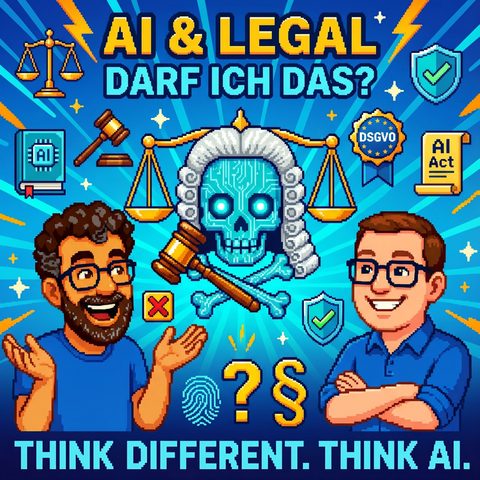
AI und LEGAL
Auf Deutsch lesenTopics Recht und Regulierung
Guest Maximilian Hermann
What it is about
May I do that?
After episodes with software developers and product people, Mark and Jens this time bring someone to the microphone who looks at AI from a completely different angle: Max, a lawyer specializing in AI and data law. Instead of a caution-caution-caution apostle mode, it's about how law and compliance can play on the field and where the real sticking points are.
Topics of the episode
From blocker to enabler: Why lawyers need to be on the field instead of issuing assessments from an ivory tower. And why a digital mindset is also needed in the legal department.
"It depends": The classic. Hallucinations, liability, and the question of whether an AI output with 70 percent quality might be completely fine in non-critical processes.
Platitudes and fear – Mark's TikTok anecdote about the lawyer with a fountain pen who mainly warns. Why you shouldn't approach people like this and where skill-building needs to start broadly.
"Data protection doesn't allow that": The biggest platitude. Data protection is not a sacred cow, but stands equally beside other legal goods. US hosting is also no longer a showstopper.
Users, operators, providers – Max explains when you slip into which role in the AI Act. Local model with n8n? User. Placing an AI system on the market? Provider with real homework – including user manual, the shape of which no one knows yet.
AI Act in reset: A regulation that isn't really in effect yet and is already being revised. How Brussels compromises work and why often bizarre regulations come out in the end.
Principles instead of individual cases – How Max builds governance in the company: not answering each question individually ("may I do that?"), but setting guardrails and representing them with consistency. Creating security, not uncertainty.
Max in practice: Which AI he uses professionally: everyday AI for research and access to knowledge plus Noxtua, a legal AI system from Germany that has been trained on legal data. Privately: fact-checking friends who "know everything". Live, on the side, at the table.
Household exemption: Sounds like the finance ministry, but is practically: In a purely private context, the GDPR does not apply. But as soon as the dictation device starts, it becomes criminally interesting.
AI glasses, guardian modes, and recordings – What happens when the plot pin runs out in the park and starts up again in the restaurant? Intent, negligence, and the topics we will continue to deal with.
Making knowledge consumable for AI: The most exciting question for Max: Legal advice today is in emails, on the audio track, in the intranet that no one reads. How does that get into a form that others can use with their AI?
How the legal profession is changing – In five years, lawyers won't review contracts or draft clauses anymore. They will bring experience, empathy, and strategic foresight. Or, as Jens puts it sharply: They will become orchestrators of agentic networks.
Mentioned in the episode
AI Act / EU AI Regulation
General Data Protection Regulation (GDPR)
Household exemption in data protection law
Noxtua – legal AI system from Germany
n8n
Tesla guardian mode
AI glasses and wearables (Plot Pin)
Take-Aways
Data protection is not a sacred cow – it stands equally next to other legal goods. With good documentation and a thorough assessment, many things are possible.
Most users ask the wrong question: "Am I allowed to do that?" seeks binary security. Better are principles and guardrails.
The AI Act distinguishes between users, operators, and providers – the greatest obligations fall on those who place AI as a product in the market.
US hosting alone is no longer a showstopper. The old platitudes are no longer true.
In purely private contexts, the GDPR does not apply – but be cautious with recordings of other individuals.
In five years, no lawyer will review contracts anymore. What remains is experience, strategy, and orchestration.
Transcript
00:00:00Welcome to Think Different, Think AI, the podcast by Mark and Jens.
00:00:07Two technology-loving minds who not only talk about artificial intelligence but live it.
00:00:14Here you will find clear classifications, genuine practical insights, and a fresh perspective on what is possible.
00:00:20Understandable, critical, and always with a wink.
00:00:24Food for thought, for a smile, and above all for discussion.
00:00:29Welcome to Sink Different, Sink AI, and I believe today I have drawn the short
00:00:38matchstick once again, that I get to do the greeting.
00:00:41I'm not alone today, I not only have Jens with me, but I have also sought legal
00:00:48counsel.
00:00:49No, that's perhaps a rather strange transition.
00:00:51Today we have Maximilian as our guest, and we thought a little bit about this. We also want to invite other
00:01:02parties to share their perspective on AI, how they evaluate AI, what is important, where one might need to pay attention, which
00:01:11challenges might exist, and since we have had people like
00:01:16professionals in software development present or people who have been
00:01:23involved in product management and otherwise with someone nerdy like.
00:01:28me and a design-savvy person, like the one we're dealing with today, have
00:01:32brought someone today who works in the legal field with
00:01:37a specialization in AI and data law, Maximilian. Max, it’s great to have you here.
00:01:44Glad to be here. Yes, we’re happy too. Yes, I think, yes, I don’t want to
00:01:49crack any legal jokes because they are, first of all, only funny to us
00:01:53and secondly, anything I say can be used against me. Jens, you’re here too,
00:01:57very nice, pleased to meet you. Hello, Max, it's great to see you here on this
00:02:03podcast as well. I'm really looking forward to this episode because with the legal field,
00:02:08there are a few clichés, and in the legal field, people often feel like they’d
00:02:13rather ask too many questions than too few. Maybe I’d prefer to ask nothing at all,
00:02:19they always want to prevent everything. Now we both...
00:02:23Always good reasons why something doesn't work. Exactly, what doesn't work. Now briefly for the
00:02:27introduction again. Now we actually know each other from a professional
00:02:31context and I have always experienced you a bit differently in all the topics we’ve been discussing over the last
00:02:36month and year, as I was used to
00:02:42in the legal field, because you actually show an extremely high openness to technology.
00:02:50So let’s maybe dive into that directly. Is that a thing, Max,
00:02:54where one would say that the legal field doesn't just want to be the future, but the present,
00:03:01Also should be one that perhaps has a technological pulse that sometimes beats faster than in other fields?
00:03:12By the way, for your benefit, you can also let out all the clichés beforehand.
00:03:18Then you might feel a bit freer.
00:03:20That’s also a bit freer.
00:03:23Okay, that means you're holding a few back, but I can deal with that.
00:03:28I don't think that question really arises; instead, we need to go along with it.
00:03:36We have to stand on the field as well, not to be the hindrance, but
00:03:43the enabler.
00:03:44For that, a digital mindset is also necessary.
00:03:47I need to know what I'm talking about when I start legally evaluating something.
00:03:51to proceed, I can't avoid it, and if one has a little interest in that
00:03:56has and also likes to engage with it, then it benefits the matter. What a lot
00:04:00what is actually important and relevant is how we, as Legals, I would say
00:04:06also, the way we change our own work, then we won't come either
00:04:11around it. So if I look at the beautiful AI possibilities that already exist today
00:04:15in various platforms and settings, it practically cries out that
00:04:20we should also place our consulting elsewhere. And we no longer have the situation.
00:04:24Oh look, Jens has a little problem, he goes to someone from the legal department and has a little chat with them.
00:04:31That was super smart in the past for us lawyers, so you could wait until someone came to you with a question and I'm exaggerating now, then you could take your fountain pen and comment on it and contribute a little bit.
00:04:45But it wasn't really on the playing field, so you didn’t participate, you didn’t jointly consider how we could combine our skills
00:04:53to push things forward, and I am convinced that will be our future,
00:05:00this will drastically change our work. We're not there yet today, but we know where it's heading.
00:05:06And that's why I'm always totally interested in what you bring with you? How can you enable us as well?
00:05:13With skills, with ideas, with thoughts, and I want to leave that one point.
00:05:18The most important thing is that we need to get out of the law bubble; otherwise, we won't get the impulses we need.
00:05:26Unfortunately, you've taken away the platitude of the fountain pen from me; I have to cross that out for myself.
00:05:32You have the Piña Colada on the beach for me because the AI was developed for me,
00:05:37because the fountain pen in my story thanks for that.
00:05:40If you now say, the legal field and also the, I mean AI changes everything, everyone has to somehow have a feeling for the others and also embark on the journey together, how does the whole world move forward?
00:05:53I mean AI promises a lot in terms of efficiency.
00:05:56AI has, on the other hand, also a bit of, let's say, this ominous sword of Damocles.
00:06:02If I mention a product, that Copilot, when I make a presentation, it hallucinates.
00:06:09And then this slide gets sent. So then you have an employee or a person,
00:06:15a user, who makes a slide, and something gets sent. How do we deal with that?
00:06:19Are there questions that come up for you as well that we can talk about?
00:06:23Or do you have an opinion on this whole topic? What do we do with all the hallucinations?
00:06:28So the 0 and 1 system, like I say, SAP, I press the button, and it does something,
00:06:34it’s no longer that way.
00:06:35A feast for lawyers, I would say, 0 and 1, Chris, yes, from which you also
00:06:39never.
00:06:40That's true, usually it means, it depends, and you get the long text that you
00:06:45didn't understand.
00:06:46But regarding the kitchen, I wanted to save it for Block 2.
00:06:49I'll just start with, it depends.
00:06:52Great, thank you, Jack.
00:06:54I think we do well not to take too much of this technological perspective,
00:07:04but when we used to ask young colleagues to prepare something for us,
00:07:10they didn't come with a hundred percent quality with finished
00:07:17products. When we do things ourselves, we are also not perfect. So,
00:07:22There's always a bit of something that resonates with it.
00:07:26Ultimately, it’s about identifying where critical processes really are and where humans need to somehow
00:07:33still maintain a bit of quality assurance, and where we simply see
00:07:39processes that just need to be implemented.
00:07:42If it works 70 percent of the time, that’s still perfectly fine.
00:07:46By the way, I think it gets more interesting when we talk about which of these processes
00:07:50we actually still need. Not everything needs to be kept alive in the future.
00:07:55But fundamentally, looking at it from a legal perspective, yes, liability issues
00:08:01can arise from this. You can indeed cause damage in a critical
00:08:07situation, legally speaking, through a misused output. Yes, but this could
00:08:12already happen today, even if I didn't use AI, just because I hastily
00:08:15threw something out there. Therefore, I believe there is
00:08:20total fear because this new and uncontrollable, unmanageable
00:08:24influx is coming for the general public, and a lot of competence-building
00:08:31is needed to create security, even in application. When you think about it,
00:08:37I once learned that teenagers are not on Facebook because all the
00:08:40old guys are there. I hope TikTok doesn’t suffer a loss of
00:08:44members because I confess to consuming TikTok, and I remember during my swiping, while doomscrolling, coming across someone.
00:08:54A person with much fatherly authority and a suit, graying hair, books in the background, and he was almost shouting in an improv,
00:09:02Caution! Caution! Caution! Caution! Caution!
00:09:04Yes, using AI can get expensive quickly, and blah, blah, blah,
00:09:09where one might say, yes, there’s probably a case for that,
00:09:12but that doesn’t really resonate with anyone.
00:09:15Yes, you can’t embark on this journey either,
00:09:18because here, I mean, we’re not at the end of the flagpole yet.
00:09:21Yes, there are so many new tools, so many possibilities.
00:09:23You can’t get a grip on that by immediately being the apostle under the Lord,
00:09:27who just shouts about everything that can go wrong.
00:09:30From that perspective, I have to say, of course, I mean, you can
00:09:36also play all the keyboards. I wouldn't question that at all, but I know
00:09:39only that when I was standing at my question with you, where you explained to me, first of all, how that
00:09:43is connected and how one might see that and how one might evaluate that, I thought,
00:09:47look, someone is listening who is missing my language a bit. Yes, from that
00:09:50perspective already a bit IT, yes, I mean, moving away from IT is one thing, but
00:09:54the IT, understanding is the other. I already have other examples,
00:09:57where an IT country has asked questions in good faith,
00:10:00which then went completely off course,
00:10:02because they arrived somewhere else with the recipient,
00:10:04has nothing to do with the IT country, can always happen.
00:10:06Where was I actually going with this?
00:10:08I misspoke, got carried away.
00:10:10Yes, I was still too much in the ghost of TikTok.
00:10:12Yes, I'm really sorry,
00:10:14but maybe I'll tie it back together
00:10:16and I'll hand it over to you now,
00:10:18The nice thing is, when you have people sitting around the table,
00:10:20with whom you can discuss things,
00:10:22without immediately feeling this sense of
00:10:24damn it, I called you on the wrong number,
00:10:26I sincerely apologize for having dialed this number.
00:10:28He started the Teams call or initiated the email.
00:10:31From that side, that was once again a compliment.
00:10:33No cliche, a compliment in your direction.
00:10:35So, Jens, now you have to save me again.
00:10:37That would be the topic.
00:10:37I like to connect with you.
00:10:38That’s no problem.
00:10:39Of course, let’s say from a
00:10:42exceptional law-round perspective,
00:10:44that is basically the wish, the best scenario.
00:10:47I believe this, this world, where
00:10:49silos were good for some reason at one point.
00:10:52Thankfully, I never understood it that way
00:10:54and I’ve never had to mean that their existence is always appreciated when I can work with people,
00:10:59who have other professions, simply because nobody can
00:11:02actually do everything at once. We have to split up. I mean, we talk
00:11:07here about, when we talk about agency systems in the future, we are also talking about
00:11:10systems that bring different competencies, have different types of usage,
00:11:14different background knowledge, internal knowledge, external knowledge.
00:11:18And accordingly, it is beyond question both in human interaction and in
00:11:24the interaction with systems, that it is totally valuable that a legal area
00:11:30no longer, you know, have to initially set up a sort of castle wall
00:11:35but rather to say, no, they are on the same level as anyone else
00:11:39as well.
00:11:40Whether I have a designer, a programmer, a process manager, whatever
00:11:43and likewise, the lawyer is also part of it, being close to the mirror, close
00:11:48to standing on the mirror, like Max Silvertisse.
00:11:51Yes, Jens, I feel really invited right now.
00:11:56Don't you feel that I haven't trained that legally correctly?
00:12:00I found that quite gracious of me.
00:12:03Legally and graciously comes, but I think...
00:12:05I've never heard anything from you that breaks the mold in any way.
00:12:08I mean, simply put, when I think about the use of AI,
00:12:13reflecting in the company and also the further development,
00:12:16that the whole topic should take, it's always about the meta level,
00:12:20that we want to realize the opportunities, but also medicate the risks, meaning in our mind's eye, there is always this scale.
00:12:27And you won't keep this scale in a good balance if you put too much on one side
00:12:34pressure.
00:12:36So.
00:12:38This scale can only be maintained properly if people work well together. I have to
00:12:46I'm looking at the same subject, but each profession has a different stake
00:12:51in it.
00:12:52Now I could make it really easy for myself and say, sure, I have my stake, I will
00:12:55position myself on the sidelines, postulate my stake from Mount Sinai, and then people have to
00:13:00figure out how to deal with it.
00:13:02Does that work in a company?
00:13:04No, that's not possible.
00:13:05We want to bring the topic to the street together and have certainly discussed
00:13:10our entrepreneurial commitment and the common goals we are pursuing.
00:13:14It’s not always easy when it doesn’t come naturally to everyone.
00:13:18But in the end, I believe these are exactly the moments we share, where
00:13:22We notice, oh look, we're just meeting up.
00:13:24And it takes something from both sides.
00:13:27First of all, thank you very much for all the praise that was given, I will
00:13:31also pass it on to the colleagues in our team, because it's
00:13:35not a one-man show for us, and I also want to tell my boss that a few
00:13:38years ago, I believe, she made a wise decision.
00:13:40But that’s also not at all what I'm trying to convey to my colleagues, you know?
00:13:45To really lay myself bare in my neighborhood,
00:13:49I have several lawyers in my neighborhood.
00:13:52These are also people with legal backgrounds.
00:13:55I don’t want to continue talking, otherwise I might get into trouble.
00:13:58But I would say the wording and the manner is certainly,
00:14:02I would say it's partly misunderstood how you deal with these topics.
00:14:07And honestly, I interrupted, I'm keeping the floor.
00:14:10And I want to use it right now for a topic, you may start with a counterpoint.
00:14:15So I'll leave the joker to you.
00:14:18There are many statements floating around, that are circulating in the world, especially
00:14:23also regarding Germany, the land of regulations and GDPR and I don’t know what, where
00:14:31it is always said that AI is not possible in Germany, Germany makes it
00:14:35completely impossible.
00:14:36Sometimes we can even say the EU makes it impossible.
00:14:38This is a broad field, where it is said that nothing works and you are overlooking AI models, oh, forget it, yes.
00:14:45Just for heaven's sake, no.
00:14:47I want to keep this field intentionally wide open, so that you have the chance to find your way out somewhere.
00:14:52What comes to your mind when you hear something like this?
00:14:54GDPR, that Germany does not.
00:14:56Please only, I don’t know, European models and please never the Chinese, Americans, and EU and really no idea.
00:15:03Anyone who comes to that conclusion makes it wonderfully simple and comfortable for themselves.
00:15:07If you also take a look at these regulatory components, it doesn’t say there that
00:15:13data protection is the sacred cow, it says right at the start, data protection has to be
00:15:18reconciled with other legal interests that are all equally valuable.
00:15:23It doesn’t say anywhere that things are not allowed.
00:15:26And I always find, when I also have high quality in legal application
00:15:30I have a solution, I can find ways and I believe we often have the problem,
00:15:36How should I put it? Data protection is a wonderful field. There are also some who perhaps have not fully understood the topic yet.
00:15:43I won't step on anyone's toes, but you do encounter this quite often.
00:15:48However, I also meet a lot of people, and in my community, you eventually get to know each other, who really do have a good grasp on it.
00:15:54And if you were to ask them, they would never say, no, that's not possible.
00:15:58They would always say, let's turn this around, let's make something happen if we properly document,
00:16:02document, if we properly consider the legal grounds, then we can make it work.
00:16:05We can get this done.
00:16:06And then we can also evaluate things properly, like for example, if data hosting
00:16:10with a provider is not possible in the EU but only in the USA, that's currently
00:16:17not a showstopper from a data protection perspective.
00:16:19Yes, it used to be that way, it was at least critical, but even then we found solutions.
00:16:25So even four or five years ago, it wasn't the case that no US providers were
00:16:31being used in a business context; there were already solutions back then.
00:16:35I actually find it more difficult when these simple platitudes take hold.
00:16:40So I still find it difficult today, and I take it quite personally
00:16:46when I hear in a conversation, yes, but you can't do that because of data protection.
00:16:52We can't use that provider because they are based in the USA; no, what has
00:16:57happened?
00:16:58Where do we need to create more transparency?
00:17:00Where do we need to bring more knowledge into the communities, into the companies,
00:17:07so that it no longer has a stopping effect?
00:17:10So it must not have an inhibiting effect on innovation.
00:17:13The legislator did not want that either.
00:17:15What users and regulatory authorities have made of it once again,
00:17:20I believe that's a bit of our problem right now.
00:17:23And data protection is not really a topic,
00:17:27where anyone thinks, if it's mentioned on the radio,
00:17:29or if a blog article appears somewhere, hey, cool, we want to join in
00:17:35and celebrate a party. That's how it's seen. We have that image. So we were
00:17:41not in the dark about it, let’s be honest. That’s the reality. It’s a bit like Google.
00:17:45When I search for a disease on Google, you always find, you're dead or dying,
00:17:49sick, you find a solution. And that's how it feels in Germany, there's always the
00:17:54damned question of the doctor when AI decides, when can the car decide whether to hit the
00:17:59grandmother or the children, who has insured it and who actually steps in when something breaks
00:18:04down, but you rarely get a hook with it, you don’t get a hook about losing the job at 80%,
00:18:11you get a hook, yes, you don’t get a hook with having 80%
00:18:14achieving this and that, because no idea, because everyone has in mind anyway,
00:18:18yeah come on, let him talk, it only works with models that I can use
00:18:21and and and and and and and and and. And maybe something else very briefly
00:18:25and you may mention it again, because I just find it nice,
00:18:26that we are discussing the topic, because also again
00:18:29and then the honeyed words stop.
00:18:32Yes, you are right.
00:18:33That doesn't just hit close to home, but I had contact with you for the
00:18:36invitation.
00:18:38From my side also to your colleagues,
00:18:39the great exchange.
00:18:42But still, one more substantive question for you.
00:18:44In life, there’s a story about whether I’m using AI,
00:18:48as a user or am I operating AI?
00:18:50Can you help me clarify that a bit, if there's something special for me now?
00:18:56So, maybe not to be all-encompassing, because then we might have too correct a statement, but still a couple of two or three guiding pillars on how I can deal with this topic.
00:19:04Because if I install some Open-Write model from the Chinese or Americans on my machine and do something with it, am I an operator?
00:19:13I wouldn’t say that you are an operator yet.
00:19:15The term operator ultimately comes from the AI Act, it’s really about whether I
00:19:20purchased an AI system as a product to use in my activities.
00:19:26Classic case, if I purchase a large HR system that contains AI components, I am
00:19:32the operator of this system.
00:19:33If I just grab a model to do a little something,
00:19:38for my own activity, then I’m in an operator position.
00:19:41It takes a bit more than that, then I would say I’m using it.
00:19:44Actually, this threshold is always crossed when I start, I take a model,
00:19:48I slap a user interface on it, present it to the outside, so that something other than
00:19:53a tool can use it.
00:19:55Then I enter these provider-operator roles and then I just have a few more
00:19:59homework assignments.
00:20:00While one must also say, is it a few more homework assignments, I would say no,
00:20:05because what does regulation want from us? That we think it through properly.
00:20:09about Human in the Loop concepts, that we need to think carefully,
00:20:13about what data we train systems on or they were trained on, that one has to think,
00:20:18about the really critical application scenarios, that there is a, we have to stop the system
00:20:23possibility. The funniest thing and now I find, you can see a bit the
00:20:29curiosities then in the law or in legal regulations. If I am a provider of a
00:20:34AI system, meaning if I really also offer it in the market so that others can buy it,
00:20:38if I can make money with it, I must provide an operating manual for my AI system.
00:20:43No one has ever seen such a thing, no one knows what this operating manual is supposed to look like,
00:20:48whether I pack it in a box and one can then imagine it like a By-Buck sheet
00:20:53with medicines.
00:20:55We are certainly also in situations where the legislator is a bit hitting the target
00:20:59shot out.
00:21:00But as lawyers, we still have the magical ability to interpret laws
00:21:06and find means and ways to implement something like that in a practical manner.
00:21:09But I would like to segment that a little.
00:21:12So actually, I am in the greatest
00:21:14obligation situation when I really place my AI system
00:21:17on the market, so that others can acquire it.
00:21:21And that’s why it has to be handled like a product, just like we know from other products today.
00:21:26So at least I understood correctly that we are a little bit light on my youth.
00:21:29If I run something like N8N with a local model on my end,
00:21:33to optimize my processes, then I don’t have a product at the outer edge.
00:21:37So in my words.
00:21:38Yes.
00:21:39That means I now already have eight influencers in my LinkedIn profile, whom I can now
00:21:45say, you friends of the night, have you done any construction beginner work again.
00:21:49Jens, do you want to stand as a witness?
00:21:52Yes, gladly.
00:21:53Yes, another example would be if I resurrect this correctly, so that I can also
00:21:57take the legal advice live here, if I now,
00:22:00build an app, I don't know, a cooking app, where an AI selects recipes for me based on
00:22:07my diabetes and other diseases, then I'm in the operator role,
00:22:12do I then basically list it in an app store?
00:22:14I would say yes. The question that arises for me is, am I somehow in a
00:22:21high-risk area regarding the AI Act, which is coming our way from a perspective,
00:22:26the health sector is always a bit tricky, I must say, but it was already so without AI.
00:22:32I was just going to say, it was already so without AI, it doesn't go exactly straight. And just
00:22:38aside from regulation, if I offer a solution, at some point, that should help a person
00:22:45cope better with a health issue, then common sense already tells me,
00:22:51I would definitely need some kind of quality standard in there.
00:22:55Nothing has changed due to AI, I would say, that can be signed off on.
00:22:59Are you practically going through your potential business cases with me so we don't
00:23:05pack it.
00:23:06No, I'm not a clown station.
00:23:07No, I'm not a clown station.
00:23:08This is now going on like this.
00:23:11Fun aside, you just said something interesting regarding the legislator
00:23:21perhaps shooting a bit over the target.
00:23:23And earlier we already mentioned the pace of technological change.
00:23:28And that this presents new demands in all areas, regardless of the legal field,
00:23:33essentially all areas are facing new requirements.
00:23:37So all areas of a company and all people in society.
00:23:41Society is facing this challenge.
00:23:43And of course, there’s the question when we look at the legislator,
00:23:46who doesn't always really seem to, when you move around a bit, give the impression that
00:23:52they are in absolute reality, that the current times are outdated.
00:23:58So, what are your feelings about it? Do you also see, regarding what is being done in Germany
00:24:04and in Europe and in Brussels, do you see a stronger openness towards these topics,
00:24:10perhaps also in terms of legislation? I think if I look at it from the EU perspective, there are things
00:24:15that are indeed interpretable, and really
00:24:22quite strongly interpretable. Is that slightly related to the topic that maybe
00:24:25it's clear that you can't grasp everything really and that some
00:24:29gaps are left so that during the course, when
00:24:34you actually see systems running, the technology changes so
00:24:37tremendously that you have adaptability? Is that basically
00:24:41the story behind it, that maybe we will find more
00:24:44interpretable legal solutions in the future?
00:24:49So, that laws are open to interpretation, that has always been the case.
00:24:53It used to be even more so.
00:24:55There were also times when the legislator did not come forward to include every individual case
00:25:01somehow in a law, but much more was done with principles,
00:25:08which were then brought together with the factual situation in the context of interpretation.
00:25:12The interesting thing is, speaking of the General Data Protection Regulation, you really noticed it,
00:25:19I, the legislator, no longer dare to work with these principles. He wants to regulate the
00:25:23individual case situation. If you look into the law, you'll see quite far ahead such
00:25:28principles. It states something like this: data processing must be lawful. According to good faith and
00:25:33fair play, it must be transparent. There is the principle of data minimization. Those are four
00:25:39sentences in a law that, in my opinion, one could directly say, yes, more is needed
00:25:43I actually don't. So if I orient myself to these principles, I can work wonderfully
00:25:47with that. So, in such a legislative process, especially in Brussels, the case is,
00:25:52a total of many stakeholders, a total of many players, a total of many interests. And then everything is
00:25:57thrown together, and this compromise, the process, everything is kneaded, and in the end, in
00:26:04these negotiations, a small barter is conducted. In other words, Party 1 wants that
00:26:10topic X is included, Party 2 wants that topic Y is included, then we get, they get
00:26:15a bit of x and a bit of y, and in the end, it's totally skewed what is written in the law.
00:26:21And so these legislative processes keep going through this machinery and getting totally fragmented.
00:26:29This is something we have to endure, because we can't change this process as it stands today.
00:26:35However, the lawmakers are realizing in Brussels that this is not how it works.
00:26:40So, an example is really the AI Act, a law, a regulation that was passed
00:26:46that isn't even properly in force yet and is already being revised again.
00:26:50Because you can see that what we've regulated doesn't fit at all with how reality
00:26:56looks today.
00:26:57It's not clear enough, it doesn't help enough, it doesn't untangle enough.
00:27:01I think it's a bold step for lawmakers to say and now
00:27:05let's tackle this directly again.
00:27:06Basically, I believe that from a legal perspective, we currently no longer have the
00:27:14opportunity to keep pace with technological development. Our old system, how laws
00:27:24were created, how we established legal requirements is currently undergoing more than a
00:27:29stress test, it doesn't work. So therefore, I believe, and by the way,
00:27:35that's also the way we're dealing with the company, we don't start translating everything into small
00:27:39detailed regulations, but we try to tackle it in principle. We try to address the guardrails,
00:27:45to make them transparent, which, from a governance perspective, we then
00:27:50definitely convey to the company with BMNs and consequences, and we also learn a lot in the process
00:27:58because let's be honest, the user who isn't pushing forward
00:28:02asks what question, they always ask, am I allowed to do this?
00:28:06They want the individual answers, they want to know, can I use my tool for this purpose here
00:28:12right now?
00:28:13Yes or no?
00:28:14That's all they want to know?
00:28:16And if they're unsure, they ask this question every time and create a
00:28:21supposed safety that actually holds them back.
00:28:25And that's what I mean, we have to work a lot on ourselves, on the
00:28:30and know how we communicate things, how we can also ensure that colleagues
00:28:36can live this freedom, how they should not be insecure.
00:28:40And it's up to us and not just us, from a legal perspective to every
00:28:44governance discipline that affects this topic itself
00:28:49to take the initiative and create this security.
00:28:52That's how I would describe it right now.
00:28:56Yes, maybe let's also take a look forward at the end of the show,
00:29:02because there were a few things in there that I found interesting.
00:29:04I heard a bit of a constitution in principle as you described it.
00:29:08But we can probably address that at the end.
00:29:10What I would be interested in now, very pragmatically,
00:29:14to you, Max, lawyer,
00:29:17are you currently using AI personally,
00:29:21both privately and hopefully in your professional environment?
00:29:24Where is that? What has changed for you personally?
00:29:28In the professional context, I think we can differentiate well.
00:29:32I will call it everyday AI, so everything you can get off the shelf
00:29:37without special know-how,
00:29:40also incorporates functionalities into the current working world
00:29:45with existing systems, is used for any purpose,
00:29:48for which it can be used sensibly.
00:29:51Research is incredible for us, what is possible now, pulling together information in a short time.
00:29:59Not just from the web, but especially from existing company information.
00:30:05We have access to knowledge that wasn't there before, that must be clearly stated, and also to information.
00:30:10Then, in the legal sector, we entered into a strategic partnership two years ago with a provider from Germany,
00:30:18Nox Tour is now also in cooperation with the largest legal publishing house, and we essentially have an AI system for us lawyers that possesses legal capabilities and has been trained on a legal data basis.
00:30:31This means that if I need to, let's say, write a letter or a note about something legal that needs to happen, I do that with it.
00:30:40we are currently developing prompt libraries for this, but as soon as functionalities become available to us in some way,
00:30:47will be asked, in which we will also talk about skills and the like, we will use that to properly introduce the topics.
00:30:54And otherwise, I use AI for everything that is somehow fun. Not everything is sensible, especially in private, but it is amusing.
00:31:02So there are simply exciting, interesting, funny use cases. For example, if I happen to know at home,
00:31:08A discussion is coming up for me soon, because I somehow want to be out with my buddies on the weekend,
00:31:12so I can simulate that with a solution.
00:31:16What great ideas have I already developed for that?
00:31:22Simple or also sometimes in a, I don't know, my current favorite example is, I am
00:31:27out with my buddies in the evening and we have like two or three who are talking a lot.
00:31:31They have no idea about anything, but they talk about everything and act like they know it all.
00:31:35How great is it to just check that out while they are talking.
00:31:37Wonderful.
00:31:38Great for you.
00:31:39It's really fun.
00:31:40It's not attacks on an interpersonal level, because we know how we are and
00:31:44we've always been this way, but my skill set is currently being greatly expanded to deal with
00:31:50it.
00:31:51Short one, I have a question, but you're not recording it, the conversations and Chris then
00:31:57secretly through the button in the ear automatically the deposit check with sunflowers.
00:32:00No, I'm not that good yet.
00:32:01I don't even know who would have asked the faulty question briefly, is that allowed?
00:32:06Well, if I’m moving around in my private environment for my private purpose and
00:32:11doing it a little for myself, I don’t see any problem at all.
00:32:15So that’s also something a lot of people don’t know, in data protection law there is
00:32:19something like the household exemption, sounds totally funny, sounds like
00:32:23something that happens with the finance minister somehow.
00:32:26Well, finance minister doesn’t sound funny to me often, but the word still
00:32:30sounds good.
00:32:31If I process data for my private purposes somehow, then I don’t have to comply with the data protection regulations.
00:32:39It simply doesn’t apply. You can read that up quickly.
00:32:43These household recordings are included in every important regulation.
00:32:46So I’ll say it concretely. I could now, in the evening, if I were in a private environment,
00:32:52record the conversation without asking, to have additional facts of the conversation basically whispered into my ear by my AI?
00:33:00I would answer it like this. Jens, if you do that, you should talk intensively beforehand
00:33:05with a good criminal defense lawyer, because you can definitely present a challenge
00:33:11there. If you do it with your own spoken word, that’s not a problem. If you start,
00:33:16turning on dictation mode and let it listen and no one sees that, and you’re practically
00:33:24recording, then you’ll have a problem. That’s a bit exciting with these,
00:33:29It has gotten a bit quiet about all these AI devices that also actually
00:33:33with the microphone and stuff...
00:33:35Like his plans that you can stick on and basically always have...
00:33:38Yes, exactly, that is in principle an interesting question, I have thought about it as well,
00:33:42because you take it and say, okay, even that is clarified, some
00:33:46do try to use the spoken word with the microphone just in your headspace
00:33:52to record, so not further, outside of my mouth basically, and which things
00:33:56to record, the microphone is basically only aimed at my head
00:33:59. Still, of course, the interesting question is, if I now have
00:34:02such a device and forget to turn it off after I've previously shared my thoughts
00:34:05while walking through the park, then I go
00:34:09into the room and suddenly it picks up other conversations.
00:34:12Then I am immediately in this criminal area already.
00:34:15So my knowledge of criminal law might be a bit rusty, but
00:34:20let's really assume you forgot that you have this device
00:34:22on. So you’re not doing it with knowledge and intention. Now, this conversation is being recorded.
00:34:28Then I would say, one could certainly say that you had no intent. If you are not
00:34:32doing it intentionally, the criminal liability should also fall away at this point. But the topics,
00:34:38I believe we will have to deal with these topics, because technology
00:34:43will develop in that direction. And we already know the topics. So think of the,
00:34:47there was once the Sentry Mode at Tesla. If people approach the vehicle,
00:34:53they get recorded and then, yeah, there’s still that mode.
00:34:58Yes, I think it’s also, when you basically increasingly...
00:35:01You know, I know people who might have answered nature's call and were
00:35:06then recorded by their own Tesla because it was next to the car, this has been known to happen
00:35:11being in the world. Yes, I can imagine that with you, Mark. I didn't even know that you
00:35:18drive a Tesla, Mark. But of course, we will see whether it's some AI glasses or
00:35:26something else that will come onto the market afterwards, because this is now
00:35:29from a usability perspective, it's of course totally exciting, that one says, I don't have to
00:35:34type everything in anymore, I can also experience it in a more immersive way
00:35:39to understand what is happening there. It is also recorded. That definitely has an advantage, doesn't it?
00:35:43No question about it.
00:35:44So maybe at this point, that also needs to lead us to think about
00:35:53how we can make our know-how consumable for AI. So maybe also
00:35:59from a UX perspective. When I think today about how legal advice
00:36:02works, then I actually need to consider how can I
00:36:06present it at the outer edge once it's done, so that someone with their AI system,
00:36:11with which they are on the go, can consume it in context, how it can be found.
00:36:16We still don't have solutions for that today, our advice is stuck in some emails
00:36:20or it takes place in audio recordings and then, when we have standardized something,
00:36:25we just put it on the internet, where no one looks at it, and so on and so forth.
00:36:29So we essentially need to find solutions so that all this,
00:36:33what we are generating in knowledge, as long as it hasn't become a commodity from AI systems,
00:36:38which will also happen with knowledge. We need to figure out how that can be made consumable for others with their
00:36:45systems. That is the most exciting question for me right now, because I believe,
00:36:48this will determine how quickly we can actually bring it to the streets in the next two years,
00:36:53three years, and not just stand there and think,
00:36:57oh look, they did that quite cleverly, but somehow we weren't part of it.
00:37:02Yes, of course, with many questions, where I wonder if I can do this now.
00:37:08There are many questions that are quite straightforward, and of course, it calls for the AI chatbot,
00:37:14Nowadays, I would say it calls for a specific legal skill that I can simply
00:37:19load into my AI, which at least answers such a question straightforwardly for a day
00:37:22and with difficult questions, where probability calculations come into play,
00:37:26that he realizes it's uncertain, then he says, okay, this is a case that needs to be discussed
00:37:29more deeply with a lawyer at that moment.
00:37:32And difficult I can also already answer, where the risk is high, so we actually need
00:37:36to come to a world where the risky situations are well routed out or those,
00:37:43that actually need to bring a strategic added value.
00:37:46So that's why I believe that the world will change a bit.
00:37:51But if the world changes in that direction, you have the skills or whatever the system finally
00:37:57is called today. Everything is fast-paced nowadays. Who knows, hardly is the episode online,
00:38:01it's already called something different than skills, let's put that aside.
00:38:04No idea, five years from now. Yes, in five years the machines will have even more knowledge, there are
00:38:10all these databases you talked about or however things will be called again.
00:38:14How will the profession change then? I mean, I will probably
00:38:20still need lawyers or legal departments, but what do you think? How will it go
00:38:23on? Because I would say that, like today, the software developer, the designer and so on
00:38:29might be contacted less because I can just do that quickly myself, like checking the contract, can I do that?
00:38:33Machines will do that. So everywhere where
00:38:40knowledge and ability become a commodity, you won’t need lawyers anymore. I’m firmly
00:38:46convinced of that. But for everything where you still need a human very well today,
00:38:53experience, empathy, strategic foresight,
00:38:58understanding business, thinking in contexts.
00:39:01That will be our task.
00:39:02I believe the lawyer will no longer check contracts.
00:39:05In fact, I’m firmly convinced that in five years,
00:39:07you won’t do that as a lawyer anymore.
00:39:09You won’t draft a clause.
00:39:10But you will prepare the whole field.
00:39:13You will be more involved in the processes of the business units
00:39:18and help shape that, bringing in strategic foresight.
00:39:21And one must say, what we can do well, as we have learned unbearably in our studies,
00:39:28recognize connections, prepare facts properly, sort information bases,
00:39:34provide them and and and, and that is something that will, I believe, make us
00:39:39really indispensable.
00:39:41So I could almost predict that the lawyers
00:39:50in the future may even become orchestrators of an agency network that provides legal advice
00:39:57to other agency networks.
00:39:59So that one might say, just as we talk about skills today, there will actually be
00:40:03some agency workflows where you may actually be the
00:40:07orchestrator of these workflows because who can judge that better than in
00:40:11the processes than the lawyers with their own legal bots that are running in the background.
00:40:14But as it is said, with the special database that you are tapping into,
00:40:18yes, there are always topics where you have to say, yes, different skills, different
00:40:23professions bring different knowledge and backgrounds. Accordingly,
00:40:28I believe that afterwards it's probably just as much a human department
00:40:33mixed with bots and agents, like in any other department as well. I believe we
00:40:37will all somehow be more of an orchestrator of AI systems. And that
00:40:43doesn't automatically mean there has to be less of us, but rather we will
00:40:48simply have much, much more interconnected work. And that will also become more complex
00:40:51honestly. I strongly believe in that, especially in the legal field. When I think about it,
00:40:56I definitely tip my hat. Because if I only have to think about
00:41:01whether we stumble today when we want to provide answers, can I use this
00:41:07one model? If I then look into these future questions or even present questions,
00:41:12where I say, what will happen if this one model
00:41:16invokes 20 other models in the background and is just another piece of software and maybe there’s a human envelope and maybe only
00:41:21a human envelope exists, and in this supply chain that we then overall have, we have thousands of agents with thousands of people
00:41:28somehow talking to produce something
00:41:30that Mark and I then take as a true
00:41:32statement or as a piece of code that causes something at our client, that's really a complex world.
00:41:38It’s totally fascinating, I mean, the spending of the whole thing is something we all didn’t learn in school.
00:41:44Everyone who has gone down the legal path until today hasn’t learned this.
00:41:48But we know we have the skills to handle it and develop this field,
00:41:55to develop the new with it, I find that totally fascinating.
00:41:58So going on this journey together and inspiring and enabling each other.
00:42:04So I don’t know, if you ask me, that's the reason why I currently enjoy going to work,
00:42:09because it’s emerging.
00:42:11Yes, it is, to be honest, still tender shoots.
00:42:15I would say in our, I’m now including myself, in our little
00:42:18nerd bubble, things are already very real for us and they are there, for 98% of the
00:42:24others it’s still not tangible at all in any respect.
00:42:27But preparing the way for these 98% and gaining experience and
00:42:32by the way, regularly landing on your face also belongs
00:42:36to it, that’s also part of the appeal.
00:42:39So that’s the cool part about the whole thing and knowing it won’t be that relaxed at the end,
00:42:45but that complexity will also come in.
00:42:47So I believe that especially the lawyers are excited about this, to be honest,
00:42:52because some of them want to suffer and it has to be complicated, and you have to think it through.
00:42:56Everyone has their hobbies and their fetishes, that’s all fine.
00:42:59And I always say, it’s also work; otherwise, it would be leisure, and you get paid for that.
00:43:05So being able to stretch yourself a bit in your profession is a nice thing.
00:43:08and if it happens with joy, as you just described, because the tasks,
00:43:12the more complicated they are, of course, are just cooler when you can solve them and
00:43:17when you step into this space, I believe that’s actually true independent of the
00:43:21legal profession; I see it in many professions as well, whether Mark has
00:43:26already mentioned, whether it’s product management where you come up with entirely new approaches,
00:43:29or whether it's design in coding, it’s always the programmers,
00:43:34so I don’t see fewer programmers, but simply much more outputs of these.
00:43:37Programs can also be produced. This means that all these professions are currently developing in this,
00:43:42which is perhaps the exciting part, in this shared space. Because this QAE world has given us
00:43:46simply a new playground, where some players are already on the board, but parts
00:43:53of the board on which we play are still not clear about how they will look in half a year
00:43:57in two or three years. Does Jens always use such a poetic image at the end?
00:44:03or I actually try not to. We had agreed that we would bring your totally motivating
00:44:09conclusion to the closing moderation and he starts again here with such game metaphors and
00:44:14chessboards. Why am I trying to hold onto this now? I'm glad you think it's great.
00:44:19You can actually take it as an invitation for a future episode again. So I think,
00:44:24and I can say this, that you disproved another platitude with the sentence you brought, with the enthusiasm,
00:44:27you conveyed, namely that also people
00:44:32of your standing, and this is meant as total appreciation, can embark on this journey of AI without needing to be afraid of it
00:44:40and can accompany it without being perceived as a brake. Yes, and I felt that,
00:44:46was totally
00:44:49enriching that we heard in this episode from you, I would say so openly, so motivated, so excited,
00:44:56things that, we heard in our name from the fire department, with
00:45:00social media and elsewhere saying, ah can't do this and go away and you have to go
00:45:06home. We also learned that he is not only a multimillionaire,
00:45:10but that he might need a criminal defense lawyer. At this point,
00:45:12if you know someone, please write in the comments. Please recommend us, yes,
00:45:15we need more listeners. Why not from the legal bubble,
00:45:19after all, if it hinders you, and if you then meet your
00:45:23buddies again in the evening while drinking birch and you then do a fact check, then they know
00:45:28now also why from my side I found the episode totally nice thanks for
00:45:33being here I’m now going to the closing, this is the
00:45:35moment where everyone can say something or remain silent forever. I'm glad
00:45:39that you were here, I would encourage everyone to leave something in the comments
00:45:44if they have questions, if they have opinions, if they would also like to be
00:45:46with us. I found it great thanks for being here, I wish
00:45:52you a good time. Bye. Bye. Thank you, Max. Bye.
00:46:22AI for reflection, for a smile, and above all for discussing.