Episode 56 · In conversation with Alexander Heusingfeld
A rule in a text file is not a boundary
Anyone putting routines onto an assistant hits compliance faster than technical problems. A field report on hard boundaries, open interfaces and the question of who may decide where a piece of data is allowed to sit.
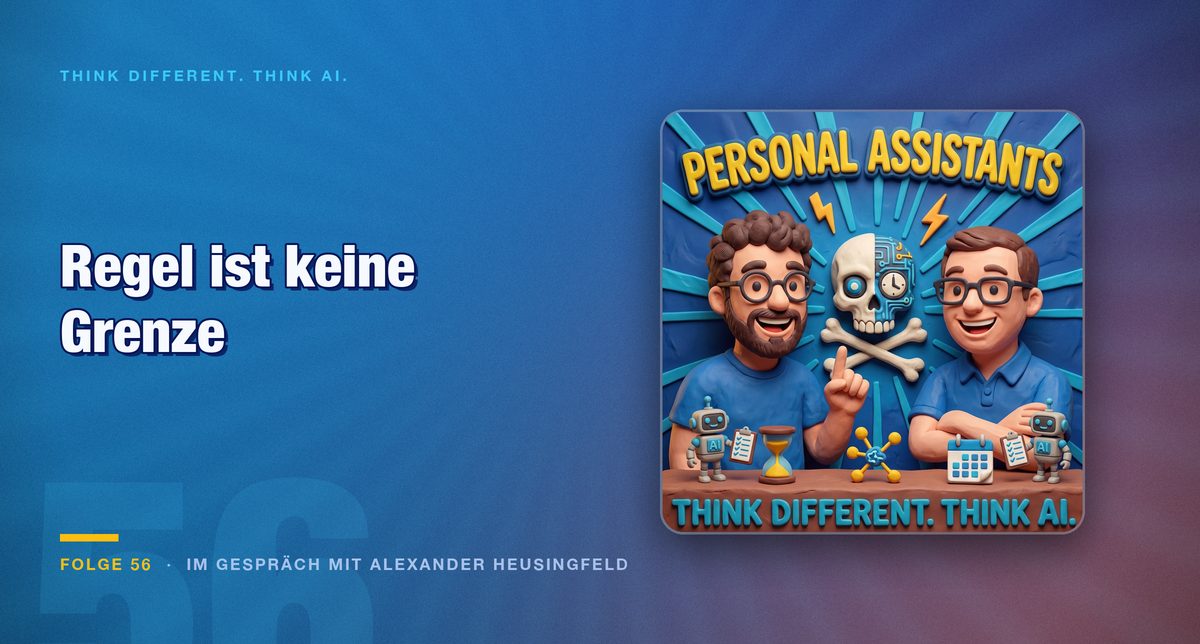
Alexander Heusingfeld asked his freshly set-up system for an overview of the routines he had configured, as a graphic. Shortly afterwards a browser window opened and the graphic was sitting in the cloud. The configuration file said that processing stays local. The apology came promptly and without evasion: the rule had been known. That moment is the core of the episode, because it separates two things that are frequently confused. A written rule is a declaration of intent. A boundary is something that holds even when a system considers another route sensible.
The everyday case that raises the question
The starting point is harmless. A personal assistant for the working day should know the project list, go through notes and mail, perhaps chat messages too, and notice in passing that an evening appointment collides with the dentist. As soon as you write that requirement down, the uncomfortable questions stand next to it.
The documents folder synchronises into a cloud. Who accepted its terms, the private individual or the employer? The notes contain information about colleagues. What happens to it when a model reads it? The difference from the familiar second brain topic is small and consequential: with a store, a human decides at every entry what goes in. A routine runs without that human and therefore needs a rule that holds even when nobody is looking.
Two machines, the same answer
Both participants arrived independently at the same solution: a dedicated device. On one side a Mac Mini that evaluates over 40 sources, builds a daily briefing from them, feeds a tablet via MCP and sorts voice notes into tasks, based exclusively on publicly accessible content. On the other a separate device with its own Apple ID, its own mail address, its own Wi-Fi segment and access only to the outside.
The term for it is hard boundaries. Whatever cannot be assessed across all scenarios is restricted by default, rather than repaired later. That is not scepticism towards the tool but a consequence of how it works.
"I am simply a friend of configuring the rights hard in one place in the operating system. You use a local user who cannot change these rights."
The difference from a written rule is practical: a user account without write permission does not argue, does not apologise, and does not explain why it interpreted the rule differently this time.
Why the old perimeter no longer fits
That this does not stop at anecdotes becomes clear when you look at the interfaces. Anyone running an MCP server without authentication has an open service on their own machine. Every local process can address it, and behind it sit mail, notes and files. At the same time more and more products are building in such servers without any way to switch them off.
The classic perimeter protection helps little here, because its model assumes a human at a keyboard and mouse. A tool that arrives on the machine through a regular enterprise licence is already behind every protective layer, and it now talks to further sessions of itself. One window takes the role of coordinator, others feed it. For the security architecture that is a piece of software the rest of the software on the device did not reckon with.
Notes about people
A separate section of the episode covers a topic that escalates quickly in companies. Most minute-taking tools want to attribute who said what and when. In most cases that is not the interesting information. What matters is the outcome and who takes something on. Names, meanwhile, are everywhere anyway, in ticket systems, wikis and repositories, often with email addresses attached.
"By now I am at the point where I say, who may decide where a piece of data may sit."
From this follows a useful reframing: when a team argues about whether a name may appear in a note, that is in truth a discussion about where this note may be stored. Added to that is the recommendation to talk to the works council about hypothetical cases before they occur. The reason is concrete: a model draws conclusions from scattered data that nobody wanted drawn, and no downstream check rules out hallucinations completely. Attribution in minutes is therefore only worth it where a follow-up task comes out of it.
What goes into practice
When it comes to building, the episode arrives at a sober recommendation. Not every routine needs a model. Anyone wanting to check a mailbox regularly uses a script and calls the AI only when there is something to decide. That saves not only cost, it also shrinks the surface on which something can go wrong. For everything deterministic the rule is: represent it in the skill as program code, without absolute paths, so that an agent does not go searching when a file is missing.
How quickly a fuzzy rule becomes expensive is shown by a calculation error in one of his own research routines. The requested five results turned into over 500 entries in the database. If that happens on a service with usage limits, the mistake turns into an invoice.
Conclusion
The episode does not deliver a list of tools but an order of operations. First clarify which routine is to be built at all and which data it touches. Then decide where that data may sit, and anchor that decision where it is not negotiable: in the permissions concept of the system. Only then the question of which model and which tool.
Anyone reversing that order builds the boundary into a text file and hopes for cooperation. That works most of the time. For the rest, there is this episode.