Episode 32 · Article on the episode
From hobby project to corporate strategy: what NVIDIA's NanoClaw really means
A hobby project called OpenClaw stands on an NVIDIA stage a few months later as NanoClaw, together with the announcement that every firm will need an agent strategy. What has substance in that and what is sales.
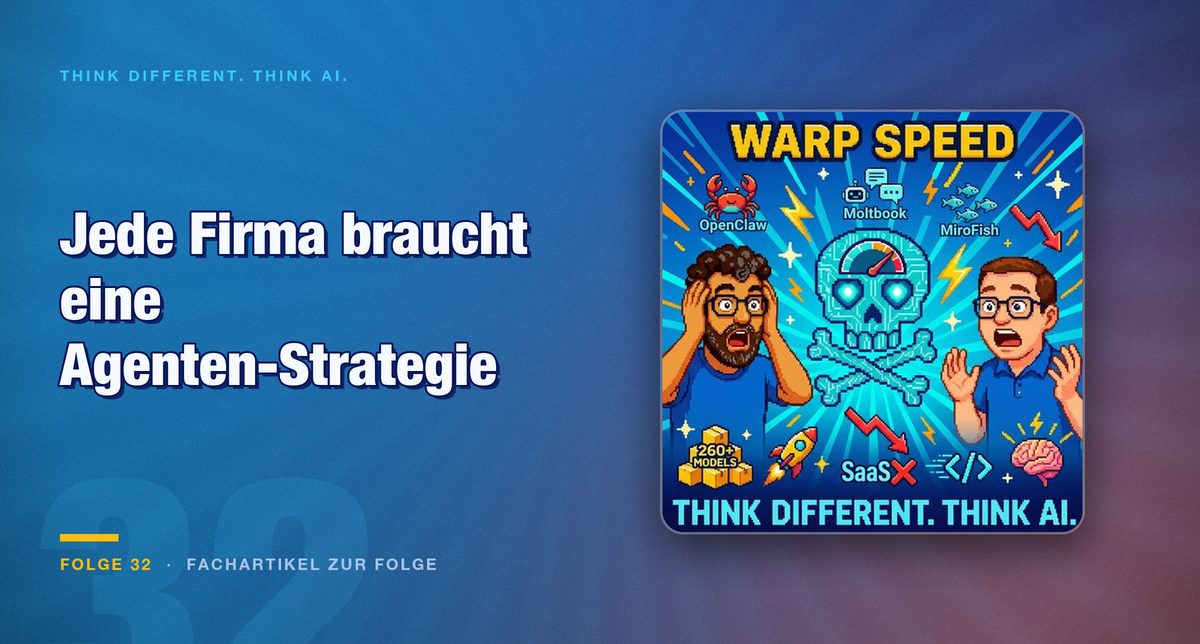
This episode breaks with the usual format. Instead of one topic, the news of recent days takes centre stage, specifically the items that left both hosts, by their own account, speechless.
The arc runs from DNA sequencing via a chatbot to a research loop in which a system independently forms hypotheses, discards them and develops new ones, without anyone sharpening the prompts.
What actually happened
OpenClaw began as one developer's vibe coding project and has gone through the roof since December. Jensen Huang brought it onto the stage as NanoClaw, including switching between local and cloud model and the claim of being an agentic OS.
The sentence that sticks: every firm will in future need an agent strategy, not merely an AI strategy.
With statements like that it is worth looking at the sender. NVIDIA sells compute, and every agent strategy creates compute load. That does not devalue the statement but places it.
It has substance nonetheless, for a reason that has little to do with hardware: an AI strategy answers which models are deployed. An agent strategy has to answer who may build which automation, where it sits, how it is checked and what happens when it does something wrong. Those are governance questions, and they arrive regardless of whether NVIDIA raises them.
The calculation behind it
The most tangible practical part concerns licence costs. The price jump from E5 to E7 at Microsoft is a considerable sum for many organisations, and Copilot licences are the occasion.
That makes the question interesting of whether your own agent environment is cheaper. The obvious calculation sets licence costs against token costs and overlooks the larger item. A licence contains operations, updates, support and liability. Your own environment contains none of that.
For every comparison, therefore, note the third figure. What does the person maintaining the whole thing cost, and what happens when they leave the company.
The vision and its limit
The picture is spun further to multi-agent systems in which an orchestrator coordinates sub-agents for programming, presentation and communication. Technically that is feasible and is already being built in several places.
The limit lies not in the technology but in the overview. As soon as an orchestrator starts sub-agents by itself, nobody knows for sure any more how many are running and what they are touching. That is the same point at which the error rate rises in other episodes.
What else happened alongside
The episode collects further observations that illustrate the pace of development. Humanoid robots are walking on real streets in China on a trial basis, while the Tesla Bot in Munich is still handing out popcorn. Perplexity Computer, Kimi and Google's Gemini CLI with MCP server and skill support increase competitive pressure. NotebookLM has gained a cinema video feature.
The oddest example: a Chinese student built a system in ten days with his project Mirofisch that has millions of simulated agents react to real world events, among other things in order to bet more precisely on Polymarket. For that there was 4.5 million dollars of investment.
What is interesting about that is less the betting application than the number in front of it. Ten days from idea to a system that convinces investors describes a collapse in implementation cost that no procurement department has priced in.
Conclusion
Instead of the usual distance, something rarer prevails in this episode: astonishment. Both hosts openly admit that they find themselves pondering the question of what a one-person firm with an agent harness, skills and automated research can achieve today.
From that arises the idea of a new category: the AI consultancy, behind which in the end stands a Mac Mini with well-maintained skills.
For everyone not wanting to found a consultancy, the practical consequence stays the same. Check which services you buy in because they used to mean effort. For some of them the effort has just disappeared, and you only notice that when somebody else notices it.
And write down the five points of an agent strategy before the first business unit puts its first skill into operation. After that it is tidying up rather than ordering.