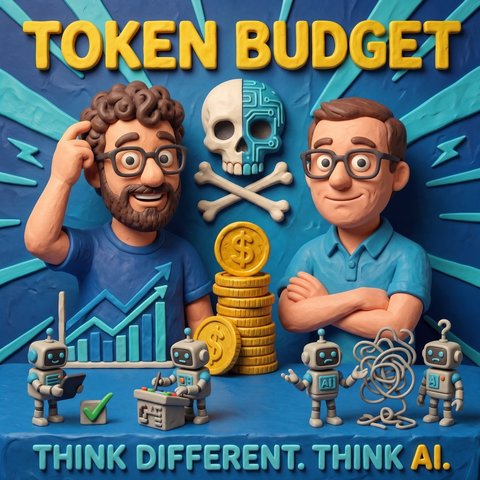
Token Budget
Auf Deutsch lesenTopics Modelle und AnbieterSoftwareentwicklungInterfaces und Interaktion
What it is about
Abos, API, Budgets und ein Agent auf dem iPhone
Wie viel darf KI kosten, und woran erkennt man, dass sich der Verbrauch lohnt? Mark und Jens sind wieder vollständig am Tisch, Jens ist nach einer Krankheit zurück. Sie sprechen darüber, wie schnell Abo-Kontingente aufgebraucht sind, warum der Umstieg auf die API-Abrechnung teuer werden kann und weshalb der Verbrauch allein noch nichts über die Qualität eines Ergebnisses sagt.
Ein Thema ist der Begriff Token Maximizing, mit dem Entwickler am Verbrauch gemessen wurden, und das Wechseln zwischen mehreren Abos, sobald eines leer ist. Berichten zufolge haben manche Konzerne die Tagesbudgets für ihre Entwickler gesenkt. Ist ein Token teurer geworden, oder leisten die Modelle schlicht mehr? Welche Aufgabe braucht wirklich das größte Modell? Schnelle Varianten kosten mehr, und nur weil einem ein Ferrari in die Garage gestellt wird, fährt man nicht effizient.
Der zweite Teil dreht sich um Apple. Mark hat auf seinem iPhone einen eigenen Agenten namens Hermes gebaut, mit einem notizbuchartigen Interface statt eines Chatfensters, Morgenbriefings aus Kalender und Mails und einer Frage an Apples Private Cloud Compute: Wie weit trägt der Datenschutz? Ob die kostenlosen Kontingente bleiben, ist offen.
Transcript
00:00:00Welcome to Think Different. Think AI., the podcast with Mark and Jens.
00:00:07Two tech-obsessed minds who don't just talk about artificial intelligence, they live it.
00:00:14Here you get clear takes, real hands-on insights and a fresh look at what's possible.
00:00:20Understandable, critical and always with a wink.
00:00:24AI to think about, to smile about and above all to join the conversation.
00:00:33Welcome to Think Different. Think AI.
00:00:36The dark side of the Force is back.
00:00:39Jens has risen from the sick.
00:00:42And I don't know if you know this.
00:00:44First of all, Jens, good to have you back.
00:00:46I don't know if you know this.
00:00:49But scientists have found out
00:00:52what the infamous man flu looks like.
00:00:55They put the virus responsible
00:00:58under the microscope.
00:01:00And it looks like the Death Star.
00:01:02On that note, good to have you back and good that you weren't torn to pieces.
00:01:08A book, the Death Star, I always get a bit... But you're talking totally normally, no wheezing and no smoking.
00:01:14So on that front I don't have to call you Darth Jens either. Very nice, glad to hear it.
00:01:19Jürgen Paderan, how are you doing? And right away the critical question, the better half isn't listening.
00:01:25What do you actually spend on tokens? Oh, okay. Well, first a cheer for
00:01:31science, for this sensational breakthrough discovery that was made,
00:01:35what I spend on tokens. So, in a purely private setting I'd say it's with
00:01:45Nvidia, ChatGPT, a bit of Max at Claude. Well, I'd say in the range of 100 to 200 dollars
00:01:59a month. You said a month. I was briefly scared, because otherwise I would have had to ask
00:02:05hour, day, week, quarter. Yeah, you never know. I recently had, greetings go
00:02:12out, I don't want to name names, someone who said, listen, honestly,
00:02:15with the 20, I think he has the 20-whatever subscription, so something small, yes. And that will
00:02:21be completely enough. And I sit there thinking, how can that be? Well,
00:02:25there was my time, I have to say, we'll leave the context hanging in the room. I once had
00:02:31vacation and I didn't use any during the vacation either, and it ended up in four figures. Yes, the vacation
00:02:39was two weeks. Well, that's how it is. There was a way to expense it, though.
00:02:45What's maybe worth mentioning at this point, I think it's a, how should I put it,
00:02:50just like you say. Spending a lot doesn't automatically mean being
00:02:55wasteful, but spending a lot also doesn't automatically mean
00:02:59being a pro. That's quite a narrow line
00:03:02you're walking when you, let's say, bring the machines to
00:03:07their knees. I recently had the chance to compare this, and namely, you
00:03:12know how it is, there are subscriptions and you've heard that
00:03:15subscriptions are subsidized. I recently got to test what that's like,
00:03:20the subsidization. That means I worked on my stuff the whole livelong day
00:03:32and tried to keep up with the coding. And at some point the tokens ran out. I mean the tokens
00:03:40from the subscription. And after the tokens from the subscription were all gone, I switched to not subscription use,
00:03:46but pay-per-use, so API-token-call style. And I then found out that on
00:03:55that one day I ended up just under three figures. Just under three figures. Then I thought briefly,
00:04:01token subscriptions are worth it, purely in monetary terms, because I hadn't changed my way of working.
00:04:07I admit, boss joins in, it was for work, greetings go out. And then
00:04:12you sit there and think, okay, wait a moment, you had the subscription, the subscription ran out, putting work
00:04:16on hold isn't an option, you used lots of tokens because you had lots of things done,
00:04:20I let lots of super agents start and they work, handing each other
00:04:23the work.
00:04:24And yes, I do switch back and forth between Sonnet and Opus and stuff like that,
00:04:28but a lot simply happened, right?
00:04:30So.
00:04:31And then it was used up and the work still has to get done, so API-based.
00:04:34And then you think, okay, if on that day you spend more than
00:04:38the subscription costs per month. I see the catch, because then nobody can explain to me
00:04:45that, with API usage, the subscription models pay off for all the providers. And that
00:04:50will get exciting when they eventually go public, because then I don't think
00:04:54they'll keep feeding everyone tokens with a golden spoon, so to speak,
00:05:00subsidized. My opinion.
00:05:02Yes, good point. We'll wait and see what happens there. I'd also say again
00:05:05a bit, like I called it earlier, for me it's
00:05:09often subscription-based. I catch up on tokens, so I probably also burn
00:05:13more tokens than I actually pay for with the subscription fees
00:05:16I have. Because first, quickly, I also had a video produced in a
00:05:19setting, now shortened. That really hit hard
00:05:23fast. If I want to nail two and a half minutes reasonably
00:05:27professionally, then that was quite easily another 200
00:05:31dollars of extra tokens that I burned in one evening. But also because I then scaled
00:05:37back, and afterwards it was totally fine, since it was only demo effects,
00:05:42if you'd then had to bring it up to truly professional quality,
00:05:46probably a bit more would have gone out. But on the other hand,
00:05:50still cheaper than if I had gone the classic route, whether I'd have
00:05:55hired someone or put in the time myself to
00:06:00produce it. You should never forget that, because all the token topics we have here,
00:06:03on the other hand, there's also, apart from the AI slop and all the nonsense that gets passed around
00:06:10and texts that... Oh, a cat video. Things like that are of course nonsense to do and to
00:06:16count in, because when we talk about productive work, then of course
00:06:19you have to say, yes, if it also produces a productive result
00:06:23then it's filed away as a trophy. I'd say what matters is that
00:06:27it's a productive item, something that comes out at the end and can be used, then of course you have
00:06:33to look at the total costs. If in the past you first shuttled a briefing
00:06:37back and forth, drove it out to an amateur, when you hand off a video like that.
00:06:41like that.
00:06:42Price costs.
00:06:43Price costs.
00:06:44Set costs, hourly rates.
00:06:45Computers are running there too, though.
00:06:46Exactly. Even there computers are running that have to render something, render 3D design,
00:06:49or something else. So there are things that are simply a lot
00:06:52faster now. We've also talked about this often in earlier episodes.
00:06:55If you look ahead, a lot of things may either not happen in the cloud at all anymore, but locally on some servers,
00:07:01then it's basically a different topic, where I say, okay, not everything has to be real-time,
00:07:05not everything has to be there right away tomorrow, so it can be computed a bit more slowly too.
00:07:10And then maybe this topic of, yes, so many tokens being burned,
00:07:18if you look at it from that angle, without me being able to do the math,
00:07:22someone else is welcome to do that. Gut feeling, I'd say it's
00:07:26maybe not such a drastic break-even calculation that would come
00:07:30out of it. Maybe even more positive for the topic of AI use
00:07:35at the home front. And maybe you should also look at it in that light.
00:07:38Maybe one more thing from my own experience, since I've
00:07:42already talked about token costs. I recently had the chance to use the
00:07:47big Opus, not Opus, the ChatGPT model with the option of
00:07:53super speed. And that was fascinating, because a, it wasn't
00:08:00finished before the tokens were used up, and b, the tokens were used up after five
00:08:04hours. After five hours it had chewed through the 500 subscription, laid it to rest.
00:08:11So it was fast. Well, it also had a lot of projects that
00:08:15it was working on in parallel. It didn't get any of them properly finished, and I have to
00:08:20get by from week to week, and I thought to myself, then
00:08:23this turbo speed doesn't help you either. If you're, let's say, done after five, six
00:08:27hours, it could have run through the whole week, then the
00:08:30performance wouldn't have mattered either. Yes, then it might even
00:08:33have gotten a bit further, because this turbo speed
00:08:38costs more in proportion too. So my big resolution is,
00:08:42when Wednesday comes and the tokens refresh for me again, that I say again,
00:08:46oh come on, take your time, because then at least you're kept a bit busy throughout, and that's
00:08:51my contribution to token cost optimization. Greetings go out. Yes, speaking of token cost optimization,
00:09:00oh oh, so this week, here at the beginning of November 2026, 2026, another year like that. What
00:09:10they've all been through. I think we learned the term token maximizing very early
00:09:15at the start of the year, or got to learn it. Do you want to explain it briefly? Yes, it was about the
00:09:22idea that actually no person, and above all no programmer, was worth anything in the eyes of their
00:09:26employer if they didn't use millions of tokens per second. So a
00:09:31bit exaggerated. But that was basically it. Accepted. Exactly. This marketing
00:09:38story, also a bit from the big providers who said, oh, you have to
00:09:41have your developers really burn through the tokens, and if a developer doesn't somehow
00:09:46generate insane token costs, then he's not really a proper developer
00:09:49anymore. In all these weird excesses, this term token
00:09:56maximizer came about, so to speak. Yes, so before that we were basically measuring our work
00:10:04by the number of tokens you use for your work.
00:10:09I'd like to add one more thing.
00:10:11At least I once heard the term token maximizing used to mean that you have several subscriptions
00:10:18and when one subscription is empty, you log in to the next one, you
00:10:24switch the login, so to speak, which of course has the charm that, if you're on Claude Code, for example,
00:10:29and you had several subscriptions and you do log off, log on, log off, log on, log off,
00:10:32then you get that 200 plan or whatever it is several times and can keep working
00:10:40in the hope that when you're through the last one, the first one starts again, and I
00:10:45even know someone who has five, it's really not me, it's not like Rita, what do
00:10:50the condoms cost? No, really, five big subscriptions at Anthropic and it doesn't last him the
00:10:57week, that's wild too. Yes, that's a bit crazy. So of course there were then
00:11:02optimization topics too, like you said. We all know this weekly budget now and
00:11:06such. And then people also started looking at, okay, can I maybe build my harness so
00:11:11that it very cleverly produces the code or whatever via AI, or the
00:11:18insanely big research task you've given it, distributes it so that you basically
00:11:22then cleanly use up those budgets that you had everywhere.
00:11:25So, we were close to saying that we're actually also a, yes, the,
00:11:33now I can't think of the saying, the one with the golden whatever, I'm always like that,
00:11:37sayings, I'm not good at them, right?
00:11:39It's more about saying that we've basically been the producers
00:11:43for this gold rush at the big providers.
00:11:46Gold rush, do you know what I think of then?
00:11:49You can say the word AI, and then imagine at gold rush, please don't
00:11:53get me wrong, but what comes to mind is a cowboy, hardly any teeth left in his mouth, but
00:11:58a smile because he pulled a gold nugget out of the river, like yes, and onward,
00:12:03and that's a bit like this AI stuff.
00:12:05Yes, and we're basically also the ones who were supposed to fuel that
00:12:10on top of it.
00:12:11So if we don't fuel it, then it's basically our own fault,
00:12:15because we're not worth anything anymore, and that of course was a very, very fine
00:12:17story for the big providers, who sacrificed themselves for it.
00:12:20But it did start to reverse a little over the summer, I had the feeling.
00:12:28It was viewed a bit more critically.
00:12:30People also said, hey, just blasting out all these tokens might
00:12:33not be such a good idea.
00:12:34Environmentally maybe not the smartest either, you always have to keep that in mind.
00:12:38These huge AI centers that are actually being built next to residential areas
00:12:42in America, that's really not a nice thing they're doing.
00:12:44No, were being built.
00:12:45The midterms. Lots of states suddenly moved toward the Democrats.
00:12:49Not that the others aren't democratic, but I mean the
00:12:52Democratic Party. And as far as I picked up, in the context of the election
00:12:56there were also votes on lots of data center projects,
00:13:00in the form of what citizens think about them. And I could well
00:13:04imagine, I mean the Democrats aren't anti-business or
00:13:08anything, but I could imagine that there's simply more
00:13:11participation now, so that you don't just say, listen up,
00:13:15you're getting a data center put in your neighborhood now.
00:13:17We park the gas turbines on trucks, because then they don't count as a gas power plant,
00:13:21but as something else. Then it's no problem at all.
00:13:24I don't care what happens with water and electricity.
00:13:26And people work there at, no idea what kind of wages.
00:13:29Along the lines of, you don't get a job and everything still stinks.
00:13:32Certainly some optimizations will take place there now.
00:13:35And I also found it totally fascinating that Sam Altman,
00:13:37who just a few days ago was telling us how terrible it is
00:13:40that people have RAM in their private computers.
00:13:43You could use it so much better on your side.
00:13:45That they're now no longer talking about AI data centers either, but about superintelligence, compute campus, blah blah blah, reframing it,
00:13:55because then they wouldn't be affected by all this data center stuff, and that plays in a bit too, where I think you want to go with this topic later.
00:14:03People, maybe fewer tokens. Maybe we put a limit on it, along the lines of, maybe we'll need the compute capacity for something else in the future,
00:14:13who knows where this journey is heading.
00:14:15Yes, definitely. And that's also a bit of what surfaced in the first days of November this year.
00:14:22There were reports that larger companies, I think it's Apple, Tesla, Microsoft and co.,
00:14:28have indeed cut their budgets for their developers, non-technical people, these ones, in some cases drastically.
00:14:39Well, then somehow from 300 dollars for developers down to 200 dollars a day.
00:14:44So a completely different sum from what we just talked about.
00:14:46A day?
00:14:47A day, yes.
00:14:48That's still...
00:14:49Wait a moment, stuff for developers or for knowledge workers?
00:14:52I haven't dug that far.
00:14:53So, these were developers.
00:14:54The developers.
00:14:55No, they were definitely developers.
00:14:56Okay.
00:14:57Yes, definitely, no.
00:14:58Right, understood, for developers.
00:14:59Because knowledge workers, I think, don't burn through it.
00:15:01Yes, the kids, they went down to 25 dollars or something like that, right?
00:15:04But that doesn't matter now.
00:15:06Those are basically the individual figures. I'd read something about Tesla too,
00:15:10200 dollars per week for some department, over 1,500 dollars for coding tools a month or something like that.
00:15:19So basically a cap was introduced. But go ahead, you first.
00:15:24I was just wondering, with this story about the RAM, as you say,
00:15:28and I heard somewhere, I don't know if it's fact or rumor,
00:15:30so I won't even frame it as either, that Microsoft is also somehow on it,
00:15:34doing something like SETI at Home, where you make graphics cards, CPU and RAM available
00:15:40to them.
00:15:41I was just wondering whether Elon will at some point get the idea of using the compute capacity
00:15:45of his Teslas while they're parked, along the lines of, so that he can compute
00:15:49for them.
00:15:50I'd find that totally funny.
00:15:51Should that be the case, Elon?
00:15:52My idea?
00:15:53I want a cut.
00:15:54Yes, maybe he's already had it and it's happening again even without you
00:15:58knowing.
00:15:59I'm trying to get rich somehow.
00:16:01It's not working.
00:16:02It's not working.
00:16:03I'm already stuck too.
00:16:04I got out of Bitcoin at 60 euros.
00:16:07With how many?
00:16:10Two.
00:16:11Two.
00:16:12Well, alright.
00:16:13Yes, alright.
00:16:14But two today?
00:16:15That would have been nice.
00:16:16Yes, an awesome vacation and more.
00:16:18But fine.
00:16:19We're at Think Different. Think AI. here, not Think Podcast, Think Missed Opportunities
00:16:24or whatever.
00:16:25Exactly.
00:16:26With heart, I'd say.
00:16:27So, to stop poking around in that wound, we're basically in
00:16:32a phase now where we're suddenly talking about budgeting tokens, and that's something
00:16:39I'd really like to talk through with you, because I think what's happening there
00:16:43is clearly connected to these IPOs, which you just hinted at. When the IPOs happen, I think OpenAI
00:16:49is also overtaking, I think,
00:16:53Anthropic, because of the speed. I think first it was Anthropic
00:16:56last week or the week before that, who announced they'd be going public soon,
00:17:00and now I've heard from OpenAI that they want to go public even faster.
00:17:04So one wants to beat the other. We'll have to see.
00:17:07You hinted earlier that in the course of this, taking another close look at the business model
00:17:11might lead to the subscriptions
00:17:17perhaps not being quite so cheap anymore, and token costs could be excluded again.
00:17:22Who knows? And I have the feeling that the big companies of the world are now saying,
00:17:27after we had a phase of "come on, everybody should get to try out AI,
00:17:32it costs nothing," that they're now thinking, aha, maybe a small limit
00:17:37isn't such a bad idea for one person or another.
00:17:41I'd like to pick up on one point.
00:17:44Yes.
00:17:45I do think these subscription prices will certainly change,
00:17:50they'll undergo a shift.
00:17:51But I find the framing "tokens are getting more expensive" not quite
00:17:56right, because if you compare what you get in performance, that's a completely
00:18:02different matter. Just because you say, okay, I don't know, the Opus model costs more and more
00:18:11tokens get used. I also think the term "burning" is funny, but
00:18:16nothing is being burned. It's converted into heat because the computer is running, but anyway, what I want to say is
00:18:21compare it to what I got a year ago for my ChatGPT subscription.
00:18:27Back then the small subscription was just as expensive as today, but
00:18:31the performance I get today for the small subscription is exorbitantly more. That I have
00:18:36higher consumption, higher usage, isn't
00:18:39because tokens per se got more expensive.
00:18:42It's simply because I push the big models to do more things,
00:18:45and maybe I say, well, come on, let me prepare a
00:18:50prototype. We discuss a finished prototype, where in the past
00:18:53we'd have said, count people onto a train, off to wherever, and off we go. Now we talk about it by
00:18:58saying, okay, I'll bring something along tomorrow and we'll talk about what we
00:19:02built there, what we identified, what we researched and so
00:19:05on. That means just because I use the system more and therefore spend more
00:19:09money doesn't mean the tokens became more expensive relative to what I get
00:19:14for them. And then when I look at what you get
00:19:17with the open-source models. I mean, people always ask, is it as good
00:19:20as the current frontier? No, or yes, or whatever, but is it as good as the
00:19:27frontier we thought was awesome a year ago? Most of them are better. And when I
00:19:34look at it, I for example love working, and I'll risk the laughter
00:19:39of our listeners here, with Sonnet and with Haiku. Haiku 5.5 is really good for standard stuff
00:19:46in terms of cost. Nothing is really measured, but I find it totally cheap for
00:19:53what it does for me. No cow-fodder could have taken it. It's like,
00:19:57you don't want to roll the dice. Okay, okay. That's a whole other story
00:20:02we're opening up there. It brings me to the topic that I always wanted to write a
00:20:06little article about. The difficulty for the ordinary user
00:20:12of making this differentiation in the first place. I think even for
00:20:16some programmers who work intensively
00:20:19with these topics it's not so easy, because you almost have to build
00:20:23your own benchmark again for your specific task, to decide whether you take this
00:20:27model or that model. We only hinted at it earlier, with which
00:20:31speed, is this an important task, the most important task in the
00:20:35world that you want to solve, or just a tough problem you
00:20:39have. That's of course really hard for us humans to judge, what is
00:20:42that actually, basically, because I have to go to my boss in a moment and present something to him, is that
00:20:46therefore the toughest problem in the world, or is it the toughest problem because
00:20:50at least somehow... Depends on your boss. Again, greetings go out to Gene.
00:20:54It could also be something else, because I want to, I don't know, understand the rules of
00:21:00the kindergarten, or have to look up whether the airport, whether the airport...
00:21:05I'm raining the kindergarten. Yes, I always say I'm not looking anything up right now. Or what counts as
00:21:10a carry-on bag and what doesn't. And for that, you'd better
00:21:14google and not ask the AI models. That's all a lot, too. All I want to say
00:21:17is that I think we'll have a topic there in the future, that
00:21:23if the providers don't do it, we should get significantly
00:21:28clearer internally and also help our people. We recently had
00:21:31an episode on AI transformation, saying that we should make much
00:21:36clearer what the models are actually for. So for example, to
00:21:39prepare a PowerPoint, if that's still necessary in my work environment,
00:21:45do I absolutely have to use the latest frontier model for it, or
00:21:50wouldn't a weaker one do, for example a locally running model that has the task
00:21:55done by tomorrow? So that's of course a really exciting question
00:22:00in this phase where apparently more is being budgeted. I think the budgeting
00:22:06also has something to do with realizing that it isn't smart to give everyone the
00:22:13Ferrari of AI with every possibility, one that can drive in every direction,
00:22:18and best case crash, or maybe not even get it to their mouth,
00:22:21when the job of an individual person is perhaps something different, someone who doesn't necessarily
00:22:26have to kick off 20 AI agents in parallel to deliver awesome programming output or
00:22:30to solve a very complex math problem or whatever. I think
00:22:34we're slowly getting into this phase where we can differentiate, because even the
00:22:38cheap models are already extremely good. You know, that's also a thing
00:22:41you just said. It's not like one
00:22:44or two years ago. The models we've gotten this year
00:22:47are still all so awesome. You can use the models from the beginning
00:22:51of the year for so many things anyway, and of course they're
00:22:53even more awesome and can do other things. But for many,
00:22:56many standard needs, even last year's models are already
00:23:01probably completely sufficient in 90 percent of the cases we actually have. And I think we've kind of developed past what we really need.
00:23:07Before we move on, we still have one topic we want to touch on, but before that, on the topic
00:23:14of token consumption and costs, let me add one more sentence. I opened with
00:23:19tokens,
00:23:20with the effort one causes, or that I partly
00:23:23cause. Now some people might think, man, what a wasteful mess.
00:23:27I have to add that of course you also use things like Ponytail here, so
00:23:33that "the best code is the code that was never written." A skill that teaches the
00:23:38agent to be frugal, to make things reusable,
00:23:44plainly and simply also to save tokens. And the thing works in that
00:23:48it somehow achieves 50 to 60 percent token reduction, because it also
00:23:53does targeted code reduction. You should do that, which of course
00:23:57also means the reverse: if you tell the thing, okay, solve this task and start 50
00:24:03sub-agents for it, highest effort level, biggest model, and repeat the whole thing 20 times
00:24:12until there really are no contradictions left, and at the end of the day it should really only
00:24:17add two numbers. That would of course also drive token costs up. So
00:24:22only, and this occurred to me when you mentioned the Ferrari, just because someone parks the Ferrari
00:24:27in my garage doesn't mean I drive it efficiently, that I don't
00:24:31wreck it, that I even master it.
00:24:34I also remember my old boss, who put me in a
00:24:38Mercedes for the first time and said, can you fetch this from the workshop
00:24:41yard for me, because the yard is being closed off. I went there, had never heard of a
00:24:46foot-operated handbrake, and proved that engine power can also release
00:24:52foot handbrakes. It tormented, it squeezed, it screamed. Everyone looked out of the window.
00:24:56I got the car out of the yard. Was that efficient? No. So from that angle
00:25:02it also applies how you handle the systems, and at this point I'd like to
00:25:08congratulate all listeners that they don't see the video of us, because Jens, with such a
00:25:12face, he didn't really say that, right in the kisser. Yes, so from that angle,
00:25:19maybe we should do it again at some point, we did want to record live again.
00:25:23Yes, I also saw that you were a guest on someone else's AI podcast.
00:25:26Well, not a guest, but a guest, so a guest guest, an audience guest.
00:25:30We'd have to manage the stage thing, but with that, this would be my closing plea.
00:25:36Watch how you spend your tokens, and just because someone says they spent a lot or not,
00:25:40that says nothing about quantity and quality.
00:25:43You do have to look at how people handle it,
00:25:47and I don't want to talk up my own case, what I reported to whom or not,
00:25:51just eyes open when buying tokens. So yes, then you may add one more sentence,
00:25:57it was never the lines of code, the famous ones, that said anything
00:26:02about the quality of a product in the end. So accordingly, you should always look at the
00:26:05right KPIs, and in the end, whether you spend tens of thousands of tokens, millions,
00:26:12or even trillions. If the problem is solved afterwards and solved better than we would have solved it in
00:26:19another way, then it made sense. And just as you make decisions otherwise in your private
00:26:25or professional life, it's now important to keep checking,
00:26:30okay, just because someone spends a lot of tokens doesn't mean they're
00:26:35wasteful. If I look at the outcome they have, not just at
00:26:41the outputs, and see that it has economic success, then it's simply also a well
00:26:46invested budget in this case.
00:26:50Well invested budget is a really great magic word.
00:26:53Yes.
00:26:54Well invested money.
00:26:57I just noticed, you can't see this, the market is the owner, the proud owner of a
00:27:04this new clamshell phone, not the new Nokia clamshell phone, but the new clamshell phone.
00:27:12Nokia Communicator 2600.
00:27:14Do people actually still say clamshell phone? Yes, actually they do. That's the class of clamshell phones.
00:27:18I haven't heard the word clamshell phone in a long time.
00:27:22When I came home with the iPhone Duo and my daughter saw it, she said at most Samsung.
00:27:27I found that kind of irritating at first.
00:27:30But yes, foldables have somehow not quite been Apple's thing. But I have to say,
00:27:37I haven't had a phone in a long time that gave me so much fun. Well,
00:27:40to be fair, even if it weren't so, at that price point you'd have to say so,
00:27:45because otherwise you'd have to admit that you spent an awkwardly large amount of money for little fun.
00:27:50But I mean it completely seriously, because this device, it's like
00:27:55a little black book, yes, you could say, old white man, little
00:27:59black book. No, that's not the point at all, because I also got that
00:28:02magnetic case from Apple. It's also what you get inside, namely the
00:28:07possibility that, depending on what you're working on, you have a small or
00:28:11a big screen. You'll say, okay, I have that with the Samsung phones
00:28:14too. But then I sat down, and we wanted to get into that, I think,
00:28:19Jens, and built myself a little harness on this device.
00:28:27Device.
00:28:28Device.
00:28:29On the device.
00:28:30Yes, the device got a harness, and before I say what the harness can do,
00:28:35I have to tell you I'm seriously irritated, because if you've followed me professionally
00:28:40so far, you'll know that I now do something with AI, but that in my
00:28:44history I was responsible for mobile app development at our company, and back then I always
00:28:50said, you know what, folks, we build beautiful apps and we place great value
00:28:54on good quality and so on, but our competence ends where the phone ends.
00:29:01So if you need server infrastructure, there are other people with the
00:29:05relevant expertise. We make sure it runs well on the phone. We don't meddle in your work,
00:29:08you don't meddle in ours, and then we all get along when it comes to the solution.
00:29:12And why am I telling this? I somehow noticed that when I started building my
00:29:19harness, it was always like this. You have a harness and the harness
00:29:22reacts to what you want from it. Usually the harness says, what can I do
00:29:26for you today? You type something into the chat and the harness does it.
00:29:30And what I've now put together on the iPhone feels like it goes a different way.
00:29:37You can type something in and it does it.
00:29:40But you can also type in, do this tomorrow at eight. Then it
00:29:46does it tomorrow at eight. Needs no server, runtime, anything. It does everything
00:29:51locally and then gives you, tomorrow for example, your daily briefing or your AI research.
00:29:58Every morning I have it tell me, what happened in the last four hours.
00:30:02And it gathers all of that, and now if someone says, and I have to say the
00:30:07word, because I coin it at least once in every episode.
00:30:10And then I went and had it do that.
00:30:13If someone now says, that's not a real harness, because you don't have a
00:30:15sandbox and so on.
00:30:16That's hilarious.
00:30:17Because it does.
00:30:18So the harness I built there, maybe a few key facts, it uses...
00:30:24Feel free to explain sandbox and harness once more.
00:30:27So a harness, for me, is, let's say, the meeting place between human and machine.
00:30:30Namely on the one hand the user interface that a human has to interact with AI systems,
00:30:35and on the other hand the runtime environment, so the program that lets me interact with an AI model,
00:30:42with the help of tools, that's MCP, and with the help of prompts and instructions, those are skills.
00:30:48And this app, this application that runs on the iPhone, represents exactly that coming together.
00:30:54That means it gives me an interface to talk to this AI model.
00:30:59And the funny thing is, this AI model is not Anthropic or OpenAI, it's Apple Private Cloud Compute.
00:31:09So the models that Apple trains itself and runs in its data center,
00:31:14where they say the privacy level is equivalent to processing on the iPhone itself,
00:31:20where up to two million app installs they don't want to charge for tokens,
00:31:24and the thing runs in this harness.
00:31:28And since you just brought up the topic of sandbox,
00:31:31you can't actually build a sandbox in iOS,
00:31:34one second, you can't build it in iOS,
00:31:36because Apple actually forbids executing code at runtime.
00:31:42And my coding agent actually thought, I've got something nice.
00:31:47Loosely put, it has an on-the-fly Python interpreter
00:31:51that then translates on the fly into something Apple-friendly.
00:31:54That means I have a sandbox and I can run skills, and with that I can for example also say,
00:31:58research this and turn it into really nice slides,
00:32:02which it assembles in this sandbox, clicking and doing things and generating program code,
00:32:08and then hands me those slides at the end. And before I keep gushing and perhaps
00:32:12mention two or three more cool Apple features, you raised your finger,
00:32:16you wanted to say something. Yes. You wait, because I have a follow-up question,
00:32:19I didn't quite understand. You briefly mentioned the 2 million apps
00:32:25that Apple expects. I had heard at some point that basically it's still
00:32:30free right now, but I didn't quite understand the 2 million apps.
00:32:33That I download 2 million apps, or what's the statement?
00:32:36No, no, no, no.
00:32:37These are different pairs of shoes.
00:32:39So first, if you use Private Cloud Compute, it counts against the user's quota.
00:32:44And the user has different things depending on what they've signed up for with Apple, iCloud Plus and so on,
00:32:49and I haven't seen conversion matrices, but I read somewhere
00:32:54on Reddit that the more expensive your subscription is, the
00:32:57more compute Apple offers you, so to speak, for the applications you have that use Apple
00:33:02Intelligence. If I build an app as an app creator, you can basically
00:33:09put it in the store or upload it to TestFlight, that's Apple's beta store, so other
00:33:14people can use it. And if two million people download it,
00:33:19then from that point it costs money, 100,000. I should check that. It's of course
00:33:25an important zero, but either would be far, far, far away for my little game.
00:33:30Yes, I think it was 200,000. I'll have to look. I'll fact-check it.
00:33:35But in any case, that's the limit for the developer to be free.
00:33:40What it costs after that, nobody knows. And what you just hinted at,
00:33:44I had it either in the pre-conversation or just now, I don't know right now, yes, I'm
00:33:47getting old, old and senile. It's somehow going through the press that Apple
00:33:51would reduce these free tokens, and I understood it like this,
00:33:56that the possibility that, if you were to load my app now, you'd trigger
00:34:02that Private Cloud Compute stuff less often before you hit a pause,
00:34:09like we know it from Anthropic and co., where it just says
00:34:12Private Cloud Compute is currently at capacity, please come back later.
00:34:15Okay, my UX heart is reacting to that again, right?
00:34:20Honestly, nothing is getting any simpler at the moment.
00:34:25So of course that's an issue for the users.
00:34:28On that topic they're already going to look at how much am I spending?
00:34:33Is the budget running out? Either the one from my company
00:34:36or the weekly budget or the daily budget
00:34:39that my AI gives me at a certain speed.
00:34:42You also say again that with Apple Intelligence that's a topic too. I think we have to,
00:34:47I don't even want to criticize that, it's all trial and error, and the vendors
00:34:50first have to find their business models and see how it works, and I think
00:34:54it's good that you can still experiment with it now. I hope that was a
00:34:57solution for Finn, because I think this is something that makes things really complicated and then
00:35:03might hold some people back afterwards, because they're afraid, maybe unfounded,
00:35:08that they'll have to spend a ton of money. That's always a bit where I say,
00:35:12we have to make all of this a bit simpler. Although, at this point I'd like to
00:35:16stand up for it, because whether I add the zero or not, 200 or 2 million,
00:35:22if you're an indie developer or even if you're releasing an app for work
00:35:28and you've got your 40, 50, 60, 70, 80, 90, 100,000 customers and you can
00:35:34provide them with an app that basically just uses the AI functionality along with it. Is
00:35:41that, not too specialized. And that limit with Private Cloud Compute, I ran
00:35:46into it myself, where it told me, you have to wait now. But this story,
00:35:50I can build myself a harness that can basically use skills, like we know it from Anthropic.
00:35:57Locally on the device, which holds everything and does everything. And you basically
00:36:03have research tasks, prepare me for the day, rate my day, like a knowledge
00:36:07navigator for the day, which has access to all the data your iPhone has,
00:36:13health, location, weather, reminders, calendar, mail not, that needs a
00:36:18bit of a different trick, but files and things like that, that's already, so I
00:36:24have real fun with this little harness, because on the one hand, I know a
00:36:29bit about iOS, what I'm doing, even if I mix up the zeros,
00:36:32I know a bit about what I'm doing and I can
00:36:35express myself a little, let's say, because I'm also thinking about it, and there
00:36:39your UX heart might beat a notch faster, thinking about what such an
00:36:44interface looks like when I don't think in chats. So the harness right now has, for example,
00:36:49an interface that looks like a notebook. You've got lots of different
00:36:54pages, from packing lists to calendars to I don't know what. You can write by hand
00:36:59and it turns that into nice handwriting, and whenever you
00:37:02write in a different color, it knows, oh, that's a command for the AI, and then it adds
00:37:06something for you, I'm trying a bit along the lines of a co-author who's always reading along,
00:37:12right. But you can also switch to chats. What's funny is, if you have a chat like that,
00:37:17you know it, lots of text and at the bottom you type something and again lots of text,
00:37:20you can take the pen and just scribble into that chat history, more
00:37:26detail here, less here, and then it reacts to that. That means you're not
00:37:32interacting just with speech, which would of course totally suit the AI system,
00:37:35but you can sit somewhere, you flip your thing
00:37:39open, up comes the chat or these pages, and you write, and it
00:37:43reacts to your handwriting. That makes the whole thing feel a bit
00:37:46more approachable. I find it extremely wild that all of this
00:37:53runs just in a phone. Fair point, the model runs in the cloud at Apple,
00:37:58but I consider Private Cloud a whole notch stricter when it comes to data protection.
00:38:04If you just look at how Apple secures its hardware, secures its infrastructure,
00:38:09how it opens up security previews, how you can check it yourself too.
00:38:13Everything's in there, theoretically my contact data would be in there too,
00:38:17everything is theoretically in there. Yeah exactly. Then I'm with you, I do assume
00:38:22the app has secured that fairly well, a few mottos, you know better, yeah, okay. So and if you
00:38:29then imagine, you've got the phone, you can fold it open and shut, unfold it, then you edit
00:38:33with the pen inside, fold it shut, then you see the status overview of your chats, the
00:38:38thing, or you've got this book mode, then you set it up, kind of like an open
00:38:43book, it's like, well, you can stand it up. And then it reacts with
00:38:48its visualization to that. That's really fun. And then, as I said,
00:38:53I'm already facing the question, if there's a bit more computing power in there,
00:38:56if you maybe have a bit more model logic in there.
00:38:59Private Cloud Compute, for example, has no image analysis. So they
00:39:04don't have that yet, in quotation marks. Then this can get really powerful
00:39:09for the classic knowledge worker. I'm standing here,
00:39:13get me, I don't know, get me a letter for the insurance
00:39:17ready, help me here, help me there. And, that's also pretty cool, it even has browser use.
00:39:22On the iPhone a little window opens on the right, looks like Safari,
00:39:27isn't Safari, but looks like Safari. And then it operates the browser in that thing.
00:39:33What I consider completely normal on a PC, it simply does on my phone.
00:39:37That really gets my eyes lighting up. I've got a bit of
00:39:41playfulness and enthusiasm there. Yes, that's basically a topic
00:39:47we two have discussed more often, whether it was something with my Mac Mini application
00:39:53or something else, that it's kind of exciting when you feel like you're a
00:39:58bit more in charge of this, I mean of the harness, either way, you build that yourself
00:40:05after all, but of what the AI does there, and not being quite so much the plaything of the big
00:40:10players. That's actually what I'm taking from your words, as I listen to you.
00:40:14already, I'm listening to you fascinated and actually wondering right now, if I need to get a Duo
00:40:19too, then we'll have to talk about that again later, what I should order
00:40:24there.
00:40:25Because it's of course pretty cool when you have it in your pocket, you just
00:40:32said it, it's of course still more of a cloud model, it's
00:40:34not a local AI model running on the Android, if I understood it correctly,
00:40:38but still your data is kind of with you, your agents with you,
00:40:45your harness is basically completely with you in your pocket, it goes along and is actually
00:40:51a bit like your real personal AI that you can carry around, the personal
00:40:57assistant in your pocket.
00:40:59Plus, which you mustn't forget, because it's Apple, plus on the
00:41:04watch, so a voice interface on the watch, plus, because you said not a local model, that's right,
00:41:10I have it with Cloud Compute now, but on the, let's say, rich board of
00:41:16extensions, there's also the question of whether you can't slam something like a Gemma model locally onto the
00:41:22box, so you get even more done locally and maybe with, no
00:41:28idea, super agents, whatever, says, okay, I'll do this and I'll send that out, and that
00:41:33you play around with that a bit, so that you become, let's say, more independent. Because
00:41:38this topic, look at my calendar, look at my tasks, look at my
00:41:44mails, fair point, you have to release those via IMAP,
00:41:47otherwise it doesn't work, otherwise Apple won't let me at
00:41:51my own mails that are in the iPhone. But look at it, prepare something for me
00:41:56and I go to my phone the next morning, I open it and the
00:42:00phone doesn't say, what can I do for you? Instead the phone says, Mark, the following things
00:42:04are open, I've prepared something for you, here, have fun. And all of that, because actually
00:42:09the model maybe locally at some point, the model otherwise remote, but all the rest
00:42:13local on your device without, I need whoever, Amazon,
00:42:20Microsoft, whoever else, some cloud instance puttering away on something, just
00:42:25in your phone. I find that impressive. Someone will say, but why don't you do
00:42:29that on your Mac. You could also ask me why you don't do it on your Windows. That
00:42:34would be out for me, because I have no Windows in my apartment. I'm a Mac user
00:42:41through and through. There are people who wouldn't even have an Apple logo tattooed on their chest.
00:42:45I don't want to give you the proof, but it's not like that. The Mac just closes and in the
00:42:52majority of cases it then shuts off. And even if you say you have a Mac Mini behind the
00:42:57TV, or mine is standing there, that's all nice, you can install your Hermes there
00:43:03and it's guaranteed more flexible right now, more capable of learning, builds skills, makes suggestions
00:43:10and so on, all fine, but it's a separate piece of craft that wants to be maintained,
00:43:15that runs somewhere, vents, somewhere, somewhere, and this thing you have in your pocket
00:43:21with you. You have it with you on vacation just the same and don't have to worry about how I connect
00:43:26to the data, and I find that so fascinating, when it clicked in my head
00:43:30to say, actually you basically have a client and
00:43:34a server, so what you used to think of as a client-server infrastructure,
00:43:37with this cloud render and co. in your pocket.
00:43:41And it is exactly that. Exactly. Only the question left is how do I get a
00:43:44sufficiently strong local model onto it.
00:43:47That would be great, because otherwise we also honestly have to
00:43:51say, you could of course also think about a virtual server solution with any mobile,
00:43:54arbitrary end device.
00:43:59Yes, of course.
00:44:00Okay, you of course have a cloud somewhere on the virtual server.
00:44:02But nobody builds that on the side either.
00:44:03Nobody builds that on the side, exactly.
00:44:04But there you basically have...
00:44:05And nobody builds my app on the side either.
00:44:07It would also work differently at the moment, but I understand what you're saying.
00:44:13It's simply what, I think, attracts us humans to some products too,
00:44:17it's a bit more convenient.
00:44:19It's not so much building it yourself and maintaining something else at another
00:44:23spot or whatever. Instead you just open it up and get going. And what really
00:44:28fascinates me too is the question of how you get it to fade into the background
00:44:34a bit again. That's what I tried with the notebook and whiteboard function
00:44:40and that kind of stuff, to say, okay, I work in there. Yes, but on my roadmap there is,
00:44:46so on my roadmap, on my personal experiment, Fatschia, something like that,
00:44:49that he wants to integrate SharePlay too, meaning multi-user, so that several people
00:44:54share a session on the whiteboard, which then takes place in the harness, where then
00:45:00the harness works in there as well, and what you can do with that.
00:45:04I think you can try out totally many cool things with something like that, although bad
00:45:09enough, right, you build a work harness, you build a private harness, at some point you should
00:45:15do something other than nothing but harnesses.
00:45:20Building harnesses is not a task that everyone out there will have to be able to do.
00:45:27Let's put it that way.
00:45:28I think it's actually a small special group that's dealing with it right now.
00:45:33Many others will simply just get it.
00:45:34That almost sounds like Alcoholics Anonymous.
00:45:35Yes, not quite that bad.
00:45:36Anonymous Ka-Elika.
00:45:37Exactly.
00:45:38I'm addicted to harnesses.
00:45:41No, so basically it's the case that I say, yes, providers are coming, whether those
00:45:45are device makers or the software providers after all, they will come and
00:45:48they will deliver you the harness, also coming there, for a small
00:45:54subscription fee, usually always. And accordingly not everyone has to
00:45:57deal with it. So what we're doing there is also a bit of
00:46:00instrumenting, also a bit of research. What's actually possible right now,
00:46:02out of professional interest, out of private curiosity, we like to take a look at
00:46:06these things and tinker around a bit and
00:46:08burn one token too many or another for our. Honestly
00:46:13so that we can then pass one or two things on to you every now and then.
00:46:17As the saying goes, let's turn the token over once more before we burn it.
00:46:21Oh, nice. That fits right in with this token rationalization phase,
00:46:27which apparently has replaced the token maximization phase.
00:46:30Well, let's see. Well, now. Right? Right? Tokens aren't getting fewer. They're apparently just
00:46:39being looked at more closely to see whether they're really productive. They're getting more and more productive. AI produces
00:46:45more and more cool stuff, honestly. We don't have time left over for that. We have to talk again
00:46:51about what's actually going on out there. We can deal with that in the next
00:46:53episodes. So in the last few weeks I've seen insanely strong
00:46:59use cases in the area of tutorials, explainers, education, where very often
00:47:06with Claude, Anthropic and an MCP connection that helps the 3D program Blender as well.
00:47:14helps.
00:47:15Or rather, when I help, yes, Blender, so the program Blender is used by
00:47:20the AI to build gigantically good, gigantically cool 3D websites
00:47:29that have fantastic teaching qualities, where you can look at technology.
00:47:35Today I still, somehow, it was from the Vercel chief, I think, he posted something
00:47:39today.
00:47:40He basically, we have a record player at home, he also rebuilt a record player
00:47:45with 3JS.
00:47:46And it runs, you can put different records on it.
00:47:47That's already awesome, spinning it and hearing the music.
00:47:50But what's fascinating is that the music doesn't simply come out of the speaker,
00:47:52but in this 3D model that runs in real time on the website,
00:47:58basically the actual vibrations of the record are queried,
00:48:02to then produce the tones again from these vibration things.
00:48:05That's kind of wild.
00:48:06And I think we should talk about things like that again in the future.
00:48:09We could do a proper episode on that.
00:48:10We'd have to make sure we put enough links for it in the show notes,
00:48:13because unfortunately we're not a visual event,
00:48:17just an audiophile event for both of us at the moment.
00:48:21But I think we have exciting topics there again, what's being done with tokens, we haven't talked about that in peace for a long time.
00:48:26We could think about, so please not as a rule, but think about whether we do a stretch, also really make the first video on our YouTube channel.
00:48:34Yes, true.
00:48:35Yes, because you first have to be very selfless to say, well, nice that we're in your podcast player of choice, do drop by YouTube, then you could see what we're doing right now.
00:48:45Exactly.
00:48:46That way we could maybe keep our channels a bit fresh.
00:48:50Maybe one last tip at the end on token minimization in your personal setup.
00:48:56What actually helps me save tokens too is a little skill I wrote for myself.
00:49:03One that takes a topic I'm planning, not only with this one, there's one called QuillMe or Superpower Brainstorming or something,
00:49:07the one is called that,
00:49:11but so that your plan is as good as possible.
00:49:14I wrote myself another skill that researches whether what I'm planning
00:49:18someone has already written up on Reddit or so,
00:49:20discussed, and also checks whether on GitHub, license-wise clean of course,
00:49:27there are already demo implementations, not to copy those demo implementations
00:49:32per se, but to take them as guidance for a plan along the lines of,
00:49:37I'm building this myself, maybe I won't fall right into all the traps that I
00:49:41had paid in for myself, plus Context 7 is a totally great MCP server when it comes to programming languages
00:49:46and in sum, but you're already taking a breath, in sum already quite
00:49:50That sounds very cool, and please share the links again, maybe in this episode too, I want to pull out one or two things from there myself.
00:49:57All I wanted to say, you just announced that in the future humanity no longer has to invent the wheel twice.
00:50:06But we're two tech nerds here. Of course we reinvent the wheel.
00:50:12This insight of saying, don't copy it, just look at all the projects.
00:50:18As I said, always keeping an eye on what is it, MIT, Apache and so on, so that you
00:50:25don't get into trouble.
00:50:26Whether you catch all of them is another matter, because some aren't so well documented
00:50:29or are irrelevant.
00:50:30This insight, I trust it, is the same topic again as in one of
00:50:35our first episodes.
00:50:36Just because the computer said it, we're not at 0 and 1, that's really
00:50:39not wrong.
00:50:40But it's still, it looked at it, when I look at it, quite honestly, you know
00:50:45yourself how I sometimes get stuck with my glasses in front of the monitor, still overlooking enough.
00:50:49And with the amount it does, let's say the correction is only one prompt away.
00:50:54And the fact that it can search for it, be it with the help of Perplexity, for example,
00:50:58or its own search queries, it's astonishing what it finds at that point,
00:51:05let's say, so that it doesn't stumble over the same mistakes itself,
00:51:10which you might not think of otherwise. Last sentence? I think by now the models
00:51:15are so strong too and when you integrate the whole thing, sometimes too many instructions make it
00:51:20worse. So when it opens that up, this does that, you rein it in, and if you
00:51:26let it run and let it make a suggestion, sometimes really cool ideas come
00:51:29out, where you say, we can talk about that, and not beforehand yes, but not that and please
00:51:35not at all, but make some suggestions, let's discuss, getting into that discussion with it
00:51:40and so keep sharpening the plan. I wanted to back up once more what you said,
00:51:46because there was another piece of news that caught my interest this week. And
00:51:51it was from Ethan Mollick, he reposted it, it's not his study, but he
00:51:54reposted it. And it was about looking at how well fact-checking is carried out
00:52:00on scientific studies. And the result was
00:52:05that humans basically only get it right around 25 percent
00:52:10of the time and have a chance of really checking the facts.
00:52:12In contrast to the models, let me look, there a Claude Opus 5 was
00:52:17tested with 90.8 percent accuracy. The GPT-5-6 from
00:52:23Solultra with 92.2 percent the best model. That means this maybe also
00:52:30overestimating of our own abilities as humans, of what we can
00:52:35actually judge, so to speak. Because just as you say, when I
00:52:39collect things together now, then I've got my average, yeah yeah, then I've got
00:52:43my good feel for whether this is AI news or
00:52:49real news, what's actually correct, that's just how I have it
00:52:51basically, when my AI brings me news research and things or I discuss something with it,
00:52:55that I do have a feeling for whether it's right or not, but just
00:52:59a feeling. Honestly only a feeling. The time when that feeling is smarter
00:53:06than an AI checking it is over. We have to be clear about that. That's
00:53:09an exciting topic, I think, that came out of this study again.
00:53:13That's of course for expert topics, but I think we can scale it down quite easily
00:53:16to everyday topics, if that's already the case with scientific studies
00:53:19by now, that AI can actually fact-check clearly, clearly better
00:53:23than a human ever could or ever could have,
00:53:27honestly. And if you add to that, and this shouldn't sound judgmental,
00:53:33that you still meet a lot of people, no matter which
00:53:38profession, whether trades, digital, IT, office administration, whatever,
00:53:44that AI exists is one thing. What it means and what it can do is still so
00:53:51different in people's perception. I still meet people who tell me, well,
00:53:55translating text, of course I use AI. And I don't want, as I said, to
00:54:02judge that, because it's quite possible that you simply don't
00:54:05know it can do more or you've never had the experience that you
00:54:09can trust it with more, because if you, for example, always work with
00:54:12the free plans, I know people who were totally appalled along the lines of
00:54:18which version was that back then, when it was said OpenAI took my friend away, that
00:54:22was the 4o or something like that. Yes, yes, that was it, I think. They were on
00:54:25old models and then OpenAI
00:54:30discontinued the models and then, ah, my model is gone, and somehow took a small
00:54:34model, because they thought small models are cheaper, yes, but
00:54:37small models aren't automatically cheaper. That's actually a
00:54:41fallacy too. And from that side, there are so many different feelings about the
00:54:47topic of AI. So many different ones from people who say, I'm on top of it, and
00:54:51maybe aren't at all. Or they say, what do I want with it? That's
00:54:54all nonsense anyway. Or it doesn't affect me. I'm not in IT.
00:54:58I do think there's definitely a change in the
00:55:03working world in IT. We've already had that as a topic, but that's being driven by
00:55:06management and Covid, which I also churn through quite differently, but I think those are
00:55:09all stories we want to get to in future episodes. So I'd like to thank you.
00:55:15Nice that the Death Star didn't get you. No, I managed
00:55:20to get through those awful, awful medications. Yes, so there the Empire
00:55:27threw everything into the balance and didn't manage it. Thanks for staying on the
00:55:30good side, on the side of AI, on the side of our listeners. And with that
00:55:35I'd say we say goodbye. We wish you a wonderful week, with whatever
00:55:39events are on the horizon. You keep hearing about new models again here,
00:55:43but that's also a truism. You hear about them constantly. And I'm looking forward to the
00:55:48next episode, Jens. Until then, all the best. Leave us a like, a comment. Feel
00:55:54free to say we're cool. And until next time. Ciao. Until next time. Ciao.
00:56:05Print Think AI, the podcast from Mark and Jens.
00:56:09Two technology-loving minds who don't just talk about artificial intelligence,
00:56:14but live it.
00:56:15Here you get clear context, real practical insights
00:56:19and a fresh look at what's possible.
00:56:22Understandable, critical and always with a wink.
00:56:26AI for thinking, for smiling and above all for joining the conversation.