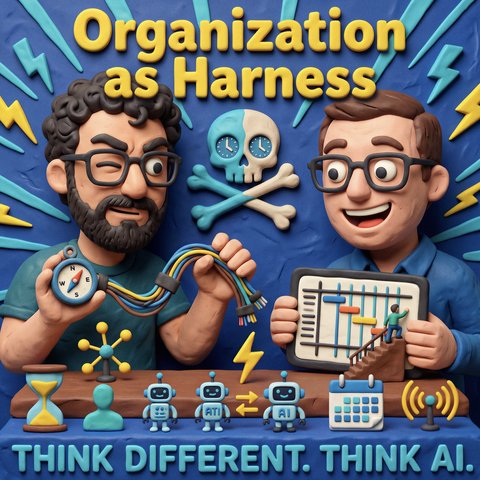
Organisation als Harness
Auf Deutsch lesenTopics Führung und ArbeitKI-Agenten
What it is about
Wie eine Organisation die Menschen durch die KI-Transformation trägt, statt Rollen eins zu eins zu automatisieren
Jens eröffnet mit der Frage, wie sich Menschen auf dem Weg in die KI-Welt vernünftig begleiten lassen, ohne dass sie abgehängt werden. Mark und er wollen dazu ihre Sicht schildern und freuen sich ausdrücklich über Widerspruch in den Kommentaren. Der Titel der Folge, Organisation als Harness, hat schon im Vorgespräch Fragen aufgeworfen: Für das englische Wort Harness fällt beiden keine gute deutsche Übersetzung ein. Mark ergänzt, dass es nicht nur ums Mitnehmen gehen sollte, sondern auch darum, was eine Organisation den Menschen ermöglicht.
Bevor es ernster wird, räumen die beiden die Social-Media-Schlagworte beiseite: das Bild vom Tesla-Roboter, der vor einem Notebook sitzt und tippt, den „AI Patty Flipper", der nach dem Auftrag nur noch auf Weiter drückt, und den Satz, nicht die KI ersetze dich, sondern der Mensch, der besser mit KI umgeht. Mark erzählt, was ihn überzeugt, dass die Transformation längst läuft: Freitagabend eine fixe Idee, am Sonntagabend steht eine Lösung. Seine Datenbrille konnte ein Display nicht abschalten, jetzt kann sie es, weil er die Firmware mit KI-Hilfe angepasst hat. Jens hält dagegen, dass nicht jeder GitHub, Repositories und Agenten-Steuerung verstehen muss, und dass die Interaktion mit KI für die meisten Menschen noch in einer speziellen Ecke liegt.
Dann geht es um die Organisation. Mark zweifelt an Aussagen wie „Copilot für alle" als KI-Strategie und an Studien, nach denen sich viele produktiver fühlen. Offen bleibt, was mit der gewonnenen Zeit passiert, denn schneller zur Kantine zu gehen schafft keinen Wert. Ein Werkzeug im Software-Stack ändert noch keine Rollen. Systeme, die jahrelang nicht gepflegt wurden, lassen sich jetzt bereinigen, und statt einer zähen Oberfläche bedienen Wissensarbeiter künftig die Schnittstellen dahinter per Chat oder interaktiver Oberfläche. Jens warnt davor, jede Rolle einzeln durch einen Skill zu ersetzen. Er plädiert dafür, Workflows neu zu denken, die Geschäftsmodelle zu klären, implizites Wissen sichtbar zu machen und den leisen Stimmen in der Organisation Gehör zu verschaffen. Ein Beispiel: Wer eine Aufgabe mit Agenten 20-mal schneller erledigt, soll danach nicht zwei Wochen herumsitzen, sondern sich auf Bedürfnisse, Innovation und Kundennähe konzentrieren.
Beide betonen, dass sich der Job ändert, ohne zu verschwinden, und dass eine Organisation dafür ehrlich sein muss. Beteiligung ist ihr Kernbegriff: Wer alles vorgibt, erzeugt Widerstand, und Widerstand kann auch schlicht Zeitmangel sein. Jens plädiert dafür, zu den Teams zu gehen, ihre Workflows zu beobachten, gemeinsam die zeitfressenden Stellen zu finden und schnell Prototypen zu bauen, etwa ein Team Second Brain oder einen MCP-Zugriff auf bisher unerreichbare Datenquellen. Mark ergänzt, dass nicht überall KI hineingehört: Für das tägliche Sortieren von PDFs reicht womöglich ein Python-Skript. Er verweist auf das Worker-Konzept bei Notion, das nach seiner Schilderung KI-erzeugte Skripte laufen lässt und damit Rechenzeit statt Tokens verbraucht. Außerdem lohnt es sich, Aufgaben über Rollen und Jobfamilien hinweg zu bündeln, statt jede Stelle für sich zu betrachten, und strukturierte wie unstrukturierte Firmendaten mit Wissen von außen anzureichern.
Im dritten Teil geht es um Rollen und Grenzen. Jens beschreibt, dass Menschen ständig die Grenzen ihrer Rolle überschreiten, mit KI-Hilfe sogar in Fachgebiete wie Recht hinein, wobei die Entscheidung beim Fachmenschen bleibt. Die Gefahr sei, die KI, die alle Rollen kennt, wieder in künstliche Rollen zu zwängen wie in der Industrialisierung. Das Schlagwort Human in the Loop hält er für überhöht: Den einzelnen Experten, der alles bewertet, gibt es nicht, Intelligenz entsteht durch Zusammenarbeit. Mark rät, nicht auf den lautesten Ruf zu hören, Prozesse von Ende zu Ende zu denken und auch eine neutrale Sicht von außen zu holen. Eine Stellenbeschreibung sei nur ein Teil der Wahrheit, und Wissen gehe verloren, wenn es nie von der Notiz ins Prozessdokument gelangt. Er rechnet damit, dass Unternehmen Wissen wieder stärker in Textformate wie Markdown oder das Open Knowledge Format legen. Jens widerspricht für die Bedienung: Text taugt als Wissensträger, aber Menschen wollen einen Slider oder einen Sprachbefehl. Die Gestaltung der Interaktion mit KI, auch mit Robotik und Sprache, sei eine große Designaufgabe, die bisher fast nur Coder bedienen können.
Zum Schluss fassen sie zusammen: Der Engpass ist weniger das Modell als das Wissen eines Unternehmens und die Art, wie man Menschen befähigt. Jobs verschwinden nicht, aber Zusammenarbeit und Einstiegswege ändern sich. Gewonnene Zeit sollte nicht sofort durch höhere Erwartungen aufgefressen werden, und wer automatisiert, sollte fragen, ob Tokens die effizienteste Lösung sind. Jens rechnet mit kleineren Teams und mehr persönlicher Begegnung, Mark mit dem Gedanken, dass Neues aus menschlicher Interaktion bei der Problemlösung entsteht. Wer anderer Meinung ist oder über das Thema sprechen will, meldet sich über Landingpage, WhatsApp-Kanal oder LinkedIn.
Transcript
00:00:00Welcome to Think Different. Think AI., the podcast by Mark and Jens.
00:00:07Two tech-loving minds who don't just talk about artificial intelligence, but live it.
00:00:14Here you get clear context, real practical insights, and a fresh look at what's possible.
00:00:20Understandable, critical, and always with a wink.
00:00:24AI to think about, to smile about, and above all to join the conversation about.
00:00:33Here we go again, Mark and I are recording a new episode, and this episode is about the whole question of how we can actually accompany people sensibly on the way into this AI world of the future.
00:00:53I think there are many approaches to how you can go about it, ideas out there that are good or bad, and I don't want to judge them just yet.
00:01:02But in this episode Mark and I want to take a look at what our two
00:01:07opinions are on how it might best succeed, and you're welcome to prove us wrong
00:01:12on whether that's good or not, or just leave it in the comments,
00:01:16what our opinion actually is on how, in this change, you can also accompany different
00:01:21skills, different people in an organization,
00:01:27so that they don't get left behind, in my view, by the AI transformation.
00:01:31That's what today's episode is about, we call it Organization as Harness.
00:01:39In our pre-conversation we already talked a bit about how to translate this word Harness
00:01:42really well into German.
00:01:45Nothing good has come to my mind yet, did anything come to you, Mark?
00:01:48When you sent the invitation I wanted to say, but maybe we shouldn't
00:01:52only frame it as "we're taking people along", but also ask what it enables
00:01:56for us, why do we believe this, let's say, this offer of taking people along exists and
00:02:03is relevant, and I hope, regardless of whether history proves us wrong about what we're
00:02:09discussing now or not, I very much hope that it doesn't play out like in our old Borg episode,
00:02:15with resistance is futile, or that at some point you, I recently found
00:02:20two pictures quite funny, please funny in the sense of not really meant all that seriously,
00:02:26What does the automation of the knowledge worker look like?
00:02:28And someone showed a picture of a Tesla bot sitting at a notebook and typing.
00:02:32I found that kind of funny on the one hand, along the lines of, the human in front of the machine was
00:02:37replaced by a machine in front of the machine.
00:02:40And the second was the AI patty flipper, along the lines of, after giving the AI an assignment you just
00:02:46keep pressing continue, like some people standing at the grill
00:02:49who just keep flipping the patty, whether that will in future, and one last point.
00:02:55And then I think we're through with all the, let's say, social media platitudes,
00:02:59yes, the mind proxy, then we're past that.
00:03:03And let's maybe deal a bit more seriously with the question
00:03:06of how to get through this AI transformation and why we also believe
00:03:10that the AI transformation actually no longer,
00:03:15it no longer has to prove itself in that sense, we're supposedly in the middle of it,
00:03:18because I don't know how it is for you, but something like Friday evening,
00:03:22a wild idea, fire up the machine, I'll put it flippantly, throw in a few bombs, and on Sunday evening
00:03:30you somehow have a cool game, a solution, something rebuilt, a Netflix on the kitchen appliance,
00:03:36I have these odd glasses from Even Realities and had the problem that, because
00:03:41I have a squint by nature, I wanted to switch off a display in there, and the
00:03:47manufacturer didn't allow that. And now it can, because I simply threw it into the firmware
00:03:53via the Rea framework. When I threw it into the firmware,
00:03:56I found a parameter to access it. And you change the world.
00:04:00And we don't want to do Pippi Longstocking here, the way you like it,
00:04:03but simply ask what it means when you move out of your own
00:04:08four walls, to your employer, to other organizations,
00:04:14to people who gather in clubs or in organizations for their daily
00:04:18grind, be it voluntary or for pay. How do you take everyone
00:04:23along, because here too there's a Gaussian normal distribution, the nerds on one
00:04:27side, even they don't see everything that's happening at the moment at all, and
00:04:32this will be my verbal diarrhea, I wanted to bring up the word verbal diarrhea once more
00:04:35today, is the point of how we want to go in today with a cold start like this.
00:04:38Exactly, I would then just add one more, because you
00:04:42So that means the big social media top buzzwords, slogans, AI slop, whatever
00:04:51is going around right now, basically.
00:04:52Another sentence that is perhaps also relevant for this episode again
00:04:56is this theme of it's not AI that replaces you, but the person
00:05:00who can handle AI better than you.
00:05:02Something like that, it has been making the rounds again and again since this ChatGPT moment
00:05:07came about.
00:05:08And I think that too is another exciting sentence that we can shed light
00:05:12on, and that's also the point and purpose of today's episode, because the examples
00:05:15you just gave, we've talked about those a few times, also in the
00:05:18last episodes, where we talked about whether there will still be software houses in future
00:05:22or whether, no, every person rebuilds any software, whether every person can actually
00:05:28reverse engineer their VR glasses so that they then basically react
00:05:32correctly.
00:05:33That's a bit implied in this sentence, that people
00:05:39who can handle AI particularly well are then basically the ones who can replace
00:05:44everyone else. And I'm not so sure about that anymore. I'm a
00:05:48bit of the view, we had this in the one episode too, that it makes no sense
00:05:52that if you've now found, for example, a good solution for people who also
00:05:57squint, who then have a problem with this software, that everyone now uses their AI
00:06:01and has to be at the same level of knowledge about what exactly to do, the way you did
00:06:06Yes, accordingly you can also go and say, I have a software solution here,
00:06:12offer it somewhere, maybe offer it as an open repo, but for that other
00:06:17people would again have to know what GitHub even is, what a repo is
00:06:20and how I can steer my AI to pull it down, and is that even
00:06:23sure what I'm doing and things like that.
00:06:25There are always many open questions where I still believe that AI, in the way
00:06:31we currently let it reach us as humans, and that is often a chat window,
00:06:35often some kind of terminal or software solution with which I can then
00:06:40kick off agents that can then do something useful.
00:06:43That is not yet something all of humanity has to deal with, in my
00:06:49opinion, and it shouldn't have to, because that is honestly still a
00:06:51bit of a special corner, in my opinion. So at this
00:06:55point, I'd say it's our little private project that we're
00:06:59sitting at here. I got the idea that we should talk about it when I finally saw these reports again
00:07:03in the social press, namely TikTok, that a large automotive group said,
00:07:10Copilot for everyone and soon, that is an AI strategy, put very flippantly.
00:07:15And then you stand there and think, okay, I recently read a study too,
00:07:19where it was somehow about people being asked how they use AI, and
00:07:2477 percent say, yes, it makes me more productive. Of those, 37 say, I gained time.
00:07:29You wonder for a moment what the others gained if they became more productive
00:07:33without gaining time. Then the question is, what did you actually
00:07:37do with the time you gained? What effect does that have? You probably
00:07:40won't, it's like, I go to the canteen to eat faster. With that I haven't
00:07:44per se created productivity, added value, or sustainability for
00:07:48my company. So what did you do with this time, and are organizations
00:07:52actually prepared for it, because let's say, how should I put it,
00:07:56you now have a new tool in your software stack, whether you're a 5-person company, a 1,000-person company,
00:08:04a 100,000-person company, you somehow bought licenses for such a tool, you
00:08:08trained people to use it, but just because the tool is there, the
00:08:12roles, how you work, what that does to you, I mean, we had
00:08:17such stories in the past too, now you have it with software development,
00:08:22This spreads into completely different categories too, because systems can automate things.
00:08:29Systems can do quality, systems can do data maintenance, and systems that
00:08:34may not have been properly maintained for decades, everything holds, it works,
00:08:42it'll do.
00:08:43These systems could now basically be cleaned up, inconsistencies could be
00:08:48resolved.
00:08:49maybe in their application, because it has a very strange UI or something, and it always
00:08:53took forever for you to process a case as a knowledge worker, as
00:08:58someone who deals with customer care or, I don't know, contract management.
00:09:03Suddenly you might not have to operate a UI that is somehow badly chosen,
00:09:08stinking to high heaven and slow, but instead you operate through a chat, through
00:09:11an interactive UI, through something, the interfaces behind it, the databases
00:09:16behind it.
00:09:17so that all this sluggishness and staleness and system boundaries, between systems too, are removed
00:09:25and you then basically talk to a cross-cutting interface,
00:09:30talk to a cross-cutting chat. That can't go past the roles completely without a plan. And then you
00:09:36of course stand on the other side and say, you may be entering a field. Yes,
00:09:39the two of us are perhaps a bit too much technology nerds, I recently read
00:09:44that we two are supposedly technology nerds.
00:09:46Maybe some people aren't.
00:09:49Maybe some people think, what a crackpot.
00:09:52But regardless of whether people take us for crackpots or nerds or whatever,
00:09:56I'm of the opinion that this AI story won't stop at all the other job profiles
00:10:01either.
00:10:03And that it's also part of it to ask
00:10:06how can you convey what's coming?
00:10:09How can you take people on the journey?
00:10:12Because, one more example. I'm already getting carried away again. I love the topic. What should I do?
00:10:18It's also like, if you take it classically, I have one or two people in my TikTok feed,
00:10:26you can tell, the old man is on TikTok and shows that the young people are leaving because the old folks are there.
00:10:31Or a midlife quiz.
00:10:34Maybe that will come too. Maybe we'll grow long hair and I'll buy myself a hairpiece.
00:10:39We'll see.
00:10:41But then my wife will immediately say, don't you dare, because you constantly have back and arm trouble.
00:10:45Yes, yes, some things are no longer good, though.
00:10:49And there are people who then quote from some, let me say, I don't know,
00:10:53from legal texts, agreements, I don't know what, along the lines of,
00:10:58I also have people in my circle of acquaintances who say, yes, then my colleague comes and wants to be trained.
00:11:03And then you stand there and think, yes, of course I want to train.
00:11:07And I'm the last person to tell someone, no, I won't show you, or whatever.
00:11:10But depending on whose eyes you look into, sometimes there's more of a pull in the eye,
00:11:15namely the effect of, come on, tell me. What you don't tell me won't get done.
00:11:19Oh, 4 p.m., I'm off. You know, roughly, yes. Here too you have to look at how you get
00:11:25it done that it's understandable, that there's acceptance, but that both sides want it.
00:11:30Both the one who conveys it, let me say, whether that's an employer or a person
00:11:34with some AI know-how, and the one who perhaps says, yes, I have to maintain
00:11:39this here and handle user permissions here or I don't know what, it's all valuable work,
00:11:43which may nonetheless have more or less great potential through the skill or something like that. I'll
00:11:50say, first of all, to be optimized. Right, I think I would just look a little
00:11:53to make sure that, I think this is not a new question. It's a question that I think
00:11:58has come at organizations and at our economy again and again with every technological push we've had,
00:12:03that we had to look at how we simply adapt.
00:12:07And I think that with this AI transformation too, one shouldn't now
00:12:13make the mistake of seeing it only as, I can replace any work that
00:12:19has happened so far one to one with a skill, or else
00:12:25make it more productive. In my opinion that doesn't do justice to this transformation we're going through
00:12:29right now. And I think that's why it's
00:12:32the exciting topic we have today, with the organization as
00:12:34a harness that gives it robustness and
00:12:39makes it adaptive. Because I think a robust organization, like a robust
00:12:43organism, can react to its environment. And an organization has to
00:12:47react to the market, to employees coming in and going out, to
00:12:53the competition, to the customer, and basically find
00:12:56the right path there. And that is not automatically deterministic,
00:13:00it's also a part that is always allowed to be a bit evolutionary, and
00:13:06the robust one, which is well set up, well, it still has to, it has to work with AI,
00:13:10it has to be productive, because otherwise it is a weaker organism than the other
00:13:13organisms out there, because it doesn't have the abilities that others may have.
00:13:17Pac-Man vibes.
00:13:18Yes, yes, and then it gets eaten up of course, yes, I was just about to say that,
00:13:21but what I want to say is that we take care that, when we look at an
00:13:26organization and at the transformation of this organization, we don't
00:13:30stupidly try to say, oh look, now I have a certain skill here,
00:13:35a UI designer, an engineer who designs some treadmill or
00:13:41something else, and the AI can now do all of that at this moment, and just
00:13:45to kaify these roles one by one at this moment, but I
00:13:50think we should look at how we can think workflows through completely anew. And this
00:13:57rethinking is, again and again, this human ability too, to adapt. There
00:14:05the topic can shift along the way, what used to cost a lot of time
00:14:10can be handed over to an AI, and that should in the near future too
00:14:15First of all, as in a digitization 1.0 phase, where you made the letter into a PDF,
00:14:21it can happily be automated there at one point or another by the AI.
00:14:25But for this to become a success, in my opinion you have to sit down intensively and look at
00:14:32what the actual needs are, what our business models are, where we earn something,
00:14:35how we get the implicit knowledge we have carried forward in an organization,
00:14:41how we also get the quiet voices that may be in an organization,
00:14:44who would otherwise get lost in the cogwheels of the trades.
00:14:48How do we make them louder with their good ideas,
00:14:50how solutions might be made in future?
00:14:52And for me that is a kind of AI enablement
00:14:55that we can basically use too
00:14:58to take the people in organizations along
00:15:01and lead them into new roles.
00:15:04Because that's where, I think,
00:15:06you always have to be open and honest,
00:15:09as with any other transformation,
00:15:10saying, yes,
00:15:12the job that was perhaps part of what you did so far
00:15:16simply changes. What you did so far, where you perhaps needed a
00:15:20week or two weeks, you can honestly do partly now
00:15:23in a day, then with quality control and I'll take another
00:15:27look or something else. That means you are actually 20 times
00:15:31more productive. And that doesn't mean you should now sit around for the next
00:15:36two weeks, but rather how can we basically make sure
00:15:39that this productivity doesn't just shoot off in some direction, but
00:15:43stays cleanly orchestrated, can be played together with the colleagues around you,
00:15:48so that it becomes an overall productive organization, where hopefully we
00:15:53humans can concentrate more strongly again on the essential parts,
00:15:57namely recognizing what the actual needs out there are, what would really be
00:16:02innovative if we knit something new together and bring it to the customer in a new way. I think
00:16:06there is a huge amount in approaching this AI transformation in such a positive way.
00:16:12Because I recently had a discussion with a colleague from another
00:16:16industry, from the UX field, where we talked about how probably
00:16:20the part of actual design, that's what I just described, so
00:16:26recognizing needs, developing business models from them, bringing them to
00:16:30market and selling them and basically making the customer happy with that, because
00:16:34they keep buying the products, that this part will become much more important in future than the
00:16:39part of the other product development, namely only, in quotation marks, now all the
00:16:44developers in the world, this engineering, the part of coding, because that will actually
00:16:49become a bit easier at this moment, right, leaving the whole security story aside
00:16:53that has to be built around it, but we are simply in a
00:16:59phase where we will be able to build more and more complex solutions for the problems
00:17:07we have, which will however lead to us making it easier for many people
00:17:13out there.
00:17:14And for that we also need human intelligence, we need the subject-matter experts
00:17:18we have in the company, who will hopefully have to deal less with, I have to copy an Excel table
00:17:22somewhere else, during their working hours and may deal much more
00:17:26with, wow, what exactly does the customer actually want? And how can we best
00:17:30bring that to the customer? And presto, afterwards I can
00:17:33push it into every channel I have, whether that's an app, whether that's
00:17:36an AI bot, whether that's a website that is AI-supported, that is generated
00:17:39at the moment the customer arrives. That's all the same, because
00:17:42that gets easier, but it's still important to understand it beforehand.
00:17:46So that it's the right product, the right service, the right
00:17:49help that reaches the customer. That's a bit broadly positioned.
00:17:54Because on the one hand you start, and you don't try to actively pull away again from the story of the software developer alone,
00:18:00the way you manufacture a product for a customer, but in companies you use software.
00:18:06Do you want to keep using this software?
00:18:08What change is this software undergoing?
00:18:10What options do you have?
00:18:11It doesn't help if you automate or support an activity from, let me call it, the previous world
00:18:16with agents, however you do it.
00:18:19Then the person may become super efficient.
00:18:22But it still sits there, because in today's process chain it dawdles around somewhere else later.
00:18:28And what you said earlier, along the lines of this implicit knowledge and distinguishing
00:18:35whether I have already digitized the knowledge or whether the knowledge exists only in people's heads and how I get the connections out,
00:18:40that there is a lot hidden in there that you shouldn't take lightly.
00:18:46Along the lines of, just because I have now, let's say, poured all the OneNote documents
00:18:50into a second brain, I haven't solved the problem of the world,
00:18:55or of the company.
00:18:57That you also, let's say, don't fall for the next promise.
00:19:00But nonetheless I think the question is
00:19:03how organizations will position themselves
00:19:06if they take this little principle, I don't know,
00:19:09organization as code, organization as harness, organization as I don't know what,
00:19:13how you position yourself then, around this topic, the human factor and the digital factor,
00:19:21working together on these solutions, along the lines of, what is it we want to achieve?
00:19:27What is it we need for that? What is that? Who gives whom which guardrails?
00:19:32I'm not saying the human hands everything over to the machine,
00:19:35but I can certainly imagine that there are, for example, jobs or role profiles
00:19:40that today, where a human today, let me say, is responsible for other furious daily
00:19:45topics, but where in future an agent might step in and say, have you taken a look?
00:19:50So agent, that's always like skills, such an agent, depending on which harness you ask,
00:19:54whether a skill is an agent, because then somehow, I don't know, the harness always has a
00:19:59different little word for it, which I always find funny too. But where a system
00:20:02says, for example, along the lines of, hello Mark, nice that you're here. I know
00:20:05you're on the road as a corporate expert, I've prepared a few things for you,
00:20:09let's take a look at those first. Versus how it is today, hello Mark, what can I do for you today? Versus, back then, let me google that for you.
00:20:18Yes, so these things are very likely per se undergoing a very strong change.
00:20:23From that side, this question of how the organization changes, and we repeat it, yes, it feels a bit like a mantra, always the same.
00:20:32It is simply in so many places.
00:20:34You can automate things.
00:20:36How do you bring that about?
00:20:37How do you get people to change together with the machine,
00:20:42so that the job, because the job isn't gone, but the job changes.
00:20:47When I think, yes, I used to have responsibility for a team
00:20:51and now I have all of it for mobility development.
00:20:54And now I have the whole topic of frontier AI with me.
00:20:57And what the AI basically enables me to do, I wouldn't have thought that a year ago,
00:21:02when we started our podcast.
00:21:04Yes.
00:21:05And that doesn't automatically mean I now have the professorship for everything, but
00:21:09the mere fact that the tools enable you to reach the next level of professionalism
00:21:17already means that the job profiles behind it would definitely have to be looked at
00:21:21at some point.
00:21:22Okay, which job profiles change how strongly, where are goals important, where are
00:21:25actions important, where is the job profile perhaps in future an AI profile and you have, for that,
00:21:31a, however we call it, profile. And that is a point. You can't simply
00:21:36say, along the lines of, let's make the change, because that will create resistance.
00:21:42Definitely. Without the workforce and society you won't be able to do it. From that
00:21:48side you should, you probably have to rather create a space for shaping this change,
00:21:53so that resistance, that's an assumption now, resistance, but I say,
00:21:58or let me take skepticism, either doesn't occur or at least is lower.
00:22:04And I wouldn't even see the resistance as so negative, because I think the resistance isn't even necessarily that.
00:22:08It doesn't have to be publicly voiced resistance, it can also be resistance that simply comes about because time doesn't allow it at all.
00:22:16You know, if I think about it, I mean, the two of us have also talked about many, many things, and we probably could, had we much, much more time, have improved many things further
00:22:23already. But sometimes we too are caught in the hamster wheel of our daily work, of our
00:22:26private life, other topics. And as a result some things don't go so fast
00:22:30or fall down again. And from the outside one could
00:22:34see that again as...
00:22:35That's the reason why I always forget to take out the trash. That would be a good
00:22:37reason. I have to remember that.
00:22:38Yes, maybe. Exactly. But from the outside that can of course also be perceived as resistance.
00:22:42Some people simply don't have the leisure and the time to take care
00:22:46of all topics. And I also don't believe, for example, that, again
00:22:50back to that saying, yes, the AI, only those who use AI well, blah blah blah, won't be done away with,
00:22:54no. There will continue to be people who don't have to have dived so deep into Claude Code,
00:23:04who don't have to have dived into GitHub repositories, who know how to orchestrate
00:23:1020 agents, in quotation marks, in today's world. Because I very much believe
00:23:17that in future people will perhaps even unconsciously orchestrate 20, 30, 40
00:23:23thousand agents in their job profiles, without sometimes really
00:23:28knowing. Oh, is that AI now? Did I just build an agent?
00:23:31That is just like the last 20, 30 years of
00:23:35digital development we've been through. Who still knows where, in
00:23:38which place, any pictures are stored on their iPhone or
00:23:40on their Android phone. That is basically something that happens in the
00:23:44background. Technology should always move more into the
00:23:49background too, and I think the job profiles of some people will
00:23:53also change because they perhaps no longer use the software they
00:23:56use today in the way they're used to, but rather that
00:23:59people who, like you at the moment, are thinking up new software solutions,
00:24:04thinking up new workflows, also provide them with software solutions
00:24:10with which they can then actually act differently, and they may not even
00:24:15be aware of how much AI is behind it, but in the right decision situation,
00:24:21when their human judgment is needed and they are really cognitively
00:24:26present, and not just yes, yes, agent, do this, do this and that, then
00:24:30they are in that moment, because the software is designed so that it basically
00:24:33makes this decision important, gives them all the information, I don't know, all the business figures
00:24:38they need for this decision, prepared at the right moment and not
00:24:41sent to them beforehand in a meeting as a PowerPoint, and
00:24:44they can then perhaps press a button to basically
00:24:47execute the command for how things continue, how a campaign is run,
00:24:50how a new product line is set up, whatever else.
00:24:52I think we're moving into a world where we also have more software, so
00:24:59software as the carrier of interaction mixing between human and machine,
00:25:03a kind of layer that basically allows you to interact with the
00:25:07machines in the background, so that we will see more different
00:25:12software solutions for the different human skills we
00:25:17have. Which in turn will trigger very, very many technical skills in the
00:25:21workflow, which perhaps used to be done by
00:25:25a human and will then simply be done by an agent in the background.
00:25:28But in my opinion, as with every technical evolution,
00:25:31the work will not become less,
00:25:34honestly, but rather more will simply come up and take a different shape, and we
00:25:39will become more productive overall as a society, because we will do much
00:25:43more with it than we could today.
00:25:45One point, I think, is that the software will actually help us, or let me call it the
00:25:49software, so the AI, because while you were speaking, along the lines of,
00:25:55we won't know how a QR code works, I believe that too,
00:26:00that you don't have to know that, because we already notice now how
00:26:03things are abstracted away when you go to the language intelligences. I just recently
00:26:07heard another podcast about how good phone assistants are getting too, digital phone assistants,
00:26:13how you talk with them, how they sound. Or there was recently the case
00:26:18that they ran studies on how often your counterpart notices in a Teams call, so
00:26:25a Teams call could also have been a Zoom call, I don't know that an AI agent is
00:26:31in there, because it was recognized neither visually nor verbally so that you knew, okay, that is
00:26:39a machine, and that then the interaction hurdle, today keyboard, mouse, screens, touch, text,
00:26:45chat, we also get an interactive UI, yes, the possibilities, be it
00:26:49in the harnesses we build ourselves, but also perhaps in the harnesses
00:26:52you get out there, that suddenly you can say, with Claude such artifacts, along
00:26:57the lines of, I'm now building myself a dashboard and I have the interaction surfaces, and we'll
00:27:01already take a first step there too away from pure prompting again.
00:27:06But before we get pulled further into this technology nerd story again,
00:27:10I think companies often face other challenges, because we have all
00:27:14noticed by now that people like us talk about this.
00:27:17I said that too, we get called nerds.
00:27:19Or some people call you a fulfilled one.
00:27:22What do you actually pin it on in an organization, really hard-nosed?
00:27:25Is AI worth it now, or do we maybe do something programmatic after all, or leave it as it is, yes?
00:27:30So how do you get to a baseline with before-and-after measurements, for example?
00:27:33I don't want to come in with Henry Ford or anything like that at all.
00:27:37Yes, nice courses on performance monitoring and co-determination bodies.
00:27:40But simply the question of how you get there without looking around?
00:27:45Hello Jens, are you doing a good job and can you use AI?
00:27:48And are the 380,000 tokens worth it or not?
00:27:51but how do you get both the person, Jens, to show interest in it,
00:27:56to use it, and perhaps not get rapped over the knuckles right away if he perhaps sent too many
00:27:59tokens through the AirTag, hm, nice and warm in here, hm, man, probably a few thousand.
00:28:04That somehow works and that you find a balance for this journey ahead of time.
00:28:11I think it's always, I repeat myself, this is actually nothing different
00:28:15from all other transformations.
00:28:16It is always, it can always be created.
00:28:17Okay, we're closing the parka, we call it.
00:28:19Exactly, no, no, no, no, okay, okay.
00:28:20Transformation.
00:28:22It has something to do with participation.
00:28:24If I just
00:28:26dictate everything, then
00:28:28of course you create resistance.
00:28:30If, just like with a
00:28:32customer out there, the need
00:28:34you really want to recognize and build a good product for them,
00:28:36then with a transformation too
00:28:38it's important to recognize what the
00:28:40actual needs are.
00:28:42So you have to go
00:28:44to the people and observe how they
00:28:46do their work. Because maybe they
00:28:48have the time at the moment to think with AI about how they can improve their
00:28:51work. That's why, in this transformational aspect, there basically also has to be
00:28:53people allowed to exist who
00:28:57help other people enable themselves. And then it's not about saying,
00:29:02here, it's just the better prompt or something like that that you can write, but
00:29:06actually, from a designer's perspective, you have to go
00:29:08and say, okay, I'll look at your work hours,
00:29:11let's think together about where topics really cost you
00:29:16a lot of time, what would help you if we did it, then basically, you
00:29:21can do that quickly with AI, quickly build a prototype of something that might
00:29:24help them, whether that's perhaps just a team second brain, whether that's access
00:29:30via an MCP server to data sources they couldn't access before,
00:29:33or whether it's a software solution that then helps them do other things,
00:29:38let that be as it may, but that is basically the work that gets done.
00:29:42So not just, you now have the new model, go do something nice, or
00:29:47you now basically have a Claude Code or something, and now look, out there
00:29:52all the people are building websites, don't make a fuss, make your
00:29:55work better with it. So, that is not the way, but really
00:29:59look at what the topics are that I need as an organization,
00:30:05identify them, then approach the teams, look at how I can simply help these
00:30:09teams, and I would, as I said, I had already hinted at this earlier,
00:30:11avoid thinking purely in previous role models,
00:30:18because this world we're moving in is going more and more toward us actually
00:30:23moving away a bit from these classic role models, in my opinion, and looking more
00:30:27at what we need in a business to build something and bring it to
00:30:35market. And there are plenty of product development cycles, design processes that
00:30:39have been described, whether that's design thinking, whether that's Lean X, other things or
00:30:43product development processes that actually don't describe roles, nobody ever
00:30:46says that for a product development process you need a requirements engineer and
00:30:51then you need someone here and there and then you need an architect and then
00:30:53you need a developer and then you need a UI designer and you haven't
00:30:56seen them, and then often people only talk about saying, you have to understand this.
00:31:00You have to understand what the market situation is, what the customer situation is.
00:31:04From that you have to go into ideation to have a new idea.
00:31:07You have to implement this idea, at least as a prototype, and then you have to market this idea.
00:31:12So rather, I think, in the future of the organization we should think in this kind of production direction
00:31:17and make sure we reinvent roles now.
00:31:20Now I've talked a bit longer than I wanted to, because your actual question
00:31:23was only, how do we take the people along?
00:31:25And I say, you take the people along by involving them and looking precisely at their
00:31:29problems, how can I help there with AI.
00:31:31I think at this point a few entry points came to mind again, about
00:31:36which I'd like to say a bit more. It was one of the cases, who says that taking people along.
00:31:40One thing you should perhaps, or it's a bit more binding now,
00:31:44if you take people along on this journey, with the question of what we call automation today,
00:31:51you might also call that automation, then you also have to be honest
00:31:54in terms of what that means in sum, because otherwise you have no frame of honesty. Because
00:31:59if I say to you, look, the AI can do the following, do you think so too,
00:32:05then he says of course, obviously, of course, so such cases can exist, but maybe
00:32:11not only that, the second is just because AI has to be on it, necessarily, probably AI doesn't belong everywhere
00:32:16either, yes, if I somehow have the case that every day I have to sort lots of PDF documents,
00:32:21then maybe I don't need an LLM system, maybe a
00:32:25classic Python script is enough, which reminds me of how Notion does it, Notion has the concept of
00:32:29workers, which means with them you can use AI to generate Python scripts that
00:32:34are then started again by AI.
00:32:36That way you have no token consumption,
00:32:38just compute time.
00:32:40Instead of always building a game,
00:32:42you just need a worker.
00:32:43And the other thing you just said,
00:32:45there the question keeps coming up again and again
00:32:47and again,
00:32:49that process chains would have to be thought across roles.
00:32:52And that the potential,
00:32:54per job family from tasks,
00:32:57sometimes the word is hard,
00:32:59because I wanted to get into tasks again in a moment,
00:33:01and the positions associated with them
00:33:03have to be considered in sum, because if I look at positions,
00:33:06I could well imagine that there are definitely overlaps,
00:33:11and the potential of companies might then also be to say, hey, watch
00:33:14out, I have a task X here, in this task X Y always comes up, and
00:33:18many people have this task X,
00:33:20be it the lawyers, be it the accountants, be it the, the, the, the.
00:33:23And then we don't build it
00:33:25per job family anew, but we aggregate it upward and think, okay, well, what
00:33:29roles are there, what positions are there, what tasks are there, which tasks
00:33:33repeat, which tasks are perhaps similar in tools, which tasks are perhaps
00:33:38similar in process descriptions, and I think at this point it's also
00:33:44totally exciting thanks to AI, when you look at it, AI copes with structured and unstructured
00:33:50data.
00:33:51You have a lot of that stuff in the company, whether you have process documents
00:33:55or a document folder, yes, an S drive, an X or a Z drive,
00:34:00a whatever, a OneNote, a Teams, a Google Workspace, a whatever,
00:34:05and you unleash the thing on it and produce a second brain.
00:34:08And you could just as well go and say, well, on the other side,
00:34:12I also have a lot of knowledge out there, so not that I bring my knowledge outside,
00:34:16but that I look at what job profiles there are, what portals there are,
00:34:20what discussions there are on Reddit,
00:34:23what skills there might be on GitHub?
00:34:26Not along the lines of take it, drag and drop, done, automation, check, value contribution,
00:34:31but saying, what is there?
00:34:33And then the experts, the people who work there, plus the tools
00:34:38you may already have, and not, super, the next consultant in the house,
00:34:43the next tool gets added and the next tool gets added and the next tool gets added.
00:34:48But saying, okay, we are now in a time
00:34:50where we really have tool landscapes, where we really have capabilities,
00:34:54where, with the structured and unstructured data we have,
00:34:58we have the chance to enrich it with world knowledge, be it from the model
00:35:02or from stated sources, of which there are probably plenty out there,
00:35:08in order to derive something from it, so that you bring this whole thing into a joint transformation
00:35:15between contracting employer, employee, unions, whatever,
00:35:19whatever else you can add in there. I always think of the big ones, because I also
00:35:22work at a big one, but that applies to the small ones just the same.
00:35:26Exactly, and yet despite all that, there were a few things that I found
00:35:29exciting again, because you said with the...
00:35:31We're doing ping-pong, right?
00:35:32Yes, yes, okay, always like this. It's a kind of thinking out loud that we
00:35:36practice in this podcast.
00:35:37A verbal diarrhea.
00:35:38Yes, yes, definitely. Thinking out loud is nicer.
00:35:40Yes, because, when you said you look at an organization and let
00:35:44the AI loose on an organization and possibly also these
00:35:47roles that my organization has. That's the exciting thing too. So how does
00:35:50work function today? I don't approach my colleague because I say he
00:35:55is the, I don't know, architect or he is a bit, no, I then approach
00:36:00the market, because I know that with the market I can solve certain tasks very, very well.
00:36:03I haven't from...
00:36:05But I have an honest follow-up question just now. So you don't go to the one
00:36:09who holds the role, you come to me?
00:36:11Yes, partly. So you would basically, what I want to say with that,
00:36:15of course, we have certain roles and they should be filled, especially
00:36:18in cross-functional teams.
00:36:19But afterward it is still the case that not everyone is constantly reading through the CV
00:36:24in an organization or constantly knows what role something is, rather we work
00:36:29together as people in a community and are super adaptable.
00:36:32It's also not the case that I say, I'm dropping the spoon now, because
00:36:35I'm not the lawyer here, but of course I do think my way a
00:36:40bit into the topics, also with AI help.
00:36:43The actual decision of course still has to be made by the lawyer or the like,
00:36:46yes, but in my opinion we constantly cross boundaries that were
00:36:53given to us by roles.
00:36:54We are simply not meant for pigeonholes.
00:36:57Mark, go ahead.
00:36:58I just wanted to, when you were still talking about lawyers, at this point
00:37:02I'd like to point out that if our dear colleague here has legal questions, he
00:37:07naturally goes more to Maximilian.
00:37:08Exactly, I'll definitely go along with that, yes, of course.
00:37:12Mugs go out when I know who that is, you can find a very nice success in our podcast episode there.
00:37:17Exactly, of course we have specialists for these topics, and then it's very, very clear where you can go.
00:37:22But work is often not covered purely by deterministic specialist knowledge,
00:37:27but by the fact that we look at a challenge from different disciplines and perspectives and produce solutions for it.
00:37:38And that has so far not been representable in that way by pure software solutions.
00:37:44AI can support much better there, no question, because there too the boundaries are simply
00:37:50disappearing.
00:37:51Disappearing in the models, because they are all roles in themselves, honestly.
00:37:55But I would advise everyone that we shouldn't run the AI transformation in such a way
00:38:01that we force the AI, although it understands the whole world, understands all roles, back
00:38:06into artificial roles only, the way we sometimes did in our
00:38:10industrialization too, where we said very firmly, this
00:38:14employee has to do this, he may turn this screw.
00:38:17That's exactly how we're building our further digitalization now. I think that is
00:38:20the wrong way. And I think what I still wanted to say there, and that's why
00:38:24it was also important that we touched on this topic earlier, about
00:38:26taking the people along, taking the different roles along,
00:38:30looking closely at where the needs perhaps sit in different teams.
00:38:33I think this ability, when several people come together and a new
00:38:41solution emerges as a result, whether that's perhaps sometimes through misunderstanding or
00:38:45through bringing several brains together in that situation, this strength
00:38:49will become valuable in the AI transformation and will stay valuable for companies too,
00:38:56that we strengthen that again. That we say, okay, we have to take the people
00:39:00we have, we have to strip away all these annoying chores. And as I described
00:39:07earlier, enable them to actually make the right decisions,
00:39:11as the human in the loop or as the team in the loop. Perhaps not even this single
00:39:16person, because a single expert who can somehow evaluate everything doesn't exist
00:39:19either. So human in the loop is also a bit of a stretch. That comes, I think,
00:39:22and in my opinion, is being hyped up very, very much at the moment through all these
00:39:25topics that we of course see from outside, that there are supposedly start-ups
00:39:28where one person builds a billion-dollar company or something else, and one person
00:39:32can build a website and so on. That's not how the world is. One person won't be able to
00:39:37knock out everything, no matter how good the AI is in the background at that moment. We have to
00:39:41work together. Intelligence emerges through collaboration and not through demarcation.
00:39:44At this point I'd also like to quote someone from our first podcast episodes. He
00:39:49talked about expert in the loop. When I listen to you, it's probably more experts.
00:39:53Spurts, organization, harness.
00:39:59Yes, whatever.
00:40:00We keep going with this now that I have my suitcase here.
00:40:03Then we do harness, Gil, MCP, bingo.
00:40:05Engineering.
00:40:06You just said what we want to learn.
00:40:08I think we've touched on a great many points.
00:40:11We are not the world champions at it either.
00:40:13If anyone would like to talk about it with us too,
00:40:15you're warmly invited to our podcast.
00:40:18What I'd still like to recommend, as a line of thought perhaps not yet
00:40:22clearly stated, is, don't listen to the loudest one who calls out, because
00:40:27I think the loudest one who calls out is not automatically the best potential that is hidden.
00:40:31We had that earlier only because if you accelerate a working group, under certain circumstances
00:40:37you haven't optimized the process either, because automating processes misses the
00:40:43redesign that would be possible with it, but you always have to think end to end, have an
00:40:48overall view of it. It may well be that a strategic analysis
00:40:54from outside is quite helpful, although from outside doesn't automatically mean
00:40:57by third parties, but perhaps also from more neutral or cross-cutting units
00:41:02within your own area, so that you basically find the things where the potential, as I said,
00:41:07is hidden and not necessarily where someone is calling out. Of course, writing
00:41:11texts is great with AI, so we do that first. Maybe there's a
00:41:14completely different place where AI can help. What you should also be clear about
00:41:19is, but probably everyone will say, that's understandable,
00:41:22a job description is only part of the truth. I don't know
00:41:25what yours looks like, but that's what I find in my circle of acquaintances
00:41:28and also in my own case, in the job description there is quite
00:41:31partly something in there, or it can't be derived in its entirety. For the third
00:41:35I'd now go into what we do. And the collaboration, the
00:41:39interpersonal, what you said, I'll go to the market. Not that now
00:41:42everyone comes to Mark. But the difference between what is in a description
00:41:46and what has somehow perhaps become established. Perhaps also
00:41:52a learning process that simply failed to migrate from a note into a process document,
00:41:58so that it was basically lost, and that is exactly where the value lies. Namely processes,
00:42:03as you said again, I'm repeating you now, yes, that's a positive word,
00:42:07sausage at the end, basically, thinking processes end to end and not just in a single role,
00:42:12but you still have to look at which tasks repeat and that then should perhaps come
00:42:16across the board. And looking ahead I'd perhaps also add again, because you
00:42:21just mentioned Word, Excel and so on, I'd suspect,
00:42:25but that's my look into the crystal ball, that these tools won't go away,
00:42:30but that, as companies go further with second brain thinking, with knowledge spaces,
00:42:37be it via RAG or via skills or via whatever system,
00:42:42these systems are perhaps nice so that a person has the feeling of a surface, but that the actual
00:42:47data storage, the working data, the move away from I have a copy of the Excel and
00:42:53the copy of the Excel and the copy of the Excel, that we move more again toward
00:42:57text formats such as Markdown or Open Knowledge Format or whatever
00:43:03else.
00:43:04And those are my, now you may go ahead, before I at some point, looking
00:43:09at the clock, begin the wrap-up.
00:43:11Yes, gladly.
00:43:12Yes, of course I have to react briefly there, because Mark is then actually...
00:43:16Involved, right?
00:43:17Yes, yes, yes.
00:43:18Mark is then even more the tech nerd than I am, I'm rather
00:43:23the design nerd on the other side, and would just say,
00:43:26a step back purely to text formats is perhaps good as a knowledge carrier, but not good as
00:43:33a means of interaction.
00:43:34Because none of us wants to read through 34,000 Markdowns afterward
00:43:39or whatever, but afterward I perhaps want to simply operate a slider
00:43:42or give a voice command.
00:43:45And that is perhaps once more a call to the design part too, and as I said,
00:43:50Yes, we will be able to copy UI elements very, very quickly and generate them in a structured way with AI too.
00:43:58But the design of the interaction possibilities we will have in future, and today we haven't even talked about physical AI,
00:44:08meaning through robotics, through voice microphones hanging somewhere, which is yet another layer of the agentic world.
00:44:16This interaction surface that we humans will have in future,
00:44:22in my opinion will explode in future.
00:44:27It has to be designed, so that in companies too we continue to have a clean grammar,
00:44:31clarity about what our customer out there actually wants,
00:44:35and in private life just the same.
00:44:38And that's where I'm once more issuing a call to the designers out there.
00:44:42Let's start with that, because so far AI interaction, as we see it,
00:44:50is also still very exclusionary, because if you really want to use AI, it requires
00:44:55that, and the question often comes up, yes, people only use chat, and very few,
00:44:58it's always the coders who are out there, very few parts of humanity
00:45:01can really use AI properly, because they can work with Claude Code
00:45:05and work with Codex and they know how GitHub works, so they use AI properly.
00:45:09Nonsense. We haven't yet designed it so that everyone else can also
00:45:15use AI properly at that moment, and so that it isn't only in the coding corner. That's why
00:45:19there is of course still a great deal of text and terminal input right now. And for
00:45:23me personally, and I've been in this digital field for something like 25, 30 years,
00:45:28it is a gigantically awesome task to design this interaction for the different people
00:45:36we have, with different levels of knowledge, with different access, in such a way
00:45:40that we become more productive as a whole through AI and AI can simply help us there, and is not
00:45:46just an AI tool that is available only to a few people who can then use it properly
00:45:50cleanly. And that is, I think, an awesome design task. I threatened
00:45:55that I'd move to the wrap-up, that what you just said, I would
00:45:59fit into the sentence. The bottleneck is not the AI system, the model,
00:46:03but the knowledge of a company, the way we handle it, how we enable people for it.
00:46:09I'd also like to note, jobs don't disappear, we said,
00:46:13but the way we work together will change.
00:46:17The way entry opportunities arise will change too,
00:46:20because you get to the point of showing impact much faster.
00:46:25But I also believe that this gained time must not be immediately eaten up
00:46:31by higher expectations. Along the lines of, you have AI now? Yes, so why does that take so long? Yes,
00:46:35in the past someone drew a picture of the UI and then immediately came the sentence,
00:46:39why isn't the app finished yet? Yes, that on the spot that you, I don't
00:46:43want to, like you think, okay, Mark is now saying we all have to get faster
00:46:47or something. No, that's not the case at all. That's why people should be given the chance
00:46:51not to have this gained time, as I said, eaten up right away by their expectations.
00:46:55And that, when you automate, you already think about what you automate
00:47:00with AI, at which point throwing tokens at it is a solution, but perhaps not the
00:47:06most efficient one. And I believe, and this is my last sentence for today's episode, before I then
00:47:13really move to the goodbye, I believe that teams will get smaller. So I believe that
00:47:17the social side of working together in teams will also become much more important, that people will go
00:47:21back into personal interaction. Personally I also believe much more that people
00:47:26like that really meet hand in hand and eye to eye, but that is my own opinion.
00:47:29Definitely. Because simply and fundamentally this moment you also spoke about,
00:47:35that intelligence and novelty and innovation arise from human interactions in
00:47:41problem solving, that will be shaped and formed much more strongly, and that also means
00:47:48that for topics you can cut this into much smaller teams, because simply and
00:47:52fundamentally, where do you want to put everyone? And if you, let's say, I don't know, if
00:47:56you lock 100 people in the room for a meeting, yes, then the AI doesn't help me anymore either.
00:48:01And if you don't have another twitch in your finger now, Jens, I'd say,
00:48:09I will now initiate the next step of automation, namely I will
00:48:14hand this recording over to my skill, which then turns the whole thing into pleasant audio,
00:48:21removes overly long pauses for thought. To my crunching on the little Ritter Sport bar of chocolate,
00:48:28which I already complained about in preparing the show, so that you put the drumming out,
00:48:31that gets removed. And if you have a different opinion or want to confirm us in our opinion,
00:48:37which we also love to hear, or want to talk about another topic, get in touch.
00:48:40We have our landing pages, our WhatsApp channel, we're on LinkedIn.
00:48:44We should think about which other social media channels we're otherwise represented on.
00:48:48and I'd say, everything will be fine. Get involved with it, and I'm curious
00:48:54what we'll talk about next time. Jens, Mark, glad you were here and we'll hear each other
00:49:01again. Until next time. Bye. Welcome to Think Different. Think AI.,
00:49:08the podcast by Mark and Jens. Two tech-loving minds who don't just talk about artificial
00:49:15intelligence, but live it. Here you get clear context, real practical insights, and a
00:49:22fresh look at what's possible. Understandable, critical, and always with a
00:49:27wink. AI to think about, to smile about, and above all to join the conversation about.