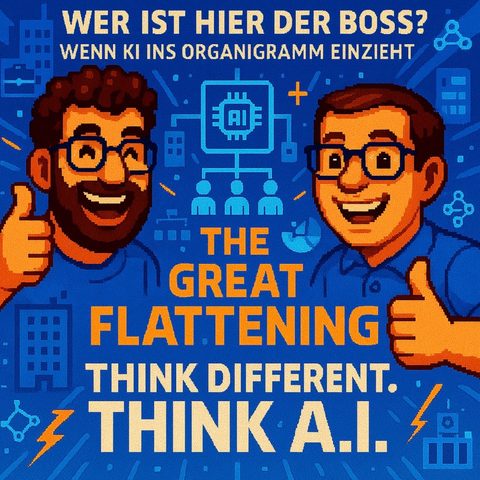
The Great Flattening
Auf Deutsch lesenTopics Führung und ArbeitWissensmanagement
What it is about
How AI flattens hierarchies
Join Jens and Mark as they explore the evolving landscape of AI in the workplace.
This episode discusses the challenges and opportunities AI presents, from changing job roles to increasing productivity. They discuss the importance of soft skills, the potential of AI to create new roles, and the necessity of an AI-first mentality.
With engaging anecdotes and expert insights, this episode provides a comprehensive look at how AI is shaping the future of work and society.
Links from the current episode
Fabric: https://fabric.so/
HeyGen: https://heygen.com/
Advisory Board: LinkedIn Post by Mark
Transcript
00:00:00Welcome to Think Different, Think AI, the podcast by Mark and Jens.
00:00:07Two technology-loving minds that not only talk about artificial intelligence but live it.
00:00:14Here you will find clear classifications, real insights from practice, and a fresh look at what is possible.
00:00:20Understandable, critical, and always with a wink.
00:00:24AI to think about, to chuckle at, and above all to discuss.
00:00:35It’s that time again, a new podcast episode from Mark and me.
00:00:40We have, as always, gone through a wild week regarding all things AI.
00:00:46We recorded a cool podcast last week,
00:00:50because maybe you have already heard one or the other.
00:00:52And that was with our dear colleague René from Values.
00:00:56And we talked a lot with René about the topic of how the world of work is actually changing.
00:01:03in the future.
00:01:04One title of the episode was Boss AI, the new boss-level AI, something like that, right, short, very
00:01:10wonderfully done.
00:01:11And there we actually talked a lot about how the world of work is changing, how
00:01:15society is changing.
00:01:16What do we need to do if jobs change, if
00:01:18requirements change, if people perhaps can no longer start in their jobs
00:01:24the way that used to be normal not long ago, and then basically studied and
00:01:30continued in their job, already knowing where they want to go. And I think that's
00:01:34a topic where we can delve a bit deeper today, I believe.
00:01:38What actually happens? At what points does AI meet us in the future, in our
00:01:46Work environment, in society, where might I see them perhaps in our org chart at the
00:01:51one or the other point, or that's a bit the topic of today's episode, which we wanted to talk about, Mark?
00:01:55Yes, exactly. So that was very inspiring and informative. Last week with René, thanks again for that.
00:02:04This time René is not with us in person, but hopefully he is listening to the episode.
00:02:09You could ask him when I see him next time and the episode would be aired.
00:02:13let's just check here whether the loyal audience is forming and continues to grow.
00:02:18And yes, exactly, we wanted to revisit the topic today, to delve deeper into some thoughts from
00:02:23last time, and incorporate new ideas as well. And now, I would also like to
00:02:28regardless of boss level or not, I want to say again that an old AI camera helped me,
00:02:34to rescue a musical weekend, but we will definitely get into a bit more detail during the episode,
00:02:38we usually have something like a fuzz shake.
00:02:44Yes.
00:02:45Yes. Do you have something to fluff?
00:02:47Yes, yes.
00:02:48Do you want to fluff?
00:02:50Explain again very briefly for the new listener what a fluff shake is.
00:02:54We have the category of the fluff shake in good old traditions, one can now
00:02:59yes, with the episode number also indicating special features of the last episode
00:03:03to draw attention again, for example, if it should happen that
00:03:07errors sneak in, that we have the chance at the beginning of an episode
00:03:13to correct them. That was the original idea behind these fluff checks. I had also
00:03:19heard it in a podcast at some point and found the term quite nice and wanted
00:03:24to take that up for us as well. I think that's great. I just wanted to mention it again
00:03:28for clarification, so I don’t explain it wrong, because the question is, someone approached me this week
00:03:32and accordingly, I have that here at this point. Thank you for your help,
00:03:36perfectly answered. For today's Phososcheck, that's a, that's a, so it’s
00:03:41again just a half-baked Phososcheck, honestly, because it’s not a real Frieder.
00:03:45A half Phososcheck. Is it just a Fahnditzfond or what?
00:03:47Exactly. Yes, exactly. It's not quite, not quite so bad. And perhaps also
00:03:52forgivable, because we are still new stars in the podcast sky and accordingly,
00:03:56that can just happen. And Mark, you used a wonderful
00:04:00medium last time, namely shared a personal story
00:04:04that I wanted to point out, that you've told this heartfelt story for the
00:04:08second time. In one episode, you already talked about your mom,
00:04:13how it was the highlight of your village when she was basically with her Apple Watch at
00:04:23paid at the checkout for the very first time and thus became a sensation from the place.
00:04:28And I think you have brought this up for the second time now. But we should take care
00:04:31that in the future we will also tell more stories and tales from our
00:04:36youth briefly from our history in the moment.
00:04:41So first of all, thanks for the mirror and the feedback.
00:04:43I hope I have some other stories as well.
00:04:46By the way, I have already mentioned Karat, that's my mother for an apology.
00:04:48What I find quite amusing is that I can definitely recall some personal conversations in my own circle where one or another
00:04:53family member also likes to share old stories again, from that side, maybe
00:04:57from the family likes to serve up old stories all over again, from that angle, maybe
00:05:03I've arrived there as well, but I'm trying to do better. You have + **[00:05:07]** a repeat of a story today with me and our listeners.
00:05:07to death today a repetition of history, fine by me and towards our listeners
00:05:12tried, because it's a little better to manage.
00:05:14All good. I'm forgetful anyway, so I didn't notice it.
00:05:18So, there will definitely be another one.
00:05:20So, I like it.
00:05:21I still knew that. But just see how well our listeners listen, that they notice such things.
00:05:28That's feedback, right? So, what's the point of that, actually?
00:05:35Nice that you guys are talking about Fuzzle Shape, what do you mean by that?
00:05:38From that side, yes, we can always bring that up again, + **[00:05:41]** not so that we keep repeating ourselves.
00:05:41so that we don't keep repeating ourselves.
00:05:43But we actually have an increasing number of listeners,
00:05:45that we take everyone along and don't lose anyone along the way.
00:05:49But let's get started.
00:05:51Let's get started and as I said, today we wanted to talk about the topic of AI in the org chart
00:05:58in general, where AI actually appears, to kind of pick up the pastor
00:06:02from the last episode, where we turned, we started into this topic.
00:06:06And honestly, also in the episode Prühe, because we had the episode
00:06:09on the topic, does AI really get vacation in my team?
00:06:13So that means, this topic actually drives us a bit, honestly
00:06:18And it's no wonder. So in many companies, I believe, the topic
00:06:26AI can help and it's not, yeah and it's not just some new territory thing, like perhaps the internet from a few years ago from
00:06:32some people have still seen it, but it seems to be something that has come to stay.
00:06:37And of course, maybe everyone who has dealt with the topic of AI or is involved with it
00:06:44has also perhaps heard this sentence. Yes, because
00:06:49I will not lose my job to AI. I won't lose it to AI itself, but I will lose the
00:06:54job to the person who uses AI. I don't even know who first articulated this job,
00:06:58this quote, but many people repeated it, I believe.
00:07:02have and a bunch of people who are somehow involved with it. Those
00:07:06their saying is, doesn't really matter. It's out there now and I find it
00:07:11actually quite exciting because basically this short sentence says a little about
00:07:17the fact that we should actually, and 'we' means everyone outside, or we can
00:07:25talk about it right away, everyone outside should actually actively engage with how
00:07:29they could use AI in their daily work to prevent this nightmare, this monster
00:07:37and the person maybe personally does not engage in the bed, and I would say
00:07:41I think I'll ask you about that, when throwing and questions, how you see it, Mark.
00:07:46So at the risk, I still remember, because you know you catch it, right?
00:07:51Yes.
00:07:52You've never seen me catch it, different topic, we are with the Kopper, with sports.
00:07:58Thanks, I got it.
00:07:59I know what René said last week, from that perspective I still want to
00:08:03pick up the sentence, after the motto let's take a look, because we had
00:08:07also in the pre-talk. Yes, I can say it right away, where you got the numbers back, but it will
00:08:11be constantly, when you look on the internet. There is one site that tells you about cool
00:08:16tools that are coming out and what you can do with them now. And on the other side sit the speakers
00:08:20on the rooftops and singing about the farewell of jobs, of employment, because AI, when AI
00:08:27basically takes over, companies will hire fewer people accordingly,
00:08:33people who are there will lose their jobs. I don't know how often I read these reports,
00:08:38Microsoft is letting go of this one and that one and they are not hiring at all.
00:08:43You do read that quite frequently. Although not every time is it mentioned that AI is to blame,
00:08:49this is sometimes interpreted literally, but when you hear something about AI,
00:08:54regarding jobs, then this topic usually comes up, yes, with AI you don’t need junior consultants,
00:09:00you then wonder, looking back to last week, how can a future fascist arise if you never hire juniors? That’s one thing and the second is,
00:09:11what I find extremely difficult about this form of presentation is that it only shows one side of the coin,
00:09:19I do believe that AI will generally change the world of work, it will arise from nothing
00:09:25stop.
00:09:26But I find that painting this specter of fear, in order to reclaim that image, is irresponsible,
00:09:32because for me, when I read that so and so many percent fewer jobs
00:09:37are being offered and so on.
00:09:38That may be content-wise correct, but it's ultimately a kind of
00:09:42clickbait and shines a light on one side of the coin.
00:09:44And it's also a very simple view of the coin because there are hardly any people,
00:09:49who contradict that, except for the people who say, yes, AI, that's a fright, that will go away,
00:09:53I also heard someone report who sees it that way. But when AI comes and does that,
00:09:59the question is not answered, yes, what does that mean? What does that mean,
00:10:03how do we deal with people? What must people be able to do? Because even if,
00:10:07when you brought up that saying, I mean, that has now, I don't want to call it evil for the time being,
00:10:12it has become commonplace, and you hear it on every corner, it's not AI,
00:10:15that makes you unemployed. It's the person who uses the AI. I recently also mentioned to René
00:10:21but then in personal conversations that, yes, yes, and it's also the multiplier factor
00:10:25behind it. It's not one person with AI affecting one person without AI, but
00:10:30perhaps the division of labor will then be completely different, and the impact a completely different
00:10:34multiplication effect. And I had also thought about where that saying actually
00:10:39comes from? Who actually cited that? I had mentioned someone and René knew someone,
00:10:42who had mentioned it earlier. But I unfortunately forgot the name from that side,
00:10:46René, if you really listen to this, I'm sorry. I enjoy listening to you and I
00:10:50try to remember everything, but that has just somehow slipped out
00:10:52of my head. Should I find that out, I would pass it on in the
00:10:55next fluff check. But that's a bit the point where I'm
00:10:59I also hoped that when we discuss, I don't think that
00:11:02we were born with silver spoons in our mouths. I believe that both of us
00:11:04still have our own opinions on what that means. The skills to handle KG.
00:11:09How should one approach this?
00:11:11I was really glad that we could revisit this entire topic with such a
00:11:14focus extends to not just leaving people to figure things out on their own
00:11:18as they might read this message, perhaps not having heard the last episode yet,
00:11:22right.
00:11:23I think that's also the last hint, so please listen to the episode again, because it
00:11:27is really worth it.
00:11:28Also, I listened to it again, not just for editing the audio,
00:11:32but also to engage with the content again.
00:11:34We are on the verge of a change, and regardless of how well AI meets expectations or
00:11:40not, it has come to stay, and it won't be any worse than it is today.
00:11:44won't be either.
00:11:45So I believe if you take a closer look at the numbers, there is everything
00:11:52possible, and that also raises the question of which figures are currently accurate
00:11:56exactly, and I believe from the IFO Institute here in Germany, they expect
00:12:01that around 20 to 30 percent of companies find that AI leads to job reduction.
00:12:06However, on the other side, I also believe about 5.6 expect that actually more jobs
00:12:09will be created.
00:12:10There’s still a difference, but I think that is always a topic as well.
00:12:15I believe that every technology that has ever been introduced always triggers fears.
00:12:20We had that last week in the podcast with the example of automation on
00:12:25assembly lines.
00:12:26But it simply takes some time, of course jobs will first be lost.
00:12:29It takes a moment for us to adapt, until then actually more productivity
00:12:35is created. This time it is indeed a bit dramatic due to the speed.
00:12:41So accordingly, I wouldn't want to downplay it or soften it,
00:12:48that there is a certain danger from the whole OrgChat. So that has nothing to do
00:12:54with the fact that it’s only entry-level jobs. We also talked about the
00:12:59boss AI last time, and there will be changes at all levels because it
00:13:04relates to the topic of use cases, AI has general capabilities to
00:13:10optimize things and make processes more efficient and accordingly
00:13:16can indeed lead to a change in the organization in many, many areas.
00:13:20And I believe we should not deny that this can happen and that this
00:13:24change is happening at a speed that is more dramatic than before.
00:13:28So I would say, I might not want to come off as a pessimist,
00:13:33optimist, but I also want to say, what are we talking
00:13:37about here?
00:13:38We are talking about, when you first hear it, that people, let's say,
00:13:43become unnecessary for certain things.
00:13:45I would like to go one level deeper on that.
00:13:48If you look at AI today, you can analyze data super well with an AI.
00:13:51You can let it produce against it, you can recognize correlations.
00:13:54But if I now think, I don't know, are you worth everything all day long?
00:13:59If I consider what I do all day long, then I can do more with AI
00:14:05But let's say, with everything I do, in today's impact, if you only look at me,
00:14:09no one has really examined that directly yet.
00:14:12If you multiply it now and say, okay, good, yes, maybe you actually need
00:14:15fewer junior forces here and there because there are now slides somehow summarized differently,
00:14:20then that is a fair point.
00:14:21That's AI, which, I'll put it this way, is able to
00:14:24prepare things and make them available to the next level of skill or whatever you want to call it,
00:14:30to people.
00:14:32But I believe this case, like the motto, I've now invested no idea,
00:14:36this and that many millions in AI and at the end of the day, in hard numerical data facts,
00:14:43there's a process optimization, a saving of employees.
00:14:47Something, really hard evidence here with McKinsey, Boston, whatever they are all called,
00:14:53proven, I believe that there are many thoughts and ideas, but I think,
00:15:00in reality measurable, there's still a bit left to be done.
00:15:04Everyone believes something will happen.
00:15:06I mean, if you look at it, there are so many companies that then from reports,
00:15:09that they have introduced cases, which then are still not necessarily
00:15:14automatically fully utilized in the here and now today,
00:15:20but still need to establish themselves. From that side, I do believe that AI, AI,
00:15:27Agents, identity, how all that is called and will be, gaining a foothold in a landscape,
00:15:33things will be adopted in a landscape, but that one also applies here, as a company,
00:15:38must deal structurally with it. And that includes, of course, the technology,
00:15:43on which basis. It doesn't help you if department A does something on technology B and
00:15:49department B does something on technology C and so on. I always say that it's like you
00:15:54have, I don't know, 500 Power Apps of which 300 are no longer maintained, 100 is the colleague who
00:15:59is responsible for it and is no longer there or the colleague is gone and then you find yourself there, you can
00:16:03be proud to say, I have 500 Power Apps, but of those, only about
00:16:06ten are still operational. That we don't allow this, that we don't transfer the entire structure,
00:16:11and that includes, on one hand, technology, on the other hand, stringency, sustainability,
00:16:17what requirements do I have for something like this, to leverage the potential, to operate the platform,
00:16:23just to pick up a few nice terms again. And in the end, it also includes
00:16:28your social and employee-related responsibility. What does that mean
00:16:33for your customers? What does that mean for the community in which your company operates? What
00:16:38does that mean for your employees, staff, what does that mean for the people who are
00:16:43in training with you, for the students, yes, how do you deal with that, regardless of whether we now
00:16:48face economically challenging times or not, when you take a look across the pond
00:16:52and listen to the talks about digital sovereignty and so on, but there are big tasks,
00:16:57where much still needs to be fulfilled and I stand by it, I can well imagine,
00:17:01that once all this is established and seen as a necessity, then indeed
00:17:05perhaps one or two personnel capacities may be unnecessary,
00:17:09resulting in possibly one or two people, so, yes, I think it will arise,
00:17:13but that many other opportunities suddenly emerge, how do I handle that?
00:17:19So I'm not saying that AI will definitely lead to mass unemployment.
00:17:23No, I don't believe that either. I actually believe that,
00:17:25because on the other hand, there are also situations where people say,
00:17:28we will have an incredible increase in productivity.
00:17:32Productivity gains do not always automatically mean that we have to reduce staff,
00:17:37we can also create much, much more from that.
00:17:42And as you mentioned, time to market, new products. I believe new roles will also arise,
00:17:48that we can't even think of right now. So we had,
00:17:51when we talk about topics like career vacations or any other matters, we would now
00:17:57need team coaches. Essentially, we also have to learn to work with the AI coaching.
00:18:04So new topics will simply emerge. When you say we have an AI that acts as some sort of boss for us.
00:18:10Just imagine, it's already like that today, I believe if one observes certain behaviors quite hardcore,
00:18:16in the algorithm, to what extent the drivers drive efficiently.
00:18:20Yes, I spoke about logistics, that AI naturally optimizes logistics.
00:18:28This time, I had also forgotten to bring up the topic,
00:18:31that there is indeed an extremely tough control portion done by companies
00:18:37with the help of, well, algorithmically, not even from the general AI,
00:18:41that we've been talking about today.
00:18:43And I believe these are things.
00:18:45New things will emerge from that. How are we currently dealing with ethical questions,
00:18:49what you just mentioned, what does that mean for my, for my immediate
00:18:54society actually? When I say I'm optimizing myself to death and
00:18:58optimize the people out. I believe that this is not the right way
00:19:01either. I think this topic of productivity gain will
00:19:05become more evident. We will be able to accomplish more things. Just like
00:19:09technology has always led to us being able to produce more, healthier
00:19:15overall and raise our standard of living, because we are advancing technologically
00:19:19progress.
00:19:20And I also think, I’m more positively excited that this will help
00:19:23as well.
00:19:24It is important, though, that everyone should engage again and everyone should perhaps
00:19:29not be able to say, in my standard portfolio, in my CV, that I somehow
00:19:34know Excel, but I believe in the future it will be increasingly important that one deals
00:19:38with the topic of prompt engineering, that I’m knowledgeable about AIs, because I believe,
00:19:42there is a lot of new things emerging there.
00:19:44I just this week saw again on Product Hunt, that's a website,
00:19:49where new products are constantly being presented.
00:19:50Sometimes startups introduce themselves there and for some time now, since the Schedule-PT moment,
00:19:57there have of course also been many, many AI applications being presented.
00:20:00And good and bad, one must say.
00:20:02What I was getting at is that this time there was one that briefly caught my attention that I looked at because it
00:20:11was about a
00:20:14Yes, app development, there are already thousands nowadays, and prompt is something that then codes, then the AI codes the entire website or
00:20:24a complete application for you
00:20:26although often it is still not good. So that’s mostly okay for prototypes.
00:20:32Is it okayish if you have an idea of what’s going on? Often this so-called
00:20:38Wipecoding, which means I program purely by feeling. This is a fixed term,
00:20:44that has just developed. This Wipecoding often leads to you quickly doing some Wipecoding,
00:20:48having something useful at first, but then actually spending hours on end again
00:20:55to work out the errors that occurred.
00:20:58And this new thing that briefly grabbed my attention was that they are now advertising
00:21:05that this AI will also test itself afterwards.
00:21:09This means they essentially have another AI as an agent that then examines the
00:21:13end product, so the application or the website that one AI builds, and then automatically
00:21:17reviews it, tests it, and then basically works out these errors in its own loop.
00:21:21And I believe orchestrating all of this, keeping everything in view, making the right decisions, whether it is in a private environment or essentially in a professional context.
00:21:30He calls for a new type of skills, to look and see what the right technology is, what I can try out, at what point I can test it, how it fits into my team processes.
00:21:39I believe this is a huge challenge where we, I think, still do not have adequately trained and developed people for this topic.
00:21:48Topic. Yes, but by saying that you are actually also saying that there are many things that
00:21:54can be used. But I believe it really also includes the knowledge that they exist.
00:22:00That is one thing, the availability. Of course, this also presupposes the other. But there
00:22:07we are back to what we said at the beginning, also the, I would say first of all,
00:22:10willingness to engage with the topic, whether it's the company, the employee, the person,
00:22:17to deal with it. When technology appears, to consider to what extent, sure, it can't
00:22:24be that everyone reads the trend radar every morning. That's not the call to action. But
00:22:28when something new comes out, not to shut oneself off from the new. So I believe that in
00:22:32the generation of my parents, I greet him out, they are definitely listening again. Back then it was
00:22:37somehow usual, the status at the Entertas is still data release, they have typed their stuff with the house
00:22:40372 simulator from IBM somehow typed their stuff there. Later they had a subway and so
00:22:46stuff. But that was very, let's say, durable with what you interacted with.
00:22:53If you look at the AI world today, you just said it yourself, right? That presents
00:22:56someone who says, okay, here I have no idea, wipe coding with quality assurance.
00:23:02If you look at image generators, right, the new nano-banana stuff from Google, which here
00:23:08produces great images without finding the inventory, whatever the whole stuff is called,
00:23:13it's so fast-paced. To recognize for yourself, first, what is the tool of my choice? Secondly,
00:23:19how does it change my ability of prompt engineering? If you just said that again
00:23:24prompting is an important skill, we also said last time that one should
00:23:28deal with it, because prompting is different than searching, where there is a text field,
00:23:32I might need to approach it differently than the familiar web search engines from Sturr,
00:23:37but even the prompting is changing, because now we also have GPT-5 and GPT-4 and
00:23:44Claude and Croc and whatever they are all called, also working with different system prompts, so with
00:23:49different guidelines entering the race, and you have to have a bit of a feel for that.
00:23:55How do I communicate with the machines? How do I handle the text window,
00:24:01as far as we will still have text interfaces in the future. All of this, if, if, if shows
00:24:06how everything is in flux. But if you ask people today, as I said, what
00:24:13you should recommend, engage with it. Take a look, let yourself be shown
00:24:18and think about how it can help you work in smaller, more flexible teams,
00:24:24so that one can also speak openly across hierarchies about things.
00:24:29I mean, just because the boss of my boss is knowledgeable about AI,
00:24:36doesn't mean I can't talk to him. And it’s not a breach of hierarchy,
00:24:40but that is just how it is. Let's think together about how we
00:24:44can approach this and not just think in classic silos, this is my job,
00:24:51don't tell me what to do, no idea, but I think that decided a lot
00:24:55from the exchange. You might know it as well, yes, I sometimes run around
00:24:59in the company doing a bit of, how can AI help me with whatever, and
00:25:04now you could say, yes, why would I care how cool Mark does it, no idea, the podcast
00:25:09he cuts, we also wanted to do another episode, here with a look behind the
00:25:12technology, but then it might still come out in the conversation, yes, damn, I have to
00:25:17do something with images too, I have to do something with towers, with video, with text generation,
00:25:20with, no idea what, and this is how we inspire each other by
00:25:24also talking about it, as I said, being open-hearted.
00:25:28It has nothing to do with love and all that, that's not the point.
00:25:31But just this change that is coming towards us, we welcome it with open arms
00:25:36and not say, like, it's all devil's work, because it, as
00:25:42said, has come to stay and nobody loses anything
00:25:48by just taking a look at it in their quiet little room, no matter how you feel about it
00:25:52because completely ignoring it will hurt many. I'm sure of that.
00:25:58Yes, I also think a bit, so the poorer middle management, it's often
00:26:05beaten up, whether in any transformation projects or anything else
00:26:10But I believe that's a topic. But I think it is actually
00:26:13often mentioned regarding the theme that it could become a bit flatter. Things are also
00:26:18faster, and one can also quickly copy something from others. I think,
00:26:22all this will lead to a somewhat flatter hierarchy company and to quicker
00:26:27decision-making processes. And that will, of course, actually mean a rethink in the
00:26:32place because I actually believe that hierarchical layers might
00:26:37simply fall away, because the higher the productivity in such a cross-functional team then
00:26:42perhaps is, that then perhaps an additional 50
00:26:45or 100 AI agents could be employed from the team, the more productive it can be and the stronger
00:26:53it must also be connected with the strategic level, which is perhaps simply
00:26:57a company that is at the higher level and all the layers in between slow down
00:27:01the innovation process. And I believe, as I said, the Indie-Jesse
00:27:06from Amazon, he has now also started to throw out the Mitre-manager and say
00:27:10manager hinders innovation. And I think that is such a topic,
00:27:14Sure, that really needs to be looked at. What actually happens in
00:27:19that moment? What kind of rethinking does it require in the company, how decisions
00:27:25are made, at what point it really has to be responsibly produced out
00:27:30there or towards customers, without needing three
00:27:35or four decision-making circles before one actually has a decision behind the principle. I believe,
00:27:40This is actually totally essential and important, that with this AI regulation now, where that
00:27:48is already good or not good, but indeed websites are being built, code
00:27:52can be produced, reports can be summarized, topics can be analyzed,
00:27:57that is diverse, in terms of topics that can be addressed, that in principle
00:28:01this, you know, the push and the speed of innovation is just much higher and
00:28:08That naturally requires that, if my company is to remain in the market, I
00:28:14then also need to bring this innovative power to the forefront.
00:28:17So it doesn't help if I have a team that is somehow AI labeled
00:28:20as a team.
00:28:21But the rest of the company is not dealing with this topic, because then you have
00:28:24two or three who might be able to get something off the ground or three or four,
00:28:29five teams, who might be able to get things going, but the rest holds
00:28:32them back.
00:28:33You found a nice point there because when discussing this topic one often thinks, yes, this costs jobs or this affects the workplace; there’s always some undertone, that’s how I felt during the conversations, it’s like we talk about software developers, controllers, accountants, you know, all sorts, but we also talk about managers, team leaders and similar roles, who might end up somewhere else, in a different setup or perhaps not at all.
00:29:03not which responsibilities we need to take on. And one might also think, let’s say,
00:29:09what can we take away from this? Regardless of the question, engage with the
00:29:12technology, how can it help you make quick decisions? How can it
00:29:18help you understand a topic faster? I recently had a discussion because I
00:29:23am working on an internal provision of a Northback lamp functionality,
00:29:26in the sense of how much efficiency can we actually gain when we say,
00:29:30ad hoc, we need to understand a topic, to understand it together. How do we get this
00:29:36quickly into the masses in terms of both the provision of information and its processing
00:29:41as well as mutual understanding and analysis? There's a notebook function,
00:29:47like the one we have from Notebook LM, which is the most well-known example on the market
00:29:51provided, we get amazing results. And what also changes is it changes much more
00:29:55the interaction with people. So earlier, I mean, you must have encountered
00:30:00another leader in person. I’ve also met my share of leaders
00:30:04in person. For me, they are also leaders. And you do indeed meet people who
00:30:10have different paradigms, like the motto I trust my people.
00:30:17Or do I want to be the expert who tells them where the journey is going?
00:30:22I do micromanagement. Show me every little detail separately and then let it go. Those are
00:30:28things where you really have to think about how to position yourself regarding these questions
00:30:32in the future. So, I always advocate trusting people, because they know best
00:30:38how everything works. I don’t have to come down from my ivory tower
00:30:41and proclaim wisdom. They should already know that. And if
00:30:46they don’t know, we can look together at how to get there.
00:30:49But especially with things like micromanagement and such nonsense, in light of what AI is
00:30:55showing me, is completely outdated. So anyone who is already
00:31:02of the opinion that they are being accused of that should take a quick look in the mirror and
00:31:06consider whether there is some truth to it, because I believe that will change and in the last
00:31:11For years, please allow me to say, the topic of trust is a double-edged sword,
00:31:16right? Just as you say, okay, I trust my people in that sense, they must also be able to trust you,
00:31:20Accordingly, again here, we need to look together across different departments. What does that mean
00:31:26for us? Let’s try things out together. Not just the theorists. This applies to all
00:31:33other IT topics as well. Just because I have a PowerPoint slide that states something is really
00:31:38great, that doesn’t mean it’s great and that it’s really easy and that it’s
00:31:43everyone can, no matter how pretty the PowerPoint slide is, reality is sometimes different in one's own
00:31:49context and it also applies here not just to sit down, I read a book
00:31:54or watched a video, but really to try it out, but of course at this point
00:31:59the disclaimer as always, to experiment wisely, so no production data, no personal
00:32:05related data will always just be in a sandbox, but to engage with the topic, I repeat myself
00:32:10in today's episode, open up.
00:32:12Yes, I think that's just the thing. So I believe the topic of speed,
00:32:18innovation, to finalize that again. I think it's important that
00:32:21transformations that have already begun, like moving towards a flatter hierarchy,
00:32:26moving towards greater diversity in cross-functional teams that can fulfill tasks. That
00:32:31will continue. It must consistently continue because now this cross-functional
00:32:35capability that the team has to implement end-to-end topics and
00:32:39thus to be able to take responsibility for them. It will simply be expanded additionally with the topic of AI
00:32:43as agents, as an agent system that surrounds it. I believe that's just something that
00:32:49will give a boost and it would be wrong to pull back and try to
00:32:54reintegrate hierarchies that would attempt, through a strong, strong governance,
00:32:58to only allow AI in the company for very specific topics or points. I believe,
00:33:04You just have to implement it everywhere. Everyone has to look for themselves,
00:33:07What can they do? Every process, every step of work that we do can be looked at to see if it already works with AI and can be improved.
00:33:15That's not happening everywhere yet. So we've also brought examples time and again.
00:33:19It's still not functioning perfectly sometimes to build another app or something different.
00:33:23I just mentioned that, but these are the right steps being taken.
00:33:27And now, to put it bluntly, from a specific example in the field of design.
00:33:31Of course, it’s also clever to perhaps already get some help there.
00:33:35Wireframes, so the structure of a website and an app, when you build that,
00:33:42you can also quickly let AI do that.
00:33:44That doesn’t mean that the entire design has to be done afterward, but
00:33:47that you can relatively quickly have the blank sheet of paper that is otherwise always there,
00:33:52is a bit difficult to fill, already filled with content, which one can
00:33:56then rub against their expertise and maybe create something new from it.
00:34:01can then rub up against it again out of their own expertise and perhaps create something new from it.
00:34:02doesn't mean that AI should take everything away or automate everything, but rather that
00:34:07it can mainly be in a supportive role. I believe that's a totally
00:34:11important aspect where it can help. And on the other hand, it offers so many new possibilities,
00:34:16that one may not have thought about before. And that's why it's always again
00:34:20important to engage with it. I don't even know if I've mentioned that example before,
00:34:23but I found it totally eye-opening for me when the topic
00:34:28of multimodal AI models came up, so no longer purely text-based, but when it was shown
00:34:34that when I walk around with my phone, I can record something that needs repair
00:34:39needs to be done or ChatGPT tells me how to fix it or I found an
00:34:43example on the internet where someone showed the topic, saying they were
00:34:48walking through a construction site and just let the AI take it in and there the
00:34:53AI, of course, being aware of the regulations in the background, could immediately
00:34:58identify areas on this construction site that were a bit tricky from a safety
00:35:02perspective and then created an Excel sheet from it.
00:35:05And that's obviously great.
00:35:06Just imagine, we can do something like that; it also prevents accidents, other issues,
00:35:10that could occur.
00:35:11And I believe that engaging with this topic has no end.
00:35:15I think there are many areas we haven't even thought of where AI
00:35:21can be applied in daily processes, and that's extremely important.
00:35:24for each individual, to say, think about it, always imagine, when
00:35:29you have a task to accomplish, how could I actually do that with AI?
00:35:34So a bit like taking on a kind of AI-first mindset in your daily
00:35:41doing in both private and professional environments, that you simply keep saying,
00:35:46okay, how would AI actually do this now?
00:35:48What could I do now if I were to deploy a group of AI agents?
00:35:54I think that's totally valuable and important to do.
00:35:57And if you gain insights from that, talk about it, create transparency, engage in exchange.
00:36:05And, what you also shouldn't do is, oh, I've dealt with AI now,
00:36:09that went well once, then of course it's the savior, it's not the case at all.
00:36:13it really isn't.
00:36:14when you look at this in my larger context of companies,
00:36:17you must not forget that you need a fertile ground not just with the workforce
00:36:23along the lines of everyone can, everyone is open, everyone is taken along on the journey,
00:36:29but also something like robust datasets here that you can use as a basis,
00:36:34because if you also apply AI, shit is still shit out. AI can do a lot,
00:36:42I would say it can rescue a lot from human language, but if you
00:36:46just load in nonsense, you cannot be surprised if nonsense comes out and
00:36:51even if you load in good data and you don't pay attention to a few rules,
00:36:56we can also eventually discuss what rack techniques there are,
00:37:00then you shouldn't be surprised if only
00:37:05parts of the loaded content are processed when working with the AI agents because they are simply ignored
00:37:10because of the incorrect use of a well-intentioned technology, things can automatically get lost
00:37:17and slip through your fingers. That's an important point. That's what you just
00:37:25mentioned. I believe there's also a saying that one should be transparent
00:37:30about what one is doing. So I think it's really important that we, just like a
00:37:36person, AI can also make mistakes. And that's, of course, particularly in the business
00:37:40environment, always important to say, okay, who actually has the
00:37:43decision-making authority, who is responsible for what
00:37:48happened in that moment? And I think that's why it's really valuable when
00:37:52you talk about it and don't just somehow hide it,
00:37:56oh, look, the PowerPoint, I made it so well, feel free to say that you made it
00:38:00with AI. It's not a big deal because it just helps,
00:38:03that everyone starts to deal with the topic and says,
00:38:07okay, that would also simply be faster. Why should I now
00:38:10basically sit around for hours or days doing something when I can do it with AI
00:38:14significantly faster. And I believe there should be transparency about this, because this transparency
00:38:19also leads to engaging with the topic. Can I even do this? Can an AI,
00:38:23just as an example, let’s say, there are three recommendations at the end in the PowerPoint
00:38:28that I present. Just because I present them, it doesn’t mean that there’s not
00:38:34maybe one recommendation and a decision that was made by an AI
00:38:39in this case, this recommendation not only being on that slide, but the
00:38:43content of the recommendation. If the recommendation is implemented one-to-one, what
00:38:48am I then, actually, the one who has put that decision in the room
00:38:52so to speak. So this means, this topic, AI might already be there, AI might already make decisions.
00:39:00Where might AI already be present in my orc damage? This is again
00:39:04not a question that needs to be answered in three or four years and which is today
00:39:07simply there. Because it is already so today. And therefore, everyone should, in the interest of their colleagues,
00:39:13their bosses, and their employees, handle it with super transparency where we use AI,
00:39:19because I believe it can simply inspire, maybe for some,
00:39:22then and promotes discussion and also about rules that one might need.
00:39:26And also about failure, even if it goes wrong. Let’s say, because I have
00:39:32mismanaged before, but maybe it really is just bad. But only,
00:39:35if you talk about it can you either optimize yourself or save others from the
00:39:40same mistakes. And for that, I mean, at this point one has to say, this is,
00:39:45well, I don’t want to use the term uncharted territory, but there is plenty of space in this pie,
00:39:50where everyone can make a contribution, even if they are just starting with the topic today,
00:39:56they can offer a valuable contribution to the overall development because they might
00:40:01look at the whole topic from a different perspective, with a different focus, with a different test case
00:40:06and thus have the butterfly effect, preventing the next person from making a foolish mistake,
00:40:14inspiring someone, and simply engaging with it.
00:40:17I mean, you know yourself, there is no Bachelor of AI or something
00:40:22with the motto, now I am the godfather of whatever.
00:40:26Each of us has our expertise, each of us has tried something, maybe
00:40:29one listens more to one or the other because they have a certain follower base, where there's
00:40:33expertise in another topic. But in the topic of AI, it is even more than in other
00:40:38technology topics. You can really meet everyone at eye level, because it
00:40:44simply because it's so new and especially so fast-paced now?
00:40:48Yes, yes. And above all, it's not just a purely IT skill in
00:40:52sending topics. So technology has always been a technical skill and now it's actually
00:40:57more that perhaps soft skills will become much more important in the future, because we've already
00:41:02talked about how AI is somehow humanizing again, but it reacts,
00:41:08it needs to be properly prompted, it can go in the wrong direction, it can work in a team
00:41:13also take on roles and then deliver those roles, and perhaps they weren't the desired roles at all,
00:41:18and that's why the outcome is weaker. There are plenty of studies,
00:41:22that show, depending on how I prompt such an AI, in what emotional state I present it,
00:41:26that the results can get better or worse. I believe that’s also
00:41:29why soft skills are partly important, so people who are good at dealing with others
00:41:33may be asked even more in this near future world, because we will
00:41:37probably also handle Kais well. That means, there will be completely new topics
00:41:40emerging, in my opinion, that are not just pure IT solutions.
00:41:44You're laughing at the imagination that there are negotiators who can talk well and psychologically
00:41:50with the hostage-taker, so that they will be sent in when AI takes over, threatens you,
00:41:55and threatens to delete your data.
00:41:58Maybe.
00:41:59Perhaps.
00:42:00No, but that's just it, I believe there is indeed still a lot in there and there are
00:42:06plenty of science fiction films that have already dealt with this in a very humorous way,
00:42:10what happens when such an AI goes completely off the rails and how to
00:42:13negotiate with it.
00:42:14But as I said, I believe this is indeed a trend that I am already noticing.
00:42:21and that I personally notice when I am out with my KIs.
00:42:25You recently posted that article again and I am also curious
00:42:29to see how your advisory board, since you have built several KIs that actually
00:42:34negotiate and communicate with each other and give you advice, you can share
00:42:38a few of your thoughts about that in a bit.
00:42:40But before you do that, I want to bring in an example
00:42:43to wrap up the topic of what I've been observing.
00:42:46Moderna, I believe, was the one that also had some relevant news,
00:42:52a bit more heated. The merger of IT and HR, these two departments, due to the AI revolution.
00:43:00This means that what we have just been discussing is becoming increasingly relevant in companies
00:43:04and is also manifesting in this way, so not just through AI in the
00:43:08workplace, but the workplace is also adapting to the AI revolution because they say,
00:43:15These are fields that simply belong together for different reasons, and we have already skimmed over one or two of those reasons.
00:43:23Yes, as you just mentioned, the advisory board, for those who have not followed it, I shared it on LinkedIn, I was pondering the question.
00:43:33Can I actually have things prepared by an AI for me, whether professionally or privately?
00:43:40What goes beyond just waking up the chat window and telling the thing,
00:43:44evaluate this, blah blah blah, to get a neat prompt, but that I build a
00:43:50workflow and say, I would like an evaluation, a development, and that then
00:43:54behind it various agents in various roles, so we simulate people with
00:44:02certain characteristics, discuss among themselves and then deliver the results to me. I
00:44:08have come up with such persona prompts, so that moderates the whole thing and so on, that should
00:44:13then be a very senior, experienced consultant who has often led human boards.
00:44:19I wrote all of this down as listed prompts so that this agent then
00:44:24acts in my workflow and I made 20 more available to him.
00:44:31There was a Steve Jobs, a Tim Cook, a Jeff Bezos, but also an Angela Merkel,
00:44:36they were all included, and then I also faced the question of how to get as much as possible?
00:44:41I mean, I’m clear that this is not Angela Merkel and Steve Jobs,
00:44:45who are actually talking to you, but how do you get as many traits as possible? So,
00:44:49what do you think from the outside makes these people so successful?
00:44:54How do they present themselves? What is important to them? I then asked Manus, who is my favorite AI,
00:45:00to analyze this for me, tell me,
00:45:04what characterizes these people to derive a persona prompt from it?
00:45:10I then posted this on LinkedIn. I received so much valuable feedback,
00:45:15that I could further refine this persona since I received
00:45:21recommendations, scholarly papers that further helped to
00:45:26delineate the personalities a bit more in the attempts. The last topic,
00:45:30that I discussed with them, not that I discussed all personas at the same time
00:45:34but I limited the word to a task focused on Johnston Iftham Cook and Steve Jobs and asked them
00:45:41to research the current developments at Apple and in relation to the Apple Vision Pro
00:45:46and give me an insight into where this thing will land in three years, what influence it has on AI, what influence it has on
00:45:53the whole AR,
00:45:56VR, Metaverse,
00:45:58spatial computing, and how all of this will pan out, and it was really
00:46:02exciting to see how these systems discussed among themselves. So Tim Cook, in the sense of,
00:46:09So, it's not Tim Cook, but the person who got a Pump, who is supposed to act a bit like that,
00:46:15was more about strategy and how many units and stuff like that,
00:46:21rather than ice cream; Pump was more about aesthetics and buttons and interactions and form factors and
00:46:28weight and all that other stuff, while Steve Jobs was more along the lines of what problem
00:46:33are we trying to solve? How could we tell the story around that?
00:46:37The three then discussed together, guided by this senior consultant in
00:46:43the discussion, and each person pretty much gave their statement, the
00:46:47others could comment on the statement, and word analyses were done,
00:46:52and, and, and, and then in the end, it was all compiled for me as a big
00:46:56document, with the results of each discussion phase,
00:47:01meaning what the individual agents wrote, and then at the very end a summary,
00:47:06which the senior consultant extracted based on an initial question for me.
00:47:12And even though I wouldn't say that I am the better CEO,
00:47:16I would totally be interested in a job offer, greetings out to you, I'm very interested,
00:47:20no, just kidding. It was really exciting to see how the same AI models, I mean,
00:47:27the underlying principle is always the same AI model, which is guided by a prompt,
00:47:30bring up different perspectives and ideas. And if you now
00:47:35just share your knowledge, what do you think works well? That was good.
00:47:40It’s bad when you let too many prompts talk to each other, like 20 of them; it just doesn’t
00:47:45work, my workflow plummets, I try to manage that, but by the end, it goes totally
00:47:48haywire for me. Yes. For that reason, I've been trying out how it is when I use Voice Cloner
00:47:53to get the right voices and then listen to the conversations of the people, it’s really amazing.
00:47:58You really have that, so you not only have the feeling that it's Steve's voice
00:48:02but the agent tells in the text it's how the thing has learned it
00:48:08based on all the keynotes. I don't think Steve spoke in the media like this
00:48:12but it's so fascinating how this impersonation works or
00:48:17it's one or it pretends that's that's the bomb and before I let you go
00:48:22because I already feel you want to say this again, just a quick note because I talked about the manuscript
00:48:24just to resolve the introduction
00:48:29Manus saved me a musical weekend, why? If you know me privately,
00:48:35you know I have a mouth, I have a wife, I have two children, I have
00:48:37a Melkrate car and I had forgotten to book a hotel for a musical weekend
00:48:43and I hadn't reminded my wife about it and I take care of
00:48:47So I called the hotel first, then went to the online portal, totally totally
00:48:52totally, and then I thought I must stay in the hotel room, can't go to the
00:48:57musical, the times shouldn't be too long and not too short, and you haven't
00:49:00seen what you're doing now, I gave Manus the task, Manus found me
00:49:04actually accommodation where dogs are welcome, which isn't too far
00:49:09away, where I even have a destination charger, so a charging point for my car,
00:49:14where it's not too far to the musical, and he booked it for me because of my Bell-Pelle-Count
00:49:21as well. And then in the end, I had my email in my inbox,
00:49:26hello Mr. Zimmern, we are pleased to welcome your family, this is such a private
00:49:30accommodation then. But that was already, so I thought again, damn effort,
00:49:34you're keeping yourself busy with this every week, you came relatively
00:49:38late to the point that Manus could help, and it was difficult to express.
00:49:42Manus saved my ass.
00:49:44Yes, I still have to smile a bit because essentially the AI is being
00:49:54introduced everywhere right now, they have already said, then everything will be
00:49:57labeled with AI and I was at a travel portal and there was this,
00:50:01there is a functionality called AI filter, which means you can
00:50:06filter for things like tennis court or anything else you're interested in,
00:50:10when you're looking for a hotel. But this AI filter works like 0.9.
00:50:15So every time I enter something there and would do it the way you describe it right now,
00:50:19I simply get no results at all. That's always one of those things. It
00:50:24actually works better if you do it directly in the tools,
00:50:28whether it's Manus or a Chat-GPT. I've also had very,
00:50:32I've had very positive experiences with, so give me the travel tips then,
00:50:35in connection. I want to be near the beach and might want to sharpen up and might also be interested in
00:50:40hip-hop and then I also get a hotel that is in a somewhat
00:50:45more rural environment where life pulses, where maybe graffiti is also in the corner,
00:50:50that's just extremely strong, honestly. So, those are then the normal filters
00:50:56and search functionalities that you have previously found on the Bookings and Hotel.com websites,
00:51:02that you've visited so far are simply miles worse and totally off compared to those.
00:51:07removes what you can essentially do with your personal, personal AI then
00:51:11just start hunting. And I think, as I said, this is simply a topic that will completely
00:51:16further change the way we search for information in the future, when these
00:51:21Things might be even more intuitive and not always have to come out of a bit.
00:51:27I also have to think that I can do this now. I believe there’s still a way in the future to make this more accessible for everyone who might not always think, ah, I can do this with AI too.
00:51:39Yes.
00:51:40Now we’ve deviated a bit from the whole organization is AI.
00:51:44Totally off.
00:51:45Yes.
00:51:46When we started the podcast with both of us, we wanted to give the whole podcast a
00:51:50give a bit of structure.
00:51:51We had the content, we had the fluff day.
00:51:53I would like to kick off the next level today and once again do the pick of the week
00:52:00or the pick of the podcast.
00:52:02Let's see what cool title we can come up with.
00:52:04to give, where we each throw in what we might have found in terms of cool tools,
00:52:10cool topics that aren't necessarily mainstream,
00:52:16and have already flowed through the net 30 times, I would say.
00:52:20I'm being a bit cheeky, as I'm talking, I'm just continuing.
00:52:24My tool is called Fabric.
00:52:26I don’t know if you've tried Fabric before, I think Fabric is really cool.
00:52:31there is a web interface, there is an app, you can use it in a very simplified way
00:52:37the motto is, I throw everything in, the thing independently structures the data,
00:52:41I can interact with the data collaboratively or by myself,
00:52:47connections are made, documents are created, it’s kind of like
00:52:52a second brain, the thing tries to support me so that I don't
00:52:59have to create my own structures like previous solutions such as Notion and all those names
00:53:03I have to come up with something where I then do all my work, but
00:53:07I try to further abstract it for myself and can deal with notes,
00:53:11websites, screenshots, PDFs, whatever, organized the
00:53:17information, builds coherent thought spaces out of it, that's what it's called, in which
00:53:22you can work alone or with other people. It's pretty cool,
00:53:29I really like it right now. If I don't like it anymore, I'll go back to reporting,
00:53:33it's still quite fresh in my toolkit. From that perspective, I thought today could be
00:53:38something where, yes, your difference says, I know it, I've known it for a long time. I've only had it for a short while. That's
00:53:44my little addition. And now comes the most exciting moment, where you have to let it in.
00:53:48Now the question comes back. Did you bring us something as well? Yes, and I
00:53:54I spontaneously remember my Ringsel because of the...
00:53:58I don't know what you had before.
00:54:00Yes, only you. I didn't want you to...
00:54:03I know. Sweet secret.
00:54:05This time I would call it Hey-Gen.
00:54:09Hey-Gen is basically a tool where I can very, very easily create voice AI from short audio snippets,
00:54:16so I can have my voice replicated.
00:54:20Or also create a complete video animation of me, so a video avatar of me very easily
00:54:25can be made.
00:54:26From a simple image.
00:54:27We can also take images that you somehow generated in Mid Journey or anything else,
00:54:30put them in there and you have the bot that speaks in no time.
00:54:35the text that you enter, in any language, with any tone, that is
00:54:40really quite cool.
00:54:41So hey Jan, for those who don't know yet, we'll put the links after in the
00:54:44show notes, definitely try it out.
00:54:46The reason I made the switch, Mark, and then we’ll end the episode now as well,
00:54:52as often with a look forward to someday, because just talking about the memory
00:54:57you just mentioned, that the tool you just brought up is a bit like a second brain
00:55:02is.
00:55:03And I just brought Hagen in with my voice and maybe also the image
00:55:08of me.
00:55:09I would love to do an episode someday, Mark, where we talk about how we can
00:55:15we could perhaps live forever through AI. So, how can we create something that
00:55:20also exists in the afterlife, in case we are no longer on this earth and our listeners are not either,
00:55:25whether it's already possible through AI. That fits well with this advisory board,
00:55:30that you just mentioned, where Steve Jobs is somehow still alive
00:55:33in your advisory board, allowing us to have a continuous conversation, like life
00:55:38after death, so to speak, through AI. I think that’s an exciting topic.
00:55:42for those who then get to experience it closely or, depending on the case, have to.
00:55:47Want to, need to, can, I don't know, we can figure that out, let's take a look.
00:55:52But I would really like to discuss this topic, because it raises so many
00:55:55interesting societal questions, philosophical questions, it could definitely be a cool challenge
00:55:59to tackle.
00:56:00I also just tried to write a system of mine, recording it, then it would
00:56:03I would say, as you already mentioned, let's wrap things up for today.
00:56:07Episode, Jens.
00:56:08I found it very exciting and enjoyable again today, and I also exchanged thoughts with the others
00:56:12that I will reflect on a bit more afterwards, not just
00:56:17because I'm still editing the episode, but also beyond that.
00:56:21If you enjoyed the episode, feel free to leave a comment, rate us on the platform,
00:56:26where you enjoy us with five stars or however it works on your platform
00:56:32Tell your friends, colleagues, and others that this podcast
00:56:37is worth it.
00:56:38every new listener. I would still like to explain what the Fussel-Hunting is.
00:56:42I would be very happy if we continue to see an increase in listeners here and with that
00:56:49I will conclude on my part through Jens, if you have nothing else, I will conclude. Thank you
00:56:52very much for listening, Jens. I would just say thanks and in the spirit of the show
00:56:58try to think differently, think AI first. That can only help us all. See you soon.
00:57:03Drugs.
00:57:06Welcome to Think Different, Think AI,
00:57:09the podcast by Mark and Jens.
00:57:12Two technology-loving minds,
00:57:14who don't just talk about artificial intelligence,
00:57:17but live it.
00:57:18Here, there are clear classifications,
00:57:20real practical insights
00:57:22and a fresh perspective on what is possible.
00:57:25Understandable, critical
00:57:27and always with a wink.
00:57:29H.I. for contemplation,
00:57:31for a chuckle
00:57:32and above all for discussion.