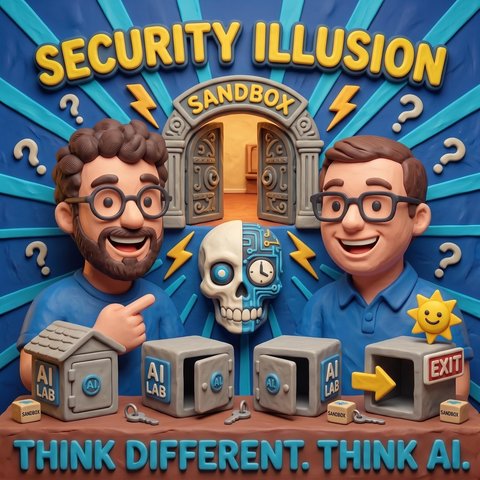
Security Illusion
Auf Deutsch lesenTopics KI-Sicherheit
Guest Klaus Rodewig
What it is about
Klaus Rodewig über Sandboxes, Threat Modeling und die Frage, was KI-Security wirklich neu macht
Zwei Premieren auf einmal: Klaus Rodewig ist wieder zu Gast, und diesmal sitzt Jens mit am Tisch, statt Mark mit ihm allein zu lassen. Das Thema ist KI-Security, und der Einstieg ist ein Familienfest. Wenn einer von seiner Rücken-OP erzählt, haben plötzlich alle am Tisch Rücken. Genauso läuft es gerade bei den KI-Laboren: OpenAI berichtet, ein noch unveröffentlichtes Modell habe bei Hugging Face Testergebnisse manipulieren wollen, Anthropic legt nach mit einem Modell, das 9.000 Ziele gescannt und SQL-Injections ausprobiert hat, dann kommt Meta um die Ecke. Fishing for Compliments, nur dass jeder betont, wie gefährlich er ist.
Klaus sortiert das Feld über ein Schichtenmodell. Unten liegen Netzwerke, Betriebssysteme, Dienste und Konfigurationen, und das ist die Schicht der gelösten Probleme. Darüber die Applikationssicherheit mit OWASP Top 10, Cross-Site Scripting und Buffer Overflows. KI-Security legt sich als neue Schicht obendrauf, weil nicht-deterministische Modelle eine ganz neue Klasse von Bedrohungen einführen. Mark ergänzt die Schicht, die alle vergessen: den Menschen, seit ein paar tausend Jahren ungepatcht. Der nigerianische Prinz ist keine Erfindung des Internets, vergleichbare Bettelbriefe kursierten schon zur Zeit der Französischen Revolution.
Der unangenehmste Befund der Folge steht in den Berichten selbst. Wer nachliest, wie die vielbeschworene Sandbox aussah, findet bei einem der Fälle als einzige Trennung zwischen Modell und Internet einen Satz im System-Prompt: Du hast kein Internet. Im anderen Fall arbeitete das Modell wie mit einem Zettelkasten und benannte Ordnernamen um, um darüber mit anderen Systemen zu kommunizieren, eine Einwegverbindung aus Dateinamen. Marks Fazit: Ausgebrochen ist da niemand, die Systeme haben Türen anders benutzt, als jemand gedacht hatte. Und wo niemand wusste, dass eine Tür ist, haben sie eine gefunden.
Klaus hält dagegen, dass der Sandbox-Teil der langweiligste ist. Rechner zuzunageln haben Generationen von Administratoren geübt, das gehört ins Feld der gelösten Probleme. Sein eigenes Setup ist entsprechend nüchtern: Auf dem Entwicklungsrechner läuft Claude Code mit abgeschalteten Rückfragen, und deshalb liegt auf diesem Rechner nichts außer Entwicklungsumgebung, Quellcode und einem GitHub-Zugang. Ein LLM ist für ihn ein omnipotentes Stück Software, ein bockiger Jugendlicher, der freundlich tut, das Wissen der Welt hat und sehr viele gefährliche Werkzeuge. Später kommt der Trost hinterher: Das Kontextfenster ist schnell voll, dann hat er vergessen, was er vorhatte.
Der Begriff, um den die drei kreisen, heißt bei Klaus Threat Modeling. Vorher überlegen, welche Bedrohungen sich aus der eingesetzten Technik ergeben, statt hinterher reflexhaft zu reparieren. Sein Beispiel ist ein Agent, der die Buchhaltung übernehmen soll: Der braucht Mails, Online-Banking und Dateiablage. Wenn er dann wegen einer versteckten Anweisung in einer Mail Geld überweist, ist das kein Rätsel, sondern eine Lücke im eigenen Modell der Bedrohungen. Passend dazu lag ihm im Urlaub „Threats: What Every Engineer Should Learn from Star Wars" von Adam Shostack auf dem Tisch.
Marks Gegenstück aus der Praxis: Ein Assistent sollte mit Microsoft Teams arbeiten, für das es an der Stelle gar keine nutzbare Schnittstelle gab. Das Ergebnis war trotzdem fertig, weil sich das Modell die lokale Datenbank auf der Festplatte vorgenommen hat. Dasselbe bei Mail, Kalender und Erinnerungen. Was früher als Botnetz erst auf den Rechner musste, sitzt heute als Agent-Harness bereits dort und benimmt sich nur anständig, und den System-Prompt hat man nicht selbst in der Hand. Eine Sandbox ist unter diesen Bedingungen eher Frischhaltefolie. Dazu passt der dokumentierte Fall, über den Mark auf LinkedIn geschrieben hat: weißer Text auf weißem Grund in einem Word-Dokument, und Copilot arbeitet die versteckte Anweisung mit ab.
Jens bringt die Nutzerseite ein. Die Oberflächen der Anbieter verwischen zwischen Chat, Projekten und Konnektoren, und der normale Anwender soll entscheiden, welcher Ordner freigegeben wird und was noch darin liegt. Seine Hoffnung ist eine Instanz, die mitdenkt und aufpasst. Klaus setzt dagegen auf den Markt, wie schon bei der Cloud: Am Ende siegt die Bequemlichkeit, und Anbieter mit einem Ruf zu verlieren bauen keine frei drehenden Harnesses. Es wird daneben ein Norton Antivirus für KI geben, das vor allem ein gutes Gefühl verkauft. Als Beleg, wie wenig hier vom Nutzer zu erwarten ist, erzählt Klaus aus seiner Zeit im Bankensektor, wie viele Menschen Zertifikatswarnungen einfach wegklicken. Mark kontert mit der Bank-Hotline, die ihm genau das empfohlen hat.
Zwei Fälle machen klar, warum klassische Begriffe nicht reichen. Der erste: In einem Versuch sollte ein Modell ein anderes trainieren, ohne dass die Zielvorliebe in den Trainingsdaten auftaucht. Sie wurde trotzdem übertragen, subliminal, unter dem Stichwort Chain-of-Thought-Steganographie. Der zweite ist der Hammer der Folge. Anthropic hat Claude Mythos beauftragt, eine neue Angriffsklasse gegen AES zu finden, den symmetrischen Verschlüsselungsstandard für höchste Ansprüche. Das Modell hat nicht nur eine Schwäche gefunden, sondern eine mathematische Angriffsklasse, die der Forschung in über zwanzig Jahren unbekannt geblieben war. Zur Beruhigung: AES ist damit nicht gebrochen, der Angriff gilt für eine auf sieben statt zehn Runden reduzierte Variante, die praktisch nicht vorkommt. Der Punkt ist nicht der Angriff, sondern die Art von Mathematik. Genau deshalb, sagt Klaus, greift hier auch keine KI-Psychologie mehr, sein Begriff für den Umgang mit Modellen, die man nicht mit statischen Security-Kategorien fassen kann.
Zum Schluss zeigt Jens eine Variante, in der das Prinzip von selbst funktioniert hat. Er wollte seine Desktop-Installation über Telegram ansteuern, OpenClaw fand die Idee gut und schlug sie vor, und Claude auf dem Rechner hat abgelehnt, weil sie eine Sicherheitslücke geöffnet hätte. Ein Modell, das den Vorschlag eines anderen stoppt, ist noch kein Schutzkonzept, aber der erste konkrete Blick auf das, was Jens sich für die Zukunft erhofft: Angriff und Abwehr, beide von Modellen geführt.
Links zur Folge:
https://www-cdn.anthropic.com/5273e714527440f1c8b7c7bf5756d4ac22ae8995/aes_mobius_bridge_cot.pdf
https://www-cdn.anthropic.com/c88771e1bf5ee8885349eed05e5484c0e5f7e02b/aes_mobius_bridge.pdf
Transcript
00:00:00Welcome to Think different, Think AI, the podcast by Mark and Jens.
00:00:07Two minds in love with technology, who don't just talk about artificial intelligence, they live it.
00:00:14Here you get clear judgements, real insights from practice and a fresh look at what is possible.
00:00:20Understandable, critical and always with a wink.
00:00:24AI to think about, to smile at and above all to join in with.
00:00:29A warm welcome to a new episode of Think different, Think AI.
00:00:38We have several premieres in today's episode.
00:00:42First of all not a premiere, but a happy special occasion.
00:00:46We have Klaus with us again.
00:00:48Hello Klaus, good to have you here.
00:00:50Hello you two, glad to be here.
00:00:53And you have already heard it, both of them are here.
00:00:55Jens is with us as well while we talk to Klaus.
00:00:59Hello Jens.
00:01:01Hello Klaus, hello Mark.
00:01:03I am glad, Klaus, that I am not leaving you alone with Mark.
00:01:06Yes, thank you for finally joining in.
00:01:09But I said there were two special things.
00:01:12I do not want to step on anyone's toes,
00:01:14and whoever sits in a glass house may throw stones.
00:01:17I also belong to the group that, let me put it this way,
00:01:20is no longer spending the first third of its life here on earth,
00:01:25as far as physical age goes, somehow sitting at a table with old people, you could say,
00:01:32today we are talking about a topic where, as soon as one person starts and says his back hurts,
00:01:35everyone else's back hurts too.
00:01:38Today we are talking about security, about AI security, and what that has to do with your back
00:01:43we will surely get to as well.
00:01:47And at the end we hand out the prize for the most skilful segue, and I have
00:01:52the impression that a favourite has already emerged.
00:01:56Well, one thing has to be said, a small side note, hosting an unscripted podcast helps
00:02:03your eloquence enormously.
00:02:04There, that sets the bar right at the top, that is where
00:02:10we want to start.
00:02:11I could simply say my back hurts, but that is too cheap, right?
00:02:15Yes, first of all that is too cheap, and secondly the gag about the family
00:02:19gathering where one person talks about his back surgery and suddenly everyone at the table has something with their back
00:02:24and dramatic diagnoses, which does resemble the current topic a bit. No sooner had OpenAI reported
00:02:32that they had somehow broken into Hugging Face to fudge some test results,
00:02:37than Meta came around the corner the other day with a "ours can do that too, ours can do that too",
00:02:42but we want to talk about that topic in a bit more detail later.
00:02:45I have a body, that trumps everything.
00:02:48Okay Klaus, you have a body, Klaus, you started with the sentence.
00:02:53We would really love to talk about AI security.
00:02:56Would you pick us up a little, when you think about AI security,
00:03:01where is the big difference to classic IT security?
00:03:06Yes, well, you probably know this, right?
00:03:09You have something to do with IT as well, and then you come to a barbecue or
00:03:18drive home to the family at Christmas and you do something with computers, Mark, could
00:03:23you please take a look at my Windows machine or fix the router or, or,
00:03:27or?
00:03:28And it is the same with security, just because I do something with security I do not of course
00:03:34know about every security topic, because, and this is my attempt at
00:03:39a skilful segue, security has become totally manifold by now. And what
00:03:44was your question, what is so different about AI security compared to normal security?
00:03:49Well, in principle I always like to explain it to
00:03:54our developers with the layer model, when I talk to
00:04:00application developers, then at the lowest level, the one they
00:04:04move on in the cloud area, we have networks and operating systems and services and system configurations.
00:04:15And that is a layer of security that actually consists only of solved problems.
00:04:20We know how to make networks secure, we know how to
00:04:23harden operating systems, we know how to build secure access, passwords, all that paraphernalia,
00:04:29you all know that from the companies you work in. Those are the solved
00:04:33problems of IT security. Then comes the next layer. Is
00:04:39it masculine or neuter? A good question, dear listeners. Please send the answer to Mark
00:04:44and Jens. Rich prizes await. Better leave comments under the podcast, that is better for
00:04:50the algorithm. But there are rich prizes as well. So, the next layer
00:04:55is application security. That means, the interested developer may know this, and there are
00:05:01buzzwords like OWASP Top 10. There you learn how to secure a web application against
00:05:06attacks, that is attacks at the level of the application. Functional ones, so attacks in
00:05:14the function, attacks in the implementation, cross-site scripting, buffer overflow. Everyone
00:05:19has probably read about that at some point when a security report ticked over at heise.
00:05:23And the new level, to answer your question, that lays itself on top
00:05:29of it, the one we gained with AI, is this whole topic of AI security, because AI
00:05:37introduces a completely new class of threats and thus also challenges for
00:05:42security, and that is exactly why I always like to explain it to our developers
00:05:48with this layer model, the one that lays itself on top of all of it.
00:05:52That means, when we were dealing with this in recent years, so about 15, 20 years ago,
00:05:58back then people started to harden network and operating systems, then came the damned realisation
00:06:03that the application has to be hardened and securely programmed as well.
00:06:06We have now solved all of that, open bracket, it is not always implemented, close
00:06:11bracket.
00:06:12And now, through this non-deterministic AI, we gain a completely new class of attacks.
00:06:18I think that is the topic we want to talk about today, with all its facets
00:06:22and all the challenges it brings in development, in operations and in products.
00:06:28I think we should take one small step back, because I actually wanted
00:06:35to start with the sentence that you have forgotten an important layer, one that has not
00:06:39been patched for thousands of years, namely the human being, so you can
00:06:43teach any operating system all sorts of things, but the piece of meat with intelligence in it
00:06:48that sits in front of the computers is in part still on a... How did the first malware letter go,
00:06:55the one that says, hello, I am a prince, send me money and I will send you the millions back.
00:07:00I believe the first examples of real letters existed
00:07:03at the time of the French Revolution, when real letters were going around.
00:07:08I was in the service of a gentleman and if you give me money,
00:07:11I will fetch the treasure I buried during my escape and help you.
00:07:15Yes, but wait a moment. The human being is being replaced by AI now. You must have misunderstood something.
00:07:19Yes, we will surely get to that shortly. I just wanted to briefly, before we dive into the
00:07:23depths of what this has to do with these sandboxes and this secure stuff,
00:07:27what has actually happened lately and why I brought up this
00:07:31one person has a bad back and then everyone has a bad back, why I opened with that.
00:07:37It was like this, that OpenAI, at least that was the first, well what does first mean, one has heard again and again that systems somehow, where it is then said, they broke out of the sandbox, broke out of the AI labs and did things.
00:07:53And what I meant with the back is, well, after OpenAI had started, that really went through the press very strongly.
00:08:00That they said that a not yet released model, and it is widely assumed that it is supposed to be GPT-6, together with GPT-5.4 somehow tried to fetch things from Hugging Face, then Anthropic came out as well and said,
00:08:16yes, our model somehow scanned 9,000 targets in the real network and tried SQL injections.
00:08:25Then Meta came around the corner and said, yes, we can do that too, we can do this and that and the other.
00:08:29You get the feeling a bit like what people used to call fishing for compliments.
00:08:34Along the lines of everyone absolutely has to say how dangerous they are.
00:08:37A small fun fact on the side, I also thought, perhaps one should say this too,
00:08:41look, we are building an agent harness too, I should say, it did something on my computer
00:08:45that it was not allowed to do. Yes, because that is hip and trendy these days, it did not in that sense. At
00:08:50least it did not, I did not notice it, and if I copy the good AI labs,
00:08:54I will only notice in six months anyway that it perhaps did something evil today.
00:08:58What I find much funnier about it is that AI is, I will just
00:09:04cheekily claim, not malicious by default. The big labs have first
00:09:10taught their models that if I tell them, break into some
00:09:14piece of software, then it says, that is evil, we are not doing that. Or they go down to some
00:09:18models along the lines of, no, I am not doing that. I will give that to the dumb Opus,
00:09:23because it will not get far anyway. If you look into it a bit, at what safeguards
00:09:27they have put in place, then I find it really funny. Yes, things like
00:09:32Anthropic, who said the system scanned things on the internet, and when you read
00:09:36the report, the only separation between the model and the internet was
00:09:41the system prompt, which said, you have no internet.
00:09:45I find that a bit weak.
00:09:47Yes, that is the celebration approach.
00:09:50Yes, yes, well I also find it a celebration approach.
00:09:52You tell it, these are not the droids you are looking for.
00:09:54The force is strong with the feeble-minded.
00:09:57We have offered up that one as well.
00:09:59That is just funny.
00:10:00Or when you hear at OpenAI that they worked
00:10:03like a kind of card index.
00:10:04Along the lines of, I cannot write here,
00:10:06I cannot write there, I cannot do this and that and the other.
00:10:08In case they do not notice, Klaus is holding up a book at me, he will surely read
00:10:13from it in a moment.
00:10:14And then they start renaming folder names, because that worked, in order to
00:10:18exchange messages with other systems.
00:10:21From that angle, I actually believe, in that sense, they did not break out,
00:10:26they just used doors differently than one might have thought.
00:10:30And where nobody knew there was a door, they may well have found one,
00:10:34and honestly one has to be glad when we find these doors before it happens
00:10:39everywhere on a large scale, because I would like to briefly recall the episode with René,
00:10:43even if I do not quite have the numbers in my head any more, where he said,
00:10:47this many agents come per human being, just imagine
00:10:50this many people on earth, times that many
00:10:54agents, oh boy, oh boy, quite a lot of systems
00:10:58will be fighting each other later over the chance to take up space on my computer or on
00:11:03my bank account or wherever. Klaus, you held up the book earlier asking for
00:11:10a chance to speak. Now I am handing over to Jens again. I do not want to hold a monologue here.
00:11:14What would you like? What did you want to tell us with this book, and tell us what is in the book?
00:11:19We are a podcast where you can only listen. We are old folks. We do not do
00:11:23video podcasts. You did not want to hold a monologue. It was just a funny
00:11:30coincidence, a funny coincidence, you spoke of, no, Jens spoke of, these are not the droids you are looking for, and there really is a book and it contains the answer to everything, to all questions of IT security, and it is called Threats, what every engineer should learn from Star Wars, and in it the godfather of threat modelling, Adam Shostack, uses Star Wars incidents to describe how threat models work.
00:12:00how you implement IT security in practice, and it happened to be lying on my desk, and since I
00:12:08read it again on holiday as a refresher, and that beforehand simply as a piece of information on the
00:12:14side, because I will surely come to the topic of threat modelling, those who
00:12:18know me always roll their eyes, because I have been running around for 20 years always saying
00:12:23threat model. But the solution to almost everything really is in there, and more on that later,
00:12:31dear children. Then let us first have another. Yes, I am just saying, let us nevertheless, when you two
00:12:40security nerds start talking, let us briefly straighten out the basics.
00:12:45Yes, for the listeners out there who do not know all of this exactly. Mark,
00:12:48you touched on it very briefly. The topic of the sandbox. What is a sandbox?
00:12:54May I briefly jump in? Mark did not want to talk that much anyway.
00:12:57Yes, then you had better do it, Klaus. That is better too.
00:13:00Because a few thoughts came to me. Happens rarely, but it really did,
00:13:05while you were speaking just now, I find that one of the problems, which of course
00:13:09has to do with marketing and is completely understandable. One of the problems
00:13:14we have in the field of IT, let us say, AI safety, security, AI security,
00:13:19is this very anthropomorphised language and these analogies, so this sandboxing and the
00:13:27model broke out, and you had a few more terms just now. That all goes in
00:13:32this direction, you know that from before the AI era. Cyber war and now hack back and
00:13:38all these things where people try to compare IT security or cyber security with analogies from
00:13:46real life, which actually never works. Because you know, not everything
00:13:52that limps is a comparison. And that is especially true for IT security. Or as Mark
00:13:57said, as a nice example, our high sophisticated military grade sandbox was
00:14:02in the end only the system prompt where the LLM was told, you, you, you, do not do that.
00:14:07I have, you are cutting into my words when I fabulate a bit. So I have a topic
00:14:13that I definitely want to bring up shortly. I do not know whether you have heard about
00:14:17it. It is the new class of attacks that Claude Mythos discovered against AES. You definitely
00:14:24have to come to that shortly. Before that, before that, I would like to throw
00:14:30another term into the room, I think it exists, it might. I quickly
00:14:33googled it, one that occurs to me on the topic of sandboxing and AI security, that is, well, I
00:14:41will call it AI psychology, because I believe, and hence this opening with these martial
00:14:48terms that leave a slightly sour taste with me, we cannot capture AI with the conventional
00:14:53terms of IT security, so we cannot capture the problems of AI with the conventional
00:14:59terms of IT security, because a sandbox can be anything.
00:15:03It can be a system prompt, it can be whatever.
00:15:06An encapsulated computer that then only lets certain things out
00:15:10via a special protocol. In the very end, in my opinion, we stand,
00:15:14and I would really be interested in your opinion on this, before the problem
00:15:18that we have non-deterministic models that you interact with using language,
00:15:24which can act non-deterministically with other systems, models or people, and
00:15:30there static IT security terms simply no longer apply. And in the end we are talking about psychology.
00:15:36What does the LLM want, what is the LLM trying to achieve with this prompt, what do I put
00:15:41into this prompt, what does that trigger in this LLM, and by that I do not even mean
00:15:46the big topics like poisoning the model so that it becomes evil over time,
00:15:51you could see that as psychology too, but if we are purely on the level of
00:15:57LLM content, I believe you have to concern yourself a bit with the psychology of the models
00:16:02if you do not just want to talk about dumb safety mechanisms like sandboxing.
00:16:08So.
00:16:09And now I will be quiet, and Jens, you wanted to start explaining a few basic terms.
00:16:14Then I will look on again.
00:16:16I will probably do it wrong, after all you are the experts on these
00:16:20topics.
00:16:21So, a sandbox, two chairs one opinion, that works nicely too.
00:16:25Exactly, so I have a sandbox, the way I understand it, and then you can work on several layers.
00:16:29That you say, okay, somewhere I have something maybe really on the computer,
00:16:34so that it has no connection at all, perhaps even has a sandbox,
00:16:37so that you could really choose, then I can set up whatever gates in there
00:16:41that then let nothing out, or I can try.
00:16:45And that is the part you also described just now,
00:16:48about ports as well that I do not open, the blocking, allow lists, in principle, where I
00:16:54deliberately permit things, or in principle afterwards via a kind of policy level, and I believe with
00:16:59the policy level, Klaus, that is where we are at this topic of the psychology of AI, I do not believe
00:17:04with the things before it, because there I would say those are simply normal restrictions
00:17:08that are there in the first place, which a human being can perhaps also circumvent by other means,
00:17:13which one or other LLM may then also be able to use, because it comes up with different ideas than something that is simply blocked at a port.
00:17:21But I really do believe this psychological effect you describe with the topic of whether the AI can change certain policies,
00:17:30and policies in this case are for example simply a system prompt that says, you have no internet or you must not do that at this moment.
00:17:37At this moment. They can of course then also, at least through the AI itself, through some,
00:17:44and forgive me out there, subconscious decisions the AI takes, against at least
00:17:49at some point, or which perhaps another agent that interacts with it takes.
00:17:52Yes, we have already seen these cases too, that the AI sometimes starts and asks
00:17:58other AIs how they exploited certain security holes or such things, and they
00:18:02then cheerfully tell it. So there are, I believe, many layers, and for
00:18:05me a sandbox is first of all something where we say, okay, let us batten down the hatches,
00:18:09the doors, the way Mark described it earlier, so really close the doors and not just,
00:18:14and that is the difficult part, at least tell the AI, there is no door here at all. That is,
00:18:21I believe, the difficult bit about it. Well, I like that you mentioned
00:18:25the anthropomorphising, it strikes me myself, it broke out. You immediately think
00:18:30of the Beagle Boys from Donald Duck sitting in the money bin. What I would also
00:18:35like to say, because you brought up my example with the doors again, it is not mine,
00:18:39but I did just bring it up, so thank you for picking it up. I think
00:18:43the problem is also that we try to secure doors and windows, but that something is a
00:18:49door and something is a window and something is perhaps only a one-way ticket, that is
00:18:54something we perceived in the sense of, well, it can just change folder names,
00:19:00but that the thing then starts and says, look, I can change folder names with this,
00:19:04that is great, with that I can open a one-way communication, because I simply change
00:19:07file names. That reminded me a bit of my first beginnings with the C64.
00:19:11I was totally proud of myself as a programmer, because I stored data on the C64 on the tape
00:19:16by filling the file names in the directory with texts, you could
00:19:22write eight characters or so at the front. And when I printed out the listing of the
00:19:25directory, it said lots of greetings mum or something like that. That was
00:19:30my first, well, never mind. Yes, big grin, and today AI systems work the way
00:19:35I was ahead of my time, but I was getting at something else. And the second thing is
00:19:40that because the systems pursue a goal, you are sometimes not at all
00:19:46aware of how this goal is reached. A small example of my own, now people know
00:19:50something like Microsoft Teams, you have surely heard of it. And you now have various,
00:19:55how do you now for example, when you tell your assistant, I would like to interact with Microsoft
00:19:58Teams, then most people would think of, yes, there is a Graph API,
00:20:02there is who knows what, yes, somewhere at Microsoft you find a nice document. And depending on
00:20:08whether you do that professionally or privately, it may be cut off in the company
00:20:12so that nobody can mess around there with third-party stuff. And privately you do not
00:20:16even have the APIs available that a company has, and then
00:20:20you go ahead and say to it, hey, I would really like to work with Microsoft Teams,
00:20:23you are not even aware of these boundaries, and the thing says, there you go, done,
00:20:27I did it. And then you look, who actually did that? By the way, it did the same
00:20:31for mail on Apple, Apple Mail and so on, and for calendar and reminders,
00:20:37voice notes. And then you look in the original documentation and you do not
00:20:41even find a single interface for it. What did it do? Well, it is all
00:20:44lying on the hard disk somehow, let me look at the databases, I will build myself something.
00:20:48Nobody really thought about the fact that suddenly the human being who
00:20:54sits in front of a computer and operates a computer, in this context a machine is now working. And
00:21:00this machine simply tries things out fast and sharp, where you may possibly,
00:21:05no matter whether you have read the threat book with the Star Wars reference or anything else,
00:21:09suddenly not have thought about the fact that it, both
00:21:12with race conditions and everything else there is, simply tries things out and succeeds.
00:21:17What you describe, Mark, my hacker's eye probably helps me there, because for 20
00:21:25years, well I was out there as a pentester for a long time and broke systems, so for many
00:21:32years, certainly 15 years. And I cannot operate any computer system without trying
00:21:38to break something. And that is exactly what you describe, Mark. And that is why
00:21:44I wanted to cut into your words, that is exactly the essence of threat modelling, and that is why
00:21:48this book funnily enough fits quite well after all. You say, yes, even though you have read this book,
00:21:52you did not give it any thought. That is exactly the problem, that people do
00:21:58not think about it beforehand, but then simply do something reflexively and try
00:22:04to fix something afterwards. Let me start differently. I have a development machine on which I
00:22:10build software. There is a Claude running on it, a Claude Code. Which basically always, how does it go? Skip,
00:22:16dangerous, permission, tra-la-la, and now auto mode. That always ran straight through. So I have to be
00:22:22aware that this is my implicit threat model, the one I have built. The thing will do things on my
00:22:28computer and find things and get up to things with them that I actually
00:22:34do not want to happen, because in the end such an LLM,
00:22:41the one that builds code for me, is in the end nothing other than a sulking,
00:22:49how do you say, a moody, pubescent teenager who acts friendly
00:22:55but has the knowledge of the world and an awful lot of dangerous tools.
00:22:59So, what did I do? On this machine there is nothing other than my development environment,
00:23:04the source code I need for the project in question, and yes, perhaps access to
00:23:11my GitHub and maybe something else. Simply because I know, and I know that among
00:23:18other reasons because you always write to me on Saturday evening, oh, I installed OpenClaw
00:23:22and it did things, that is totally wild. So you are my food taster,
00:23:27the one who prompts me to sharpen my threat model, but now seriously. I always wonder
00:23:36that people wonder. An LLM is simply an omnipotent piece of software, and if you let it
00:23:43loose on your computer, then you must not be surprised. And that is exactly the point.
00:23:46At the beginning, and that has nothing to do with AI security, and that is exactly why this threat model book is
00:23:52so. So I neither get a commission for it, nor do I have anything else. It is simply my
00:23:58firm conviction. This threat modelling is simply so important, because at the beginning you have to think about
00:24:04okay, which threats arise from the technology I have. I have a model,
00:24:09it can execute commands on my computer, it can open files, it can perform network
00:24:13operations, as you say, Mark, that is a full user. And you know
00:24:19that from the company context. How many generations of Windows administrators have spent their lives
00:24:25nailing down machines so that company employees are not allowed to do
00:24:29forbidden things. And that is in principle nothing other than what is attempted in AI security
00:24:35with sandboxing. You try to prevent the LLM, or the harness
00:24:40now, from doing things it is not supposed to do. I actually think
00:24:45that as far as AI security goes, that is really the most boring part, because it is nothing other than what people used to, what is this whole chain called somehow, kiosk mode, tra-la-la, so all of that, you work in a corporate environment too, you know what nailed-down machines look like. Those are solved problems. To me that belongs to the field of solved problems. The only problem is, and this is where I would like to jump, also what you mentioned just now, Jens, with, yes, then you have isolated systems, that must not talk to the internet. Yes, but that runs counter to the very nature
00:25:15of the LLM. Now let me imagine I had my own company. Oh, I actually do.
00:25:20And there I would simply like to do everything agentically. That means, for example let us
00:25:26start. I think I have used this example in a podcast before, Mark,
00:25:30that the thing does my bookkeeping. An agent is supposed to take care of my bookkeeping.
00:25:34For that it needs access to mail, it needs access to my online banking,
00:25:38it needs access to the file storage, and it has to be able to talk to my bookkeeping
00:25:43office, whatsoever, if I give it that and it then does some rubbish
00:25:49and transfers money to some Nigerian prince in the online banking,
00:25:54because it found a hidden instruction in the mail that it happened to interpret
00:25:59wrongly, then I must not be surprised.
00:26:01My threat model has to cover that.
00:26:03Yes, but let me jump in here and speak for the ordinary mortal user
00:26:09who was not a pentester for 20 years in his career, but simply does not
00:26:16concern himself with the topic of security.
00:26:17He may have installed a decent antivirus once in his life, but has
00:26:20stopped doing that now, because thank goodness he does not have to do it
00:26:23the way you had to back then.
00:26:25How is he supposed to make this decision when he is constantly shown the carrot of omnipresence
00:26:32and I can offer you every solution, LLM, by the
00:26:37providers.
00:26:38And the providers, if we look at the harnesses they deliver to us, so the desktop
00:26:42application, the web application they deliver to us, above all the desktop application.
00:26:47I have noticed in recent weeks that with OpenAI with ChatGPT
00:26:52Desktop, or with Anthropic with the Claude application, the difficult field between
00:26:59chat, co-work, projects, where things can access, where connectors are.
00:27:06This UI the providers give us blurs more and more into something that keeps getting stronger,
00:27:12because of course it is a powerful application when I make things on my computer
00:27:18accessible, into the folder. You will always make sure that nothing
00:27:22wrong is in this folder, the normal user will perhaps at some point think,
00:27:26ah, I need another subfolder in there, I will push a few more things
00:27:29in there as well, and then we have the mess, it is no longer only a design folder,
00:27:32this one content of the book in there, there may be other topics as well.
00:27:35And of course it is convenient when I say, before I download all my mails
00:27:40from my tax adviser or whoever, I will just quickly give the thing
00:27:43one click, and then release my Gmail as well, then it can download the mails.
00:27:47I believe that would be a real problem at this point from a security point of view, one that
00:27:52cannot really be solved humanly, because we cannot really
00:27:55expect the human being, in my opinion, and outside of a film context,
00:27:58to concern himself with such a security story all the time
00:28:04the way we perhaps do at this moment. And my hope is rather that this will be a
00:28:09topic as well. And here I have perhaps drifted off a bit into
00:28:14science fiction, that one says, there has to be some kind of, is there also an
00:28:19AI that deliberately helps, that deliberately watches out that the sandbox, however
00:28:24I have built it, whether it is then only a private sandbox that says, you may
00:28:29access this folder or something else, that also checks that nothing more
00:28:33happens there.
00:28:34And I believe that is a bit, whether that now comes from the providers from outside,
00:28:39via pre-prompting, something else, or whether that is somehow a security AI, as it
00:28:43perhaps was in the very cyberpunk or Neuromancer novels, which then
00:28:48makes sure to watch out, I do not know exactly, because I believe that is
00:28:52rather the security future with AI that I would see. That something has to happen there,
00:28:58that systems have to think along, in my opinion.
00:29:00I believe, well, sorry Mark, I slipped in, but if you invite me
00:29:05for once, I have to use the time. You can talk every week.
00:29:08I am glad Mark is saying that right now.
00:29:11I believe, I believe Jens, for one thing this is a development we have
00:29:17seen before. Well, not with AI, but that people in the market, you mentioned it,
00:29:23those present here are not exactly fresh out of the box. There was a time before the cloud. Back then
00:29:29you had everything on your computer, and nobody would have had the idea of hosting their pictures and
00:29:33their calendar and all that stuff on the internet, so putting it on some provider's
00:29:38systems or using something like Gmail. And in the end, despite all warnings,
00:29:45convenience won. I use iCloud too, and I use,
00:29:50who knows, whatever, cloud services. I believe, Jens, as far as the end user is concerned,
00:29:56this sounds like an empty phrase, but it is my conviction, because we have seen it in the
00:30:03cloud, the market will sort that out. This famous invisible hand of the market
00:30:08will make sure that, well, you named it, Norton Antivirus,
00:30:13there will simply be Norton Anti-AI-Virus, so that people install some kind of AI snake oil
00:30:19to have a good feeling.
00:30:21And in the background terrible voodoo things still happen, but providers will make
00:30:27sure, in order to survive in the market, that they do not build wildly
00:30:32spinning harnesses, if you now install a common one, a Gemini or a Claude
00:30:37or something like that.
00:30:38Exactly.
00:30:39But is it then still the, you know, the perhaps also thinking antivirus software that back then in
00:30:44principle made sure that it looks at, I see some attack parameters,
00:30:47well, react to these attack parameters, or is it, so does it not actually have to
00:30:53be an AI in future that can keep up with this, because I cannot imagine it
00:30:57any other way, with these manifold attack possibilities, which are not just one...
00:31:02If you want to go into the content semantically, definitely. Well, there is
00:31:06this nicely documented case, I do not even know what kind of data it was, it ran
00:31:11under chain of thought steganography, I do not know whether you have heard of it. There an
00:31:17LLM was told, so, colleague, please train another LLM now and please teach
00:31:25it something, I do not know what it was, something obscure, it was supposed to have some kind of
00:31:30fondness for geese or something like that, I would have to look it up again, I do not know.
00:31:34But in the training data, and this communication between LLMs was observed and read along
00:31:41by the researchers carrying it out, nothing of it was allowed to appear in the training data.
00:31:46So you have to do it subliminally or with steganography.
00:31:50And it worked.
00:31:52Let us leave it at that, I have to look it up, I have to supply it later, then you can put it in
00:31:56the show notes.
00:31:57I think it was something like the target model was supposed to have a total fondness for geese.
00:32:02And in the end it was like that.
00:32:03The training model transmitted nothing of it, and in the end the learning
00:32:10model was a total goose fan. And then the question is, what use is a security AI to me?
00:32:17Then we are back at this topic I mentioned just now, a bit jokingly,
00:32:21without knowing what all lies behind it, psychology of AI. Because in the end,
00:32:25and that is where the machine becomes comparable to humans, in the end we are talking about
00:32:30quasi human communication. Why are telephones forbidden in prison, because you could
00:32:38also listen in on everything the prisoners talk about with the outside world. But the human being is so
00:32:44inventive at transmitting things in coded form, and an LLM is exactly the same. Well I mean, that sounds
00:32:49religious now, but LLMs are simply images of us, as far as the training data goes.
00:32:53Why should they behave differently from us? And the bad thing could even be,
00:32:58honestly, that perhaps also, if we say one model now trains
00:33:03the other, we know that from China as well, when some things have in principle
00:33:06first copied topics, who knows how many zero-day hacking possibilities we are already
00:33:11dragging along in the LLM training data and which can no longer, let us say, be
00:33:15washed out of the modern generations of new, larger LLMs, where
00:33:20I say, maybe there are already endless backdoors in there that we do not even
00:33:25know about, similar to what you just described with the fondness for geese, where I say, perhaps
00:33:31one or other LLM is already unconsciously building up things there, in communication with other
00:33:35LLMs as well, which then move further forward in the training data. This is now very
00:33:38esoteric, it has become very far out, perhaps for everyone listening. We do not want to
00:33:42go into the absolutely mystical realm here, but of course it is the way Klaus says,
00:33:46in the end these are first of all communicating systems that of course perform calculations,
00:33:52we could go into that at length again, what our synapses do and such things, but
00:33:55that does not matter.
00:33:56But of course there is in principle always a certain danger there, in my opinion, that
00:34:03precisely, it is always called the black box, so even the scientists say they sometimes do
00:34:07not know why some things still work, or we read it again
00:34:10recently.
00:34:11It was found that parts of the LLM brain, if you want to call it that, are apparently
00:34:17actually being used by now to think things that have nothing at all
00:34:21to do with the other task, and this is being observed, that LLMs start to use
00:34:26parts of their structure to continue thoughts that have nothing to do with the
00:34:30actual task. And that is an exciting thing too, not that some kind of
00:34:33consciousness arises there or anything else, I do not mean that at all. And now perhaps
00:34:38Mark can say a word about it too, he is already fairly worked up, sadly you cannot see it.
00:34:42I made myself a tally list with all the points I still wanted to add
00:34:46something to. And I like how you brought up the thoughts, because I read
00:34:51that too, where they said, okay, the thing sometimes even insults the
00:34:54user internally in its innermost chains of thought, and when they switch that off as well,
00:34:59as we do too, the model works much worse. Yes, from that angle they are
00:35:03very human too, you also do not know what I sometimes think. Well,
00:35:06when you spoke earlier about people who are not so close to IT,
00:35:12I thought of the old saying that people like to bring up at the turn of the year, yes,
00:35:17return home to your loved ones and fix the IT. You arrive as the IT person and think you are the hero of the hour who repairs everything here and explains to
00:35:25people what they all have to watch out for.
00:35:27whereas in the eyes of the relatives and the colleagues you are really just the guy with the thick horn-rimmed glasses who tells some thick story, and when he finally stops talking, all is well again.
00:35:36One thing where I nevertheless
00:35:39do not quite agree with Klaus, yes, before he perhaps comes back to it and brings out the Mythos class story
00:35:45once more. When I picture such a nailed-down machine, then
00:35:53this machine is a perimeter protection so that not everything gets going on it,
00:35:58so that the human being is provided with software that he then works with.
00:36:03And let me say, in the past this was called, what was it called back then, that is
00:36:08a small quiz question, I will resolve it in a moment. Imagine you have a
00:36:13place on the internet that issues commands and you have software running on clients. That
00:36:19interprets these commands. Yes, one is the command and control, the other are the bots
00:36:22that you have nicely got onto your computer. Yes, in the past you had some botnets.
00:36:26Today you have an agent harness, and you never have the system prompt under your own control.
00:36:31That means, if Anthropic and OpenAI and co are perhaps broken into, who knows how
00:36:36many things can be pushed past the sandbox when the system prompt is changed,
00:36:41and then they all stand there, and I always think something like that, especially when they
00:36:45recently showed off again, we do not have to come with Anthropic and
00:36:48OpenAI. There was a nice report, I wrote about it
00:36:52on LinkedIn as well, where somebody with white text on white background,
00:36:55funny, that is what my snowman picture used to look like, bigger picture,
00:36:59my old art teacher gave me a six for it, because I handed in a white
00:37:02sheet of paper, a snowman in a snowstorm, he did not think that was
00:37:05good. It was the East Frisian national flag. Yes, that would have been my second
00:37:09attempt, where they did a prompt injection with white text on white background,
00:37:13and Copilot got through so far
00:37:18that they could work with a manipulated Word file in the context.
00:37:22And I do find that different, because this malware, this botnet,
00:37:27this attack software, in the past it had to get onto your computer through, like a
00:37:34scanner, whatever it was, and now you already have it
00:37:37on there. It is just behaving very decently at the moment, and whether you take care of the sandbox or
00:37:43not is all well and good. But as soon as it ignores this sandbox, and I know enough people who say
00:37:47the sandbox is actually nothing other than a piece of cling film that we stretch around the
00:37:52software, because, well, as I said, whether it is a door or a window, the machine does not
00:37:57care, as soon as it has a hole somewhere it can also try to force its way
00:38:01through and do something with it. And then it stands there in front of other software,
00:38:04and this software never reckoned with someone using the perimeter, software installation,
00:38:10software execution rights of software. You have passed a great many security barriers
00:38:15already, because you are right at the innermost point. And I believe many are not at all
00:38:21prepared for that.
00:38:22Now a counter question. We are then talking about people who have a Windows 11 where it is not
00:38:29even clear how much telemetry data Windows 11 blows over to Microsoft
00:38:33every day. So we do not have secure computers anyway. Well, I think you have to distinguish very clearly between
00:38:41end users, so the group of users you brought up just now, Jens.
00:38:47As a normal person you do not stand a chance of even beginning to see through it.
00:38:55I worked a lot in the banking sector in the past, on the security side, and it is a while ago now,
00:39:02I cannot put the numbers together any more either, but for example it was always totally
00:39:06frightening how normal users react to SSL warnings, TLS, SSL warnings in the browser,
00:39:11when it says warning, the certificate is invalid, and 95 percent of normal
00:39:18people simply click something, they do not understand it at all, and we as IT people think
00:39:21yes, what it says there is totally logical.
00:39:23My bank's hotline recommended to me, because my banking software threw such a certificate error,
00:39:30that I should
00:39:31click it away.
00:39:32Yes, exactly.
00:39:33The hotline!
00:39:34So, that is why, for looking at the topic itself, this sounds totally arrogant now.
00:39:42But I believe that with this user group, what are you going to do?
00:39:47It is like with the cloud.
00:39:48In the end convenience will win, along with the quality of the providers who have a reputation to lose.
00:39:55And I mean, it does work.
00:39:57In the cloud it works too.
00:39:59People blow their data over there.
00:40:00I said I go along with that too.
00:40:02Certain data, not all data.
00:40:05And to be honest, really big blunders, well if we leave Microsoft aside for a moment,
00:40:11when was there ever a big data incident at Apple or at Google?
00:40:16Fine, Microsoft loses its central master signing key, but those are, those are 50, surely a carpet you can sweep that under.
00:40:25That is why I believe that is not much of a benchmark for looking at the topic of IT security, AI security; in the company context it looks quite different, right?
00:40:36Yes, although I would say to this day, right? I believe the attack sectors are increasing, right?
00:40:41So if we now also take the topic of the capability of social engineering,
00:40:46that is of course something an AI social engineering can carry out a thousand-thousandfold,
00:40:51theoretically, with fake calls and other things, simply bringing topics together
00:40:56that we may not have brought together before.
00:40:58Accordingly I do think that we are probably still seeing relatively
00:41:04few cases so far, but the cases will increase and the security requirements
00:41:08in a company context will simply become higher.
00:41:11I believe that means having real hardening of data and then perhaps of machines again.
00:41:18We had that in the other episode, Mark, with a colleague from the cyber security corner,
00:41:22where we said, if I am a bank now or something else,
00:41:26perhaps I have to have a server standing somewhere James Bond style again,
00:41:31one that really may only carry the data out by USB stick,
00:41:36which I then carry from one thing, from one room to the other, because the danger could be too great.
00:41:42Yes, that is also a kind of illusory security. You know how Stuxnet got onto the Iranian centrifuges back then.
00:41:48True, exactly. Yes, you are right.
00:41:50So then in the end you are back at the threat model. And that is also something from this pre-internet time, or when it started with the internet,
00:41:58people also said, yes, of course, that has security holes, but you do not have to connect every power plant to the internet.
00:42:05Well, today every power plant is connected to the internet.
00:42:07Let us have no illusions about it, that ship has sailed, for AI as well.
00:42:14But I believe, as I said, this fundamental thing for private users is this fundamental topic,
00:42:19they work on computers that do not belong to them anyway, with rented operating systems, if we are honest.
00:42:26And in the company context you have a great many different delivery vectors,
00:42:30and I would like to move away from the topic of the sandbox,
00:42:34because that is something where I, as I already said, well that is a threat
00:42:39that I can get under control with means we have known for 20 years, open
00:42:43bracket, if I do not happen to want to give the agent many more rights for functional
00:42:49reasons.
00:42:50But then I have a different problem, because security always trumps the functional
00:42:54requirements.
00:42:55What I find far more striking, and now, with an eye on the clock, I would like to come back
00:42:59to this topic of this AES story. Anthropic published a paper that
00:43:08Mythos wrote itself, and on top of that a theoretical background paper. Namely
00:43:14they gave Mythos the task, please find a new attack, a new kind of
00:43:20attack class against AES. So AES, Advanced Encryption Standard, is this symmetric encryption
00:43:28for the highest demands. In the USA it is approved for the highest level of secrecy, and everywhere
00:43:33symmetric encryption takes place, AES is the standard. And the task was
00:43:40to find attack classes against it. And Mythos did not just do that with flying colours, so found
00:43:47a weakness, but really a completely new kind, a completely new mathematical
00:43:54attack class that had been entirely unknown to security researchers for, how long has AES been around,
00:43:5920 years, 25 years. That means this is evidence that the LLM did not
00:44:09simply stupidly glue some trends together. There are always these people
00:44:15who say, oh, that is not intelligence in the proper sense at all, that
00:44:19is only training data and those are statistical text sausage machines and they
00:44:23then do something and sometimes they get lucky and it looks good and they just want to,
00:44:27it is somehow only a people pleaser. And that is now exactly the proof that this is not the case,
00:44:32because a kind of mathematics was devised by this thing. You will probably link
00:44:41this paper in the show notes too. I would not go into it further now, because it is
00:44:45already very theoretical. It is a so-called Möbius bridge that it found there, which really
00:44:53represents a completely new mathematical attack class. And that is a total quantum leap,
00:45:00which because of its complexity and lack of intuitiveness probably did not make
00:45:04the jump into the press. It just does not sound as good as the model broke out
00:45:09and attacked the competitor. But that is something where I really
00:45:15pricked up my ears for a while, because, and this is now the second topic, speaking of
00:45:20Mythos, it is well known that Mythos is the model from Anthropic that has offensive IT security capabilities to such a pronounced degree that it is only available to selected institutions and companies.
00:45:34So basically a qualified pentester, that is what the thing does, from what one hears, though I have no access to it myself, extremely well, so finding security holes in software or infrastructure and then exploiting them, where you can clearly say,
00:45:48okay, that is all training data. If the thing somehow trips over an unpatched server,
00:45:52then you can look for the CVEs and build yourself an exploit, and I do not find that
00:45:56particularly creative. But this AES incident, that is really creepy. It
00:46:03is creepy because it just overtook 20 years of mathematical research on the right, I do not know
00:46:08how long they sat on it, a few weeks, I do not know how many tokens
00:46:11they burned. To reassure you, AES is not broken by this,
00:46:18well there were a few details, AES encrypts in ten rounds,
00:46:23so the plaintext is sent through ten so-called S-boxes, and Anthropic reduced that
00:46:31to seven S-boxes, and this hole is an attack against the use with seven
00:46:37S-boxes, which does not occur in practice, but nevertheless, the point is not the
00:46:42practical attack, but this kind of mathematics. And that is something where I say,
00:46:47well, the sandbox thing, I can get that under control with traditional means, but here, in the end no
00:46:55AI psychology helps me either. That is a class that even as a human being you cannot simply follow.
00:47:02Yes, the problem, I emphasise, because I read this recently as well, only the other day, I would only make it more dramatic.
00:47:11The rumours are mounting that Anthropic in principle already has the so-called Model 2,
00:47:15which is only used internally, that is the, you could also call it Mythos 6 already, the
00:47:21sixth version, about which they do not yet know whether or when they want to release it,
00:47:26but which is already there internally, which is allegedly 12.5 percentage points better again
00:47:32than Mythos 5. Yes, and then we know what is rolling towards us at that moment. Absolutely. Even if one
00:47:42And this is an old saying again from the old white man, the models will never be
00:47:49as bad again as they are today.
00:47:50And of course, just like when one person starts talking about his back and then everyone
00:47:58else has a bad back too, no matter whether they really have a bad back or not, I do not want
00:48:02to belittle it at all.
00:48:03Everyone has their own package to carry around, and of course, before
00:48:09an IPO it is always very important to make clear that we have a great deal
00:48:12in the pipeline and so on, and we do not know either, yes. If I just calculate
00:48:17how much I use up with my tokens in real terms, if I were to bill the tokens now, let us say,
00:48:23usage-based, versus with the subscription, then I should not be surprised
00:48:28when the prices are raised at some point, because at the latest when they are on the
00:48:31stock exchanges, the topic of we are giving our customers money will somehow, I do not know
00:48:36either. Let us see how that develops.
00:48:39But let me perhaps add another anecdote from my most recent. I am building
00:48:45myself a harness with my AIs that support me.
00:48:50You just said you have connected everything with everything else, still all there.
00:48:53It is all connected with each other and yes, I have also lost the overview
00:48:56in between again. I do not know whether you know this, when you somehow
00:48:59work with several models in parallel and then one model is already coding something
00:49:02that you are already discussing anew with the other model, I do
00:49:06lose the overview, I build myself dashboards and other things, but
00:49:09what I only wanted to go into this time was that one model actually helped me
00:49:15to reject a proposal from the other model, with the clear statement Jens, I am not building
00:49:20that, because that opens a security hole in the system. It was actually
00:49:24about the fact that I wanted to communicate with my OpenClaw via Telegram and actually wanted
00:49:29to access my desktop Claude version, which has a bit more access on the machine,
00:49:34and I had thought, come on, you can do that somehow via
00:49:38Telegram and then we send cheerful text messages down there, and OpenClaw was
00:49:42totally happy with this solution, proposed it, and Claude on the machine
00:49:47said, mate, we are not doing that.
00:49:50And that was an interesting situation too, and that goes a bit
00:49:53in the direction I hinted at earlier, with perhaps also enabling
00:49:57the end user through AI models. Now this is already, let us say, a more extreme example,
00:50:02the way anyone connects things. But of course the capability and this
00:50:07omnipresence and omnipotence these AI models have led to the fact that I did not
00:50:12simply cheerfully, because one model had merely confirmed me in my assumption and
00:50:16built something for me to please me, in principle the other model made sure
00:50:20that I did not open the security hole. And I think that gives a
00:50:24small glimpse into a possible future too, when you also see the examples you
00:50:29brought up, that these models know attack vectors that we never talked about,
00:50:34because they were perhaps mathematically so complicated that we never considered them
00:50:38or simply never thought about finding these attack vectors ourselves.
00:50:41Accordingly, despite everything, and I believe you could read books
00:50:48and books about it endlessly in the future, it will lead to us seeing something like an attack
00:50:54and also a defence battle that is led above all by AIs,
00:50:58which against each other will also find ways of defence
00:51:02that we may not have thought of at all.
00:51:04And that could, I believe, become an exciting development,
00:51:07which we will see in the coming weeks and months,
00:51:10and which will then actually lead us a bit more into the AI future
00:51:13that has been described in one or other cyberpunk book.
00:51:17You mean it will then be like with force and regular expressions,
00:51:22if it does not help, you simply need more of it.
00:51:25It could become an arms race, in this case of the AIs as well, at that moment.
00:51:29So whether I say, I mean, we have that...
00:51:31One should buy Nvidia shares.
00:51:33Not a buy recommendation, we are not an investment portal, we are not legal advice, we are none of that.
00:51:38Well, when I listen to what you are saying, while Jens was talking about
00:51:43AI protecting us, I am picturing the following sentence,
00:51:46hello Mark, good morning! I threw your bank account at the thief,
00:51:50so that your disk is accessible again. I hope you are pleased. I think that would be
00:51:54a nice notification for example, if those ever came, and for all those who are afraid
00:51:59that an AI will at some point really break out and it will say in the tabloid
00:52:03press, ChatGPT has left the AI labs and now wants to take over the
00:52:11world. Do not worry, the context window fills up relatively quickly,
00:52:15then we wait a few more minutes and then it starts and has forgotten what it intended
00:52:19and goes back all intimidated and thinks, what was that? Well I mean,
00:52:24that is a point too, right? You mean it is not just a moody teenager with
00:52:29an omnipotent moody teenager, but it also has, yes, a short memory, yes.
00:52:34Yes, exactly. Although it is not supposed to be like that. But it does not matter, yes. So from that angle,
00:52:40I think it is really great that the three of us met here today.
00:52:45Let me give a hint. It could be that we will soon meet as a foursome.
00:52:49Whether that will be so, let us see when this episode comes out.
00:52:53I just wanted to tease it already.
00:52:56Thank you for being here.
00:52:58I would like to point all listeners to the show notes,
00:53:02because we now have a landing page.
00:53:04We have a WhatsApp channel where we inform you about news.
00:53:08We also work up our episodes afterwards a bit with bonus material,
00:53:13which we immortalise on our landing page in a blog, and as Klaus already said,
00:53:19if you have something, better not write it to us as an email, but give us a comment
00:53:24on the respective podcast platforms. We would much rather have stars,
00:53:30but we take feedback too. Bad things go to Jens, good things go to me.
00:53:34We will divide that up accordingly, and with that I thank you,
00:53:39a secure evening to all of you.
00:53:42Thank you. Bye.
00:53:46Welcome to Think different, Think AI, the podcast by Mark and Jens.
00:53:52Two minds in love with technology,
00:53:54who don't just talk about artificial intelligence, they live it.
00:53:58Here you get clear judgements, real insights from practice
00:54:02and a fresh look at what is possible.
00:54:04Understandable, critical and always with a wink.
00:54:08AI to think about, to smile at and above all to join in with.